

To decide how often to post on Instagram, start at 3 to 5 feed posts a week. Buffer’s study of 2.1 million posts found that this range more than doubles follower growth compared with 1 to 2 posts. Your own right number is the highest weekly rate at which new posts still match or beat your recent median reach. Count Stories on their own, because they do a different job.
Most frequency advice stops at an average. An average tells you what happened across 100,000 accounts. It cannot tell you the week your extra post starts to be weaker than your usual post. That point comes at a different rate for a solo creator with one shoot day than for a brand with a content team.
This guide covers what Buffer’s data shows and what it leaves out, what Adam Mosseri has said in public, and a simple median test you can run in Instagram Insights. It also covers how many times a day to post, separate counts for Reels, carousels and Stories, and how to keep a rate you can hold for months.
Key Takeaways
- Starting range: 3 to 5 feed posts a week. Buffer calls it the sweet spot for reach and growth without burnout.
- More can help: In Buffer’s data, reach per post rose about 12% at 3 to 5 posts a week and about 24% at 10 or more, compared with 1 to 2.
- No official number: Adam Mosseri has said in public that there is no single right frequency, and that there is no ideal number of Stories.
- Your ceiling: Raise your rate one post a week at a time. Keep the new rate only while the median reach of your new posts holds.
- Separate counts: Reels, carousels and Stories reach different people. Track a median for each one.
- Bottom line: Use the study to pick a start, then let your own Insights set the number.
How often should you post on Instagram?
Post 3 to 5 feed posts a week as a start. In Buffer’s study, that range more than doubled follower growth against 1 to 2 posts a week, and weeks with zero posts fell below the same account’s own average. If you have the time to keep quality steady, 6 or more posts a week kept adding reach in the same data. Stories have no fixed number.
The table below turns the published data into starting points. Use it as a starting point and adjust from there.
| Your situation | Feed posts a week | Why this range |
|---|---|---|
| Keeping an account active | 1 to 2 | Buffer’s minimum; weeks with zero posts measured below the account’s own average |
| Steady growth | 3 to 5 | Buffer’s “sweet spot” for reach and growth without burnout |
| Growth push, with time to keep quality | 6 to 9, or 10+ | Reach per post kept rising, up to about 24% at 10+ posts a week |
| Stories | No fixed number | Mosseri: “There’s not a specific ideal number” |
Feed posts here means photos, carousels and Reels together, because that is how Buffer counted them. The best time to post on Instagram is a separate question with its own data, and it matters less than steady posting.
What Buffer’s 2.1 million posts show about posting frequency
Buffer analysed 2.1 million posts from 102,000 accounts and compared each account with itself. In weeks when an account posted more, it gained followers faster. Median reach per post was also higher in the busier groups: it rose about 12% at 3 to 5 posts a week and about 24% at 10 or more. Posting more did not lower reach per post in this data.
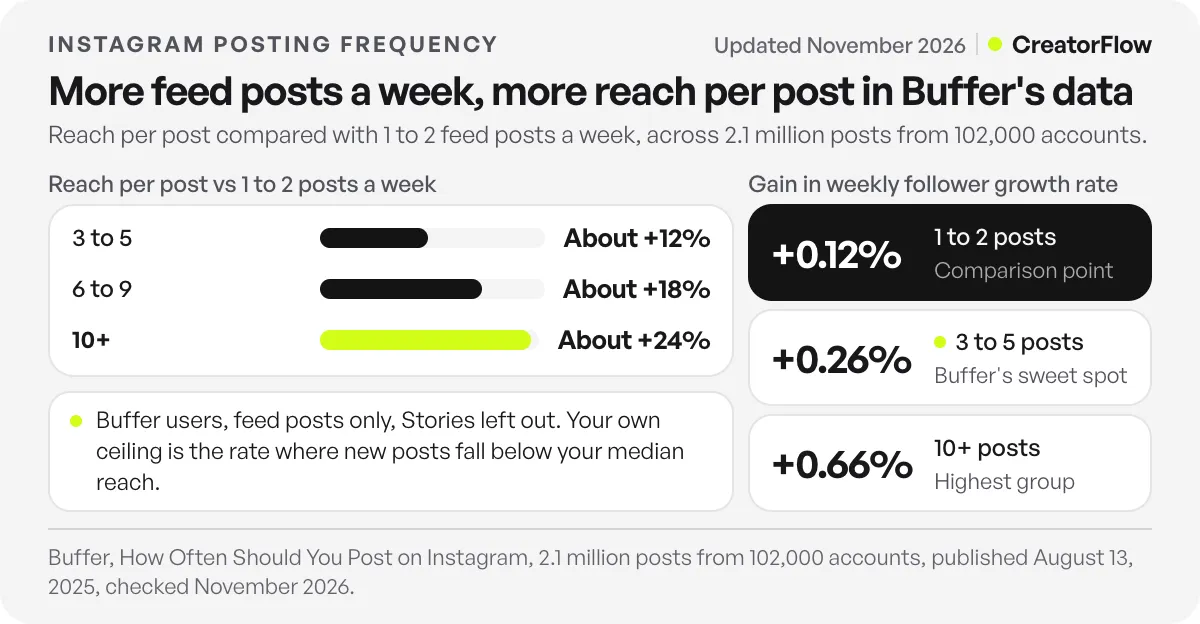
Buffer’s study, published on August 13, 2025, used two methods. A z-score compares each week’s follower growth with that account’s own average. A fixed-effects model checks whether the same account grows faster in the weeks it posts more. Both methods take out the simple explanation that big accounts post more and also grow more.
| Feed posts a week | Reach per post vs 1 to 2 posts | Gain in weekly follower growth rate (Buffer’s model) |
|---|---|---|
| 1 to 2 | Comparison point | +0.12% |
| 3 to 5 | About 12% more | +0.26% |
| 6 to 9 | About 18% more | +0.44% |
| 10+ | About 24% more | +0.66% |
The multiples you see quoted come from that last column. +0.26% is a little more than double +0.12%, and +0.66% is about 5.5 times it. They are multiples of a small weekly number, so they show which way growth moves. They do not mean 5 times more followers.
Three limits matter before you copy the numbers. The accounts are Buffer’s own users, so they already plan and schedule posts. Stories were left out, because Buffer says Stories are not typically shown to non-followers. Formats were not split, so the data does not say whether the extra posts were Reels or carousels.
The fourth limit is the one this guide is built on. A within-account model shows that extra posts helped on average. It does not show whether those extra posts were as good as the account’s usual posts. Your limit is the rate where they stop being as good, and only your own numbers can show you that.
What Adam Mosseri has said about how often to post
Adam Mosseri, the head of Instagram, has not given a fixed posting number. He has said that posting more generally means more reach overall, that people should balance volume against burnout, and that there is no ideal number of Stories. He has also said that when a post is published matters a lot for ranking.
In a December 2024 Reel that answered this exact question, Mosseri gave no single number, RouteNote reported. He pointed to successful accounts that post rarely and others that post several times a day, and said that in general more posting means more reach.
In a September 2026 video series, Mosseri said recency matters a lot in ranking, which is why the feed runs roughly in chronological order, Social Media Today reported. The same summary notes that creators try to post as much as they can to raise their odds of a hit, while managing their time to avoid burnout. It also says he pointed creators to Trial Reels for testing new content. Meta’s own numbers point the same way. On its October 2026 earnings call, Meta said nearly 45% of the Reels Instagram recommends are less than a day old. Our Instagram statistics roundup lists that figure with its source.
On ranking signals, Mosseri named “watch time, likes and sends” as the top three in January 2025, according to Social Media Today. The article suggests tracking likes per reach and sends per reach. Those per-reach numbers are useful in the test below, because they do not grow only because a post reached more people.
How to find your own posting frequency
Measure the median reach of your last 8 to 12 feed posts, each checked 7 days after posting. Then add one post a week for four weeks. If the median of the new posts holds at or above the old median, keep the higher rate and try the next step. If it drops, go back one step. That rate is your ceiling for now.
The median is the middle post when you sort them from lowest to highest reach. Use it instead of the average, because one viral post can pull an average up for months and hide a weak month. Reach counts unique accounts, so it tells you how many people saw a post. Our guide to which Instagram metrics are worth tracking explains why reach beats views for this job.
Check every post at the same age. Instagram Insights shows totals up to the moment you look. A post from yesterday will always look weaker than one from last month. Write down each post’s reach on day 7 and compare only day-7 numbers.
Change one thing at a time. Keep your formats, topics and posting times roughly the same during the test. If you add a post and switch from carousels to Reels in the same month, you cannot tell which change moved the number.
Read three results. Median reach holds or rises: keep the new rate. Median reach falls but sends per reach and likes per reach hold: the content still works, so check whether posts are landing too close together. Both fall: your extra posts are weaker than your usual ones, so step back and use the time on fewer, better posts.
Here is an illustrative example, not measured data. A creator posts 2 times a week, and the median day-7 reach of the last 10 posts is 1,400. They move to 3 a week for a month, and the median of those 12 posts is 1,520, so they keep 3. They try 4 a week, and the median of the next 16 posts falls to 1,050 with lower sends per reach. They go back to 3 and test 4 again later, once they have a backlog of ideas.
If your posts ask people to comment a keyword, count keyword comments per post as a third number. It shows intent better than likes do. With CreatorFlow’s comment-to-DM automation, each keyword comment sends one DM with your link, and the Pro and Growth plans add link click tracking. That lets you see whether a higher posting rate brought more clicks, or only more posts.
How many times a day should you post on Instagram?
For most accounts, once a day or less on the feed is enough. Buffer’s highest group was 10 or more posts a week, which is about one or two a day, and that group still gained reach per post. No published study cited here measured several feed posts a day. Stories are different, and several a day are fine.
If you want to test a second daily feed post, run the median test on the second post alone. Compare second-of-the-day posts with your normal median. If they land below it most of the time, they cost you a shoot and an edit without adding reach.
Space two posts on the same day several hours apart. Mosseri’s point about recency means a new post gets its first chance with people who are scrolling around that time, so give each post its own first hours. Use the two strongest slots in your Insights under Most active times, then test.
How often to post Reels, carousels and Stories
Count each format on its own. In Reels, most of what people see comes from accounts they do not follow, so Reels do most of the work of reaching new people. The feed mixes posts from accounts people follow with recommended posts. Stories are shown to people who follow you. A good weekly plan sets a number for each format.
Reels. Track a separate median for Reels. They also appear in the Reels tab, so mixing them with carousels in one median hides what each format does. Instagram’s own ranking explainer says that in Reels “the majority of what you see is from accounts you don’t follow.” In the September 2026 series, Social Media Today’s summary also notes that public posts from small creators may be shown to non-followers to gauge the response. If you want to try a new Reel idea without adding to your follower feed, you can test it on non-followers with Trial Reels first.
Carousels and photos. These are where your followers save and share your useful posts. They need their own median too. A carousel that reaches fewer people than a Reel but earns twice the saves per reach is doing its job.
Stories. Mosseri said in May 2025 that “There’s not a specific ideal number. Feel free to post as many as you like”, in an answer reported by OnlineMarketing.de. At that time, posting more than four or five Stories a day reduced reach, and Instagram called that a problem to fix. In September 2025, Engadget reported that Instagram had fixed the issue. Mosseri said, “That is not at all the intended behavior of Instagram.”
For Stories, the median test uses a different number. Look at how many people reach your last frame compared with your first. If people leave halfway through a run of eight Stories, post five. If they tap through to the end, you have room for more.
How to keep a posting rate you can hold
Pick the rate you can hold for three months. In Buffer’s data, weeks with zero posts measured below the account’s own average. A steady 3 posts a week every week is safer than 7 one week and none the next. Build a small backlog before you raise your rate.
A backlog of four to six finished posts lets you keep the rate through a sick week or a busy launch. Batch the work by type: one session to plan, one to shoot, one to edit. Plan the week in a free Instagram content calendar template so you see gaps before they happen.
Raise your rate only when the backlog grows faster than you post. If the backlog keeps shrinking, your rate is above what you can make, and rushed posts tend to show up in the median. Lower the rate by one, rebuild the backlog, and test again.
Posting more also means more comments to answer. Plan that time when you add a post, or the extra reach turns into unanswered questions.
FAQ
Is posting every day on Instagram too much?
Not for every account. In Buffer’s data, accounts that posted 6 or more times a week still gained reach per post. Daily posting is too much for you when your new posts fall below your own median reach, or when you cannot keep the rate without gaps. Run the median test for a month before you decide.
Does posting too often hurt your Instagram reach?
Buffer’s study of 2.1 million posts found that reach per post went up, not down, as accounts posted more, up to about 24% at 10 or more posts a week. None of the Instagram statements cited in this guide describe a penalty for posting often. The real risk is weaker posts, which pull your median down whatever your rate is.
Is posting 3 times a week on Instagram enough?
Yes, for most creators and small businesses. Three posts a week sits inside Buffer’s 3 to 5 range, which more than doubled follower growth compared with 1 to 2 posts a week. If your median reach holds at 3, test 4 for a month. If it falls, 3 is your rate for now.
How often should a new or small account post on Instagram?
Start at 3 feed posts a week and post Stories on most days. A small account has few past posts, so wait until you have 8 to 10 posts before you calculate a median. Then run the median test. Mosseri’s September 2026 series noted that public posts from small creators may be shown to non-followers.
Do Stories count toward how often you post on Instagram?
No. Buffer’s study counted only feed posts, meaning photos, carousels and Reels, and left Stories out. Buffer notes that Stories are not typically shown to non-followers, so plan them as a separate daily habit. Mosseri said in May 2025 that there is no ideal number of Stories.
How many Reels should I post a week?
There is no published Reels-only number. Buffer’s study did not split formats. Start with 2 or 3 Reels inside your weekly total, track their median reach separately from carousels and photos, and add one Reel a week while that median holds.
Sources and checks
Checked November 3, 2026: Buffer’s posting frequency study (2.1 million posts from 102,000 accounts, published August 13, 2025); Adam Mosseri’s December 2024 Reel as reported by RouteNote; his January 2025 ranking signals and his September 2026 video series as reported by Social Media Today (January 2025, September 2026); Instagram’s ranking explainer (May 2023); his May 2025 Stories answer as reported by OnlineMarketing.de; and the September 2025 Stories fix as reported by Engadget. The worked example in the test section is illustrative. Instagram’s ranking changes often, and your own Insights are the final word for your account.