

Soft selling is a low-pressure way to sell. You persuade with useful help, stories and proof, and you let the buyer decide when to act. On Instagram, it means your posts teach and show results without a pitch, while the way to buy sits in fixed places a follower can find alone, such as your bio, a pinned post, a Highlight or a comment keyword.
Many creators get the first half right and skip the second. They stop ending every Reel with “DM me to join” and keep posting good content. Then a follower who has watched ten of their posts decides she wants the offer. She opens the profile and finds a bio that names the niche and a link to an old podcast episode. She leaves. Nobody pitched her, and nobody showed her the way to buy either.
This guide covers what the research says, why constant pitching makes people tune out, and the five places on Instagram where the ask can live instead. It also gives caption lines, three examples, the signals to track, and the moments when a hard sell is the better choice.
Key Takeaways
- Definition: A soft sell persuades with help and proof and leaves the timing to the buyer. Hard selling asks directly and pushes for a decision now.
- Why it helps: People learn to spot sales tactics and judge the seller by them. A pitch in every post teaches followers to read each post as an ad.
- The catch: Removing the pitch works only if the way to buy is still easy to find. Move the ask out of the video. Do not delete it.
- Where the ask goes: Up to 5 links in your bio, up to 3 pinned posts, Story Highlights, one plain caption line and a comment keyword that sends the link by DM.
- How to check it: If followers keep asking “price?” or “how do I join?”, your buying path is hidden. Fix the path before you add a pitch back.
- Bottom line: Teach in the content, sell in the fixed places, and test that a stranger can find your offer from your profile in under a minute.
What Is Soft Selling?
Soft selling is a sales approach that persuades indirectly. The seller builds trust through useful information, stories and proof, avoids pressure, and lets the buyer choose the moment to act. Hard selling is the opposite. It is a direct, explicit ask that pushes for a decision now, often with urgency or a discount. Most real businesses use both, in different places and at different times.
The terms come from advertising, and even researchers say they are loose. In a 2010 paper in the Journal of Advertising, Okazaki, Mueller and Taylor noted that no generally accepted definition of soft sell or hard sell exists. They built a separate scale to measure each one. A follow-up study by the same team, covered later in this guide, describes the soft sell as indirect and image-based and the hard sell as direct and information-based.
On Instagram, the difference shows up in where the ask sits. The table compares the two on the surfaces you use every day.
| Surface | Hard sell on Instagram | Soft sell on Instagram |
|---|---|---|
| End of a Reel | ”DM me now, only 3 spots left” | Ends on the lesson or the result |
| Caption | Offer, price and deadline in every post | One plain line that says where the link is |
| Bio | A sales pitch | Who you help, plus the offer link |
| Stories | Daily countdowns | A saved Highlight that explains the offer |
| Who moves first | You push followers toward the sale | Followers come to the offer when they are ready |
Why Pitching in Every Post Makes Followers Tune Out
People learn how selling works, and they use that knowledge to judge every message they see. When most of your posts end in a pitch, followers start to read each new post as an ad. That changes how they read the rest of the post, and how they see you. Fewer pitches keep your content in the “useful” part of their mind.
Marketing researchers have a name for this. The Persuasion Knowledge Model, published by Marian Friestad and Peter Wright in the Journal of Consumer Research in 1994, describes how people build up knowledge of sellers’ goals and tactics. They use that knowledge to cope with persuasion attempts. The model also says people use selling attempts to form their opinion of the marketer as well as the product.
On Instagram this plays out post by post. A follower who sees a pitch at the end of every Reel learns to expect one, and the lesson comes second. Take the pitch out, and the lesson or the result is what she remembers. She still wants to know what you sell, so the ask needs its own place.
Why Soft Selling Fails Without a Visible Buying Path
Soft selling fails when creators remove the pitch and put nothing in its place. A follower who is ready to buy must then find the offer on her own. If the bio link points to an old page, the pinned posts are last year’s giveaways and no caption mentions how to get the offer, she leaves. The ask has to move to a place she can find without help.
Most people who see a post with no pitch are not ready to buy, and the soft approach suits them. A few are ready today. For those few, every extra step between wanting the offer and seeing the link costs sales.
A pitch in the video used to carry them to the link. Without it, your profile has to do that job. So the soft approach is a change of location for the ask. The video teaches, and the fixed places on your profile and in your captions sell.
Build those places before you drop the pitch from your content. If you want to see every point where social sales leak, from the post to the checkout, the guide on fixing the places buyers drop off walks through each one.
Where to Put the Buying Path on Instagram
Put the ask in places that stay visible after the post scrolls away. Five places work: links in your bio, pinned posts at the top of your grid, Story Highlights on your profile, a plain line at the end of each caption, and a comment keyword that sends the link by DM. Use at least three, and point each one at the same current offer.
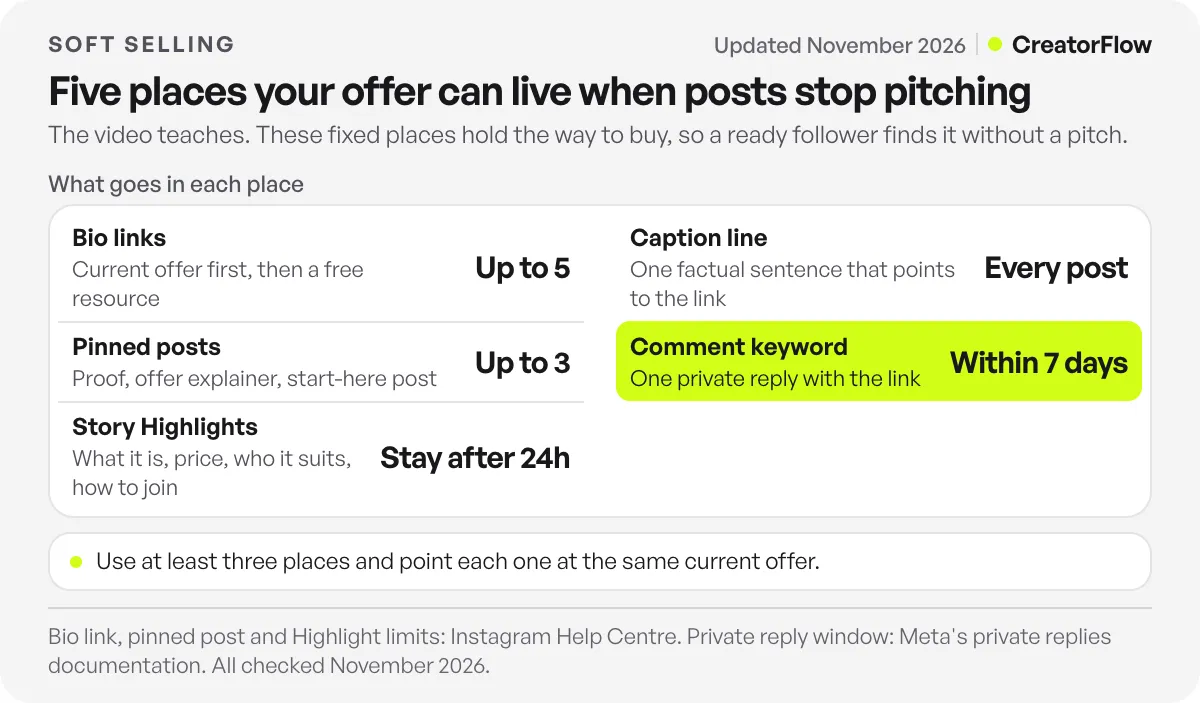
| Place | What Instagram allows (checked November 2026) | What to put there |
|---|---|---|
| Bio links | Up to 5 websites on your profile | Current offer first, then a free resource |
| Pinned posts | Up to 3 posts at the top of your grid | One proof post, one offer explainer, one start-here post |
| Story Highlights | Stories stay on your profile after 24 hours | Offer questions: what it is, price, who it suits, how to join |
| Caption line | Text under every post | One factual sentence that points to the link |
| Comment keyword | One private reply within 7 days of the comment | The link, sent when someone asks for it |
Bio links
Instagram’s Help Centre says you can add up to 5 websites to your profile (checked November 2026). Put the current offer first. A bio that names who you help and the result they get tells a visitor in one line why that link matters. The guide on writing an Instagram bio has examples you can adapt.
Pinned posts
You can pin up to 3 posts to the top of your profile, according to Instagram’s Help Centre (checked November 2026). Visitors see them before anything else on your grid. Use one for proof, such as a client result or a customer photo shared with permission. Use one to explain the offer in plain words, and one to tell a new visitor where to start.
Story Highlights
Instagram stories disappear after 24 hours unless you add them to a Highlight, and Highlights stay on your profile after the story is gone (checked November 2026). Make one Highlight that answers the questions a buyer asks before paying. Cover what it is, what it costs, who it is for and how to get it. Give it a plain name such as “Join” or “Shop”.
A caption line
A caption line is the smallest ask that still works. It states a fact instead of making a pitch, for example “The full checklist is the first link in my bio.” Put it at the end, after the value. Readers who want more will find it, and everyone else reads past it.
A comment keyword
A comment keyword lets a reader ask for the link with one word, and you answer in their DMs. Meta’s private replies documentation sets the rules (checked November 2026). The reply must go within 7 days of the comment, and only one message can be sent. Follow-ups are allowed only after the person responds, within 24 hours of that response. The reply goes to the main inbox if the person follows you and to message requests if they do not.
A tool such as CreatorFlow sends that one DM with your link when someone comments the keyword. The keyword-to-link example shows the setup. A keyword is a light ask, so keep it for a free resource and let the resource point to the paid offer. For choosing trigger words people will type, see the comment LINK strategy.
How to Write a Soft Sell Caption
A soft sell caption gives the full value first and ends with one factual line about where the offer lives. It does not use countdowns or “last chance” wording. A ready buyer knows what to do, and everyone else can enjoy the post without feeling pushed.
| Pitch line | Pointer line |
|---|---|
| ”Spots are filling fast, DM me now" | "The program details are the first link in my bio." |
| "You need this guide, grab it today" | "Comment PLAN and I’ll send you the full plan." |
| "Stop scrolling and book your call" | "My booking page is pinned at the top of my profile." |
| "Last chance, price goes up tonight" | "Prices and what’s included are in my Join Highlight.” |
Each pointer line names one place. Rotate between the four places so followers learn all of them, and keep the same keyword for the same offer.
A carousel can repeat the pointer line on its last slide, and a Reel can show it as on-screen text. For which format carries which job, see the breakdown of the best Instagram format for sales.
Soft Selling Examples on Instagram
The pattern is the same in every niche. The post teaches or shows a result with no pitch, the caption ends with one pointer line, and the profile holds the offer. Here are three illustrative setups for a coach, a small shop and an affiliate creator.
A nutrition coach
The Reel shows how to build a lunch with enough protein, filmed in her own kitchen. The caption ends with “My coaching program is the first link in my bio.” Her pinned post tells one client’s story, shared with permission. Her “Join” Highlight covers the price, the start date and who the program suits.
She also runs a comment keyword, MEALS, that sends a free shopping list. The last page of the list links to the program.
A ceramics shop
A carousel follows one mug from raw clay to glaze, with no price in the slides. The caption ends with “This mug and the matching set are in the shop, link in bio.” The pinned posts show the bestseller, a packing video and care instructions. A “Shipping” Highlight answers costs, delivery times and countries.
An affiliate creator
A Reel tours a home desk setup. The caption ends with “Comment DESK and I’ll send links to everything in this video.” The DM sends the product list. Label affiliate links clearly: the UK’s influencer guide from the ASA and CMA explains how. Check the disclosure rules in each country where you sell.
How to Tell If Soft Selling Is Working
Judge the results by what buyers do. Three signals matter. More people reach the offer page, more people buy without asking you first, and fewer DMs ask “price?” or “how do I join?”. If those questions rise after you remove the pitch, your content is doing its job and your buying path is hidden.
Run a path test once a month. Ask a friend who does not follow you to open your profile and find out how to buy, with no help. Time it. If it takes more than a minute, or they open the wrong link, fix the place where they got stuck.
Count the questions. A DM that asks “how much?” is a buyer doing work your profile should have done. Note which post each question came from. Then add the answer to the Highlight or pinned post that post should have pointed to.
Track the link. On CreatorFlow Pro and Growth, link click tracking shows how many people opened the link from a keyword DM, with clicks by country and city. Change one place at a time, so you know which change made the difference.
When Is a Hard Sell the Better Choice?
A direct ask fits moments with a real reason to act now. Examples are a launch week, a cart that closes on a fixed date, a small batch of stock, or a returning customer who already trusts you. In those moments a clear, honest pitch helps buyers. The mistake is using launch-week urgency every week, until followers stop believing it.
The research does not name a single winner. In a 2010 study of US and Japanese consumers in the Journal of International Marketing, Okazaki, Mueller and Taylor expected soft-sell ads to be received more alike in both countries than hard-sell ads. Soft-sell appeals were accepted somewhat more uniformly, but to the authors’ surprise, hard-sell appeals were too. They concluded that both styles have potential across those markets.
A practical rhythm is to teach with no pitch most of the time. When you have a real reason, run a short, clearly dated sales push and say the end date. Keep the bio link, pinned posts and Highlights live all year, so the quiet weeks still sell.
FAQ
What is the difference between soft selling and hard selling?
Soft selling persuades indirectly with help, stories and proof, and lets the buyer choose when to act. Hard selling makes a direct ask and pushes for a decision now, often with a deadline or a discount.
Is soft selling better than hard selling?
Neither is better in every case. The soft approach suits everyday content, because it keeps followers reading. A hard sell suits moments with a real deadline, such as a launch or a cart that closes on a fixed date.
How do you sell without selling?
You teach or show results in your content and put the way to buy in fixed places. On Instagram those places are your bio links, pinned posts, Story Highlights, a short pointer line at the end of each caption and a comment keyword that sends the link by DM. The buyer finds the offer when she is ready, without a pitch in the post.
Does a soft sell work for coaches and service businesses?
Yes, when the buying path is clear. Teaching content builds the trust a coaching offer needs, but the profile must still say how to work with you. Put the offer in your first bio link, pin a post that explains it, and keep a Highlight with the price and next step.
Can a comment keyword count as a soft sell?
Yes, if it offers something free and useful. “Comment PLAN for the full plan” asks for one word and gives value back. The free resource can then point to your paid offer. A keyword that only sends a sales page works more like a hard sell.
Sources and checks
Checked November 3, 2026: the Instagram Help Centre pages on bio links, pinned posts, Story Highlights and when stories disappear, and Meta’s private replies documentation, all linked above. The research is Okazaki, Mueller and Taylor (2010, two papers) and Friestad and Wright (1994). The caption lines and the three examples are illustrative, not customer results.