

Transformation photos are a pair of images of the same client, one at the start of a program and one later, used to show a physical change. A pair counts as proof only when both frames are taken under the same conditions, the dates are on record, and the client agreed in writing to where the photos appear. Without those three, a viewer has no way to tell a result from a better camera angle.
Most progress photo guides are written for the person in the photo. They cover lighting and poses, and stop there. A coach has a second job. The photo that helps a client track progress becomes marketing once it goes on your Instagram, and marketing has rules. A pair shot in two rooms, posted without a signed form, under a caption that implies every client gets the same result, fails three tests at once.
This guide covers both jobs. It gives a photo protocol to hand to clients, a consent form checklist, and the rules that apply once the photos are public: Instagram’s Community Standards, Meta’s ad rules, the FTC in the US and the CAP Code in the UK. It is general guidance, not legal advice.
Key Takeaways
- What makes it proof: Same light, distance, camera height, time of day, clothing and pose in both frames, with both dates on record.
- Consent first: Written consent that names each place the photo may appear and how the client can withdraw.
- Meta ads: Weight loss ads must target people 18 or older and cannot show pinched fat, attack appearance or promise a set result in a set time without a qualifier.
- FTC (US): A client result in your marketing implies it is typical. If it is not, state what clients generally achieve. “Results not typical” does not fix it.
- UK: The CAP Code bans claims that people can lose a precise amount of weight in a stated period.
- Bottom line: Keep a results log for every client, not only the best ones. It gives you the typical result that makes your best photo safe to post.
What Makes a Transformation Photo Count as Proof
A transformation photo counts as proof when the only thing that changed between the two frames is the client’s body. Light, distance, camera height, posture, clothing, time of day and editing all change how a body looks. If any of them differ, a viewer cannot separate the result from the setup. The dates matter too, because the time between photos is part of the claim.
In a TODAY report, a personal trainer and fitness blogger took a “before” and an “after” within three minutes of each other. Pose and lighting did all the work. Your audience has seen posts like that, so a fair pair has to look fair.
| Condition | Fair pair | What breaks it |
|---|---|---|
| Light | Same window or lamp, same time of day | Harsh overhead light in one, soft side light in the other |
| Distance and height | Same spot, camera at the same height | Phone held closer or lower for the “after” |
| Lens | Main camera at 1x in both | Wide-angle or portrait mode in one frame |
| Body state | Same time of day, same point in the day’s meals | ”Before” after a big dinner, “after” first thing in the morning |
| Clothing | Same garment or same type and fit | Loose shirt before, fitted set after |
| Pose | Relaxed, arms in the same place | Slouched before, flexed and tilted after |
| Editing | Crop only, same crop on both | Filters, skin smoothing, body reshaping |
| Dates | Original files kept with their dates | No record of when either photo was taken |
How to Take Progress Photos That Compare Fairly
To take progress photos that compare fairly, fix the setup once and repeat it every time. Pick one spot, one light source, one camera height and one distance, and mark them. Shoot at the same time of day in the same clothes, using a timer or a helper instead of a mirror. Save the original files with their dates and edit nothing except the crop.
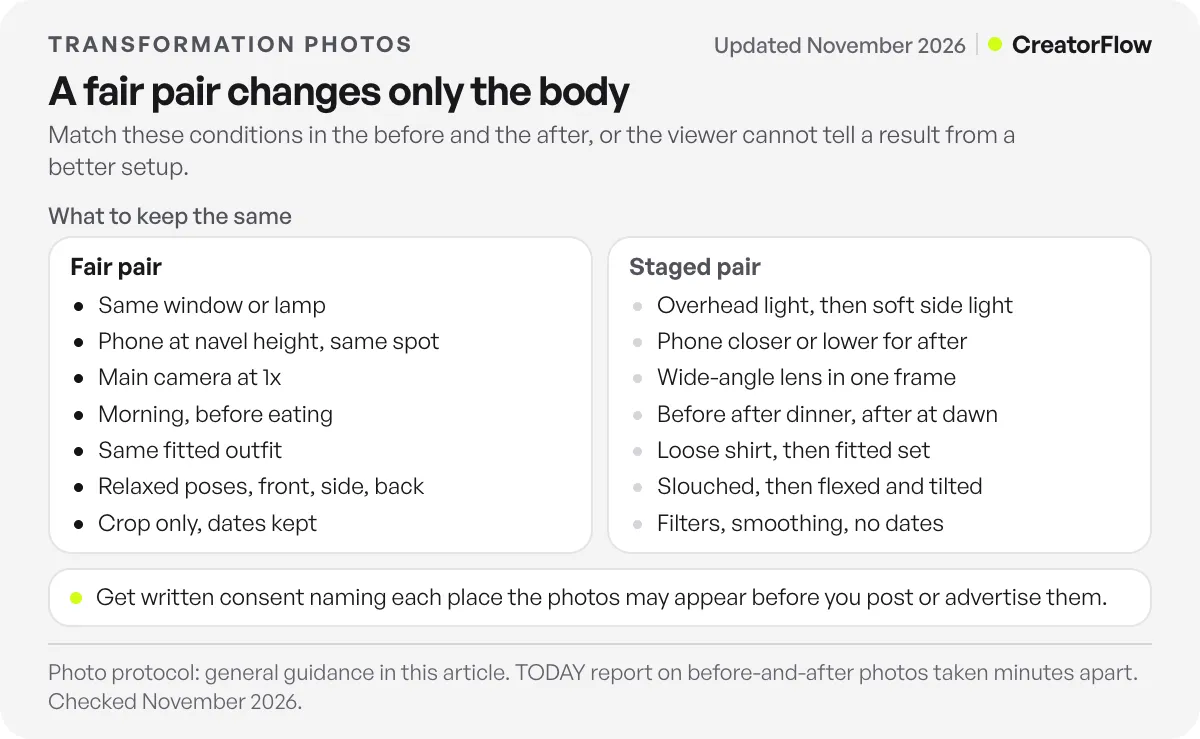
Send these seven rules to every new client before their first session.
- One spot. A plain wall, with tape on the floor for the feet and for the phone stand.
- One light. Face a window at the same time of day, or use one fixed lamp. Turn off overhead lights.
- One height and lens. Phone level at about navel height, main camera at 1x. Wide-angle lenses stretch the body near the frame edges.
- One time. Morning, before eating. Food and water change how the stomach looks during the day.
- One outfit. The same fitted sports bra, shorts or underwear every time.
- Three relaxed poses. Front, side and back, arms slightly away from the body. Compare relaxed to relaxed, flexed to flexed.
- No edits. Use the timer, keep the original file and crop both photos the same way.
Keep each client’s photos in one folder, with the date as the file name. The phone stores a date in each original file, so do not screenshot or re-save them through an editing app. If a client trains with you in person, take the photos yourself in your studio, where you control the light.
How Often to Take Fitness Progress Photos
Take a baseline set before the first session, then a new set every four weeks, then a final set at the end of the program. Visible change in fat or muscle is slow, so photos taken every few days mostly show water and posture. Some coaches prefer every two weeks. Pick one interval and keep it.
A pair labelled “12 weeks” is a claim about time, so the dates must support it. If a client misses a set, note it in their folder, and never fill the gap with a photo from a different setup.
On the same day as each photo set, record body weight, a few tape measurements and one performance number, such as a lift. When a photo shows little change, the other numbers often still show progress. Together they also become your results log.
How to Get Client Consent for Before and After Photos
Get consent in writing, before the first photo, on a short form that names each use separately. A client may be happy for you to see their photos and still not want them on your feed or in an ad. Put each use on its own line, so they can say yes to one and no to another.
A clear consent form covers these points:
- Where they may appear: your private records only, Instagram feed and Stories, your website, paid ads. One tick box each.
- What is shown: face visible or cropped, first name or none, and which numbers you may share.
- Edits: the photos will not be retouched beyond cropping.
- Payment or discount: anything the client gets in return, such as free or cheaper coaching.
- How to withdraw: who to email, and what happens next.
Be honest about withdrawal. You can delete a post or stop an ad, but you cannot recall a screenshot or a share, so say that on the form. For UK and EU clients, photos are personal data, and Article 7 of the GDPR says withdrawing consent must be as easy as giving it. In the UK, rules 3.47 and 3.50 of the CAP Code section on testimonials require permission to use a testimonial, plus evidence that it is genuine and the person’s contact details.
The rules in this guide differ by country and change over time. Have a lawyer in your country check your consent form once before you use it.
Instagram and Meta Ad Rules for Before and After Photos
Organic progress photos mainly need to stay within Meta’s nudity rules. Paid ads face extra rules. Meta’s current Health and Wellness ad standards say ads for weight loss services must target people 18 or older, and they ban pinched-fat close-ups, negative statements about appearance and promises of a set result in a set time without a qualifier.
Organic posts
Meta’s Adult Nudity and Sexual Activity standard removes photos with visible genitals, visible anuses, close-ups of visible buttocks, and visible female nipples outside a breastfeeding or protest context (checked November 2026). For progress photos, keep shorts or underwear on, a sports bra or top for women, and frame the full body instead of a tight crop on the glutes.
Paid ads
Meta’s Health and Wellness ad standards and its business help page on the same policy set these rules for ads that promote weight loss or weight gain products and services (checked November 2026):
- The ad must target people 18 or older.
- It cannot show a close-up of a body area with pinched fat.
- It cannot contain statements that attack a person’s appearance, body parts or hygiene. A line like “Hate your stomach?” fits that description.
- It cannot use clickbait, such as extreme claims or a promise of a specific result within a set time without disclaimers or qualifiers.
Services marketed for general wellbeing, such as fitness services and health clubs, are outside the 18+ rule, and Meta’s help page shows a fitness-focused image as an allowed example. Some marketing guides still describe a blanket ban on before-and-after images. The current pages contain none for fitness, but review still judges each ad, so a weight-loss pair with a dramatic caption can be rejected.
FTC Rules for Client Transformation Photos
In the US, the FTC treats a client result in your marketing as a consumer endorsement. Under the Endorsement Guides (16 CFR Part 255, revised in 2023), that result implies other clients will get something similar. If you cannot show that, you must state what clients generally achieve. Free or discounted coaching given to the client must be disclosed.
Typical results
Section 255.2(b) says an endorsement about a key result will likely be read as what people “will generally achieve”. Without proof of that, the ad should clearly disclose the generally expected performance. The FTC’s Endorsement Guides FAQ adds that “Results not typical” or “Individual results may vary” does not change how people read the claim.
The FAQ’s own example is an ad that says “I lost 50 pounds in 6 months”. If users do not generally get that, the ad should say what they do get, such as “Women who use QRS Weight-Loss for six months typically lose 15 pounds.” A coach only has that typical number if they record every client’s start and end measurements, including clients who stalled or left early.
Material connections
Section 255.5 says a connection between the endorser and the seller must be disclosed clearly when the audience would not expect it. The FTC lists money, free or discounted products, and a business, family or personal relationship as examples. A client who got coaching free or at a discount in return for photos has a connection to you. Say so in the post, in plain words, for example: “Maria received her coaching free in exchange for sharing her photos.”
Section 255.1 adds that endorsements must reflect the endorser’s honest experience, and the advertiser is liable for misleading statements made through them. An edited or staged pair is a misleading statement in picture form. Our guide on where to place a disclosure on Reels, Stories and captions covers placement.
UK Rules: What the CAP Code Says About Weight-Loss Results
The UK Advertising Standards Authority applies the CAP Code to a UK business’s own website and social media, including an Instagram profile, according to its guidance on own websites. Section 13 covers weight-control marketing and is stricter than the US rules on numbers and time periods.
The CAP Code section on weight control includes these rules (checked November 2026):
- 13.1: Testimonials that are not supported by trials do not prove a weight-loss method works.
- 13.3: Weight-loss marketing must not be aimed at under-18s or at people for whom losing weight would bring their BMI below 18.5.
- 13.9: Marketing must not claim that people can lose a precise amount of weight within a stated period, or lose fat from a specific body part.
- 13.10: A claim that one person lost an exact amount must state the period and must not be based on unrepresentative experience. For people who are normally overweight, losing more than 2 lbs a week is unlikely to fit good medical practice.
- 13.11: Claims that exercise, alone or with a diet plan, leads to weight or inch loss need evidence. Intensive exercise programs should tell people to check with a doctor first.
In practice, “Sam lost 14 lbs over 12 weeks” describes one person, states the period and stays under 2 lbs a week. “Lose a stone in 6 weeks” promises a precise amount in a set time, which rule 13.9 bans.
How to Post Transformation Photos on Instagram
Post the pair with both dates, what the client did, and what is typical for your clients. Name any free or discounted coaching, and crop the face if the form says so. Put your best pairs in a Story Highlight and a pinned post, so new visitors find them without scrolling.
A caption that covers the rules above has five parts:
- Who and when: “Maria, week 0 and week 16.”
- What she did: “Three strength sessions a week and a daily step goal.”
- The change: “Down 9 kg, and her deadlift went from 40 kg to 85 kg.”
- Typical result: “Clients who complete my 16-week program lose 4 to 6 kg on average.” Use your own results log for this number.
- Connection, if any: “Maria received her coaching free in exchange for sharing her photos.”
The numbers above are an illustration, not a real client. Use your own.
Result posts work best as one regular part of your content, next to teaching posts. Our guide to content pillars for coaches shows how to plan that mix. When result posts draw “how do I start?” comments, add a keyword line such as “Comment START for my program details.” CreatorFlow then sends one DM with your program page link to each person who comments the keyword, and on Pro it tracks clicks on that link. The CreatorFlow page for fitness coaches shows the setup, and the Instagram funnel for fitness coaches covers what happens after the click.
FAQ
How often should clients take progress photos?
Take a baseline set before the program starts, one set every four weeks, and a final set at the end. Photos taken every few days mostly show water and posture.
Do I need written consent to post a client’s before and after photos?
Get it in writing every time. A signed form names each place the photo may appear and records any payment or discount. In the UK, the CAP Code requires permission to use a testimonial.
Can I use before and after photos in Instagram ads?
Meta’s current Health and Wellness ad standards contain no blanket ban on fitness before-and-after images. Weight loss ads must target people 18 or older and follow the image and claim rules above.
Is “results not typical” enough under FTC rules?
No. The FTC says that line does not change how people read a result. Either prove the result is what clients generally get, or state the result they generally get.
Do I have to disclose that a client got free coaching for their photos?
Yes, in the US. Free or discounted services are a material connection under the FTC Endorsement Guides. The FTC FAQ says an Instagram disclosure should be visible without clicking “more”.
Can I edit or filter transformation photos?
Crop both photos the same way and do nothing else. Filters and body reshaping change what the photo claims, and endorsements must reflect the client’s honest experience.
Sources and checks
Checked November 3, 2026: Meta’s Health and Wellness ad standards and business help page, Meta’s Adult Nudity and Sexual Activity standard, the FTC Endorsement Guides at 16 CFR Part 255 (revised version published in the Federal Register on July 26, 2023) and the FTC’s Endorsement Guides FAQ, the ASA’s CAP Code section 13, section 3 and remit guidance, and GDPR Article 7. The caption and consent examples are illustrative, not client results. This is general guidance, not legal advice.