

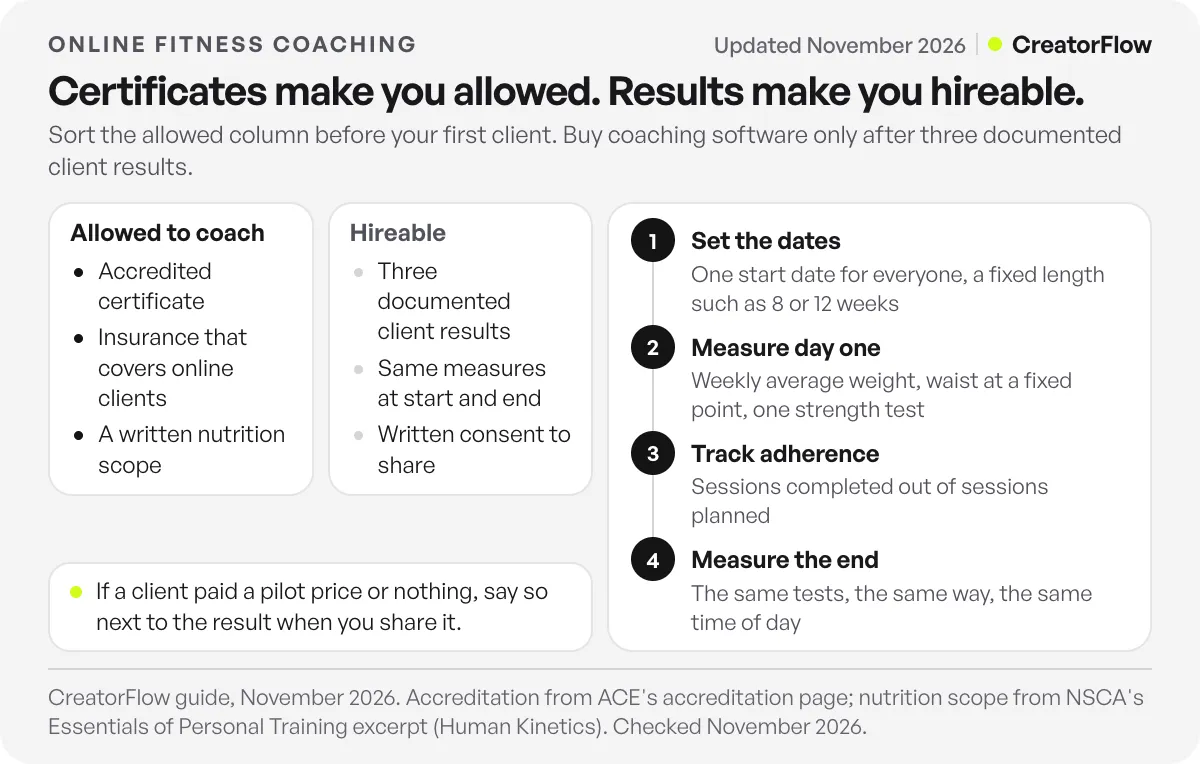
To become an online fitness coach, earn an accredited certificate, learn which nutrition advice you may give where your clients live, and buy insurance that covers clients online. Then document three client results before you pay for coaching software. The certificate and the insurance make you allowed to coach. The documented results make you hireable, because they are the part a stranger can check.
Most guides put the steps in a different order. They start with the certificate, then the coaching app, the website and the logo. A new coach can finish all of that and still have nothing to show a buyer. Two parts of the job are easy to skip and expensive to get wrong. One is what you may say about food. The other is whether your insurance covers a client in another state or country.
This guide covers the certificates that count in the US and the UK, the line between general nutrition advice and diet prescription, the insurance questions to ask before your first online client, and how to run a dated pilot that produces proof you can use. It ends with when to buy software and how to turn the results into enquiries on Instagram.
Key Takeaways
- Allowed is different from hireable: a certificate and insurance let you coach safely. Documented client results are what make a stranger pay you.
- Accreditation belongs to a program: in the US, check that the exact certificate you buy is accredited by the NCCA. ACE, for example, lists four of its programs as NCCA accredited.
- Nutrition has a legal line: general advice on eating for performance and weight change is within a trainer’s scope. Diet plans for a medical condition belong to a dietitian.
- Insurance has borders: some policies cover live online classes worldwide but exclude clients in the USA and Canada. Ask your insurer where your online clients may live.
- Run a dated pilot: fixed start date, fixed length, the same measures at the start and the end, and written consent to share the result.
- Bottom line: spend on software only after you have three documented results and a waiting list to serve.
What You Need to Become an Online Fitness Coach
Four things come first, in this order: a recognised certificate, insurance that covers online work, a clear rule for what nutrition advice you give, and documented results from real clients. The first three protect you and your clients. The fourth is what sells. A website, a coaching app and a brand come after, once there is something to put on them.
| Step | What it gives you | When to pay for it |
|---|---|---|
| Accredited certificate | Knowledge, and the credential gyms ask about | First |
| Insurance that covers online clients | Cover if a client is hurt following your plan | Before your first client |
| A written nutrition scope | A clear line you will not cross with food advice | Before your first client (free) |
| Three documented client results | Proof a stranger can check | Next, through a dated pilot |
| Coaching program with a fixed length | Something a buyer can read and pay for | Once the pilot shows what works |
| Coaching software, website, app | Time saved on admin | When admin, not clients, limits you |
The order matters because each step changes what the next one costs. A coach with three documented results can price a program from evidence. A coach without them is guessing, and the software bill arrives either way.
Do You Need a Certification to Coach Fitness Online?
Yes, in practice. A certificate teaches you to program exercise safely, and gyms commonly ask for one. In the US, the benchmark is a certificate accredited by the NCCA, the accrediting body of the Institute for Credentialing Excellence. In the UK, the usual route is a Level 3 personal training qualification endorsed by CIMSPA.
The NCCA accredits individual programs, not whole companies. ACE’s accreditation page says four of its programs hold NCCA accreditation: Personal Trainer, Group Fitness Instructor, Health Coach and Medical Exercise Specialist (checked November 2026). Many certification bodies sell several certificates, so check the exact name of the one you buy before you pay.
In the UK, awarding bodies publish their Level 3 qualifications directly. One example is the 1st4sport Level 3 Certificate in Personal Training. CIMSPA describes itself as the professional development body for the UK’s sport and physical activity sector, and it endorses training and qualifications that meet its standards (checked November 2026).
If you live in the EU, rules are set country by country. Ask your national fitness or sport body which qualification it recognises before you choose a course. If you plan to coach clients abroad, the rules that matter for nutrition advice are the ones where the client lives, which is the next section.
What Nutrition Advice Can an Online Fitness Coach Give?
You can teach general nutrition: how much protein supports training, how eating relates to weight change, and which popular claims are false. You cannot prescribe a diet for a medical condition. NSCA’s textbook for personal trainers says referral to a nutrition professional is needed when a client has a disease state affected by nutrition, such as diabetes or an eating disorder.
The line comes from NSCA’s Essentials of Personal Training, published in an excerpt by Human Kinetics. It says general advice on nutrition for performance, disease prevention, weight loss and weight gain is “well within the personal trainer’s scope of practice”. Diet work for a disease state is medical nutrition therapy, and it belongs to a licensed nutritionist or a dietitian (checked November 2026).
In the US, each state sets its own rules. The same excerpt explains that states regulate nutrition advice through licensure, statutory certification or registration. Licensure is the strictest, because practising without a license is illegal. If you coach clients in other states, check their state’s rules too. The excerpt points trainers to the state dietetic licensing board.
In the UK, one title is protected by law. The British Dietetic Association’s HCPC registration page says “dietitian” is the only food and nutrition title protected by law, and that “nutritionist” is not protected (checked November 2026). A fitness coach can talk about food. A fitness coach cannot call themselves a dietitian.
Write your own nutrition scope in one paragraph. Put it in your client agreement and on your sales page. A good scope names what you do (education, habit coaching, general targets), what you refer out (medical conditions, eating disorders, pregnancy diets), and who you refer to. It shows clients where your help stops, and it protects you if a conversation drifts.
Does Personal Trainer Insurance Cover Online Clients?
Some policies do, and some exclude clients in certain countries. Before your first online client, ask your insurer three questions in writing. Are live online sessions covered? Are pre-recorded programs covered? Which countries may your clients live in? Online cover is often tied to where the client is, not where you are.
One real example shows why the last question matters. The YogaPros insurance FAQ for its members’ policy says live online classes are covered worldwide, excluding the USA and Canada. It also says sales of pre-recorded classes are covered only within set territorial limits (checked November 2026). That is a yoga teachers’ policy, so check whether your fitness policy has similar wording.
A UK coach with that wording could take a client in Spain and be covered, then take a client in Texas and not be. The fix is cheap if you ask first. Ask the insurer to add the countries you sell to, or limit your sales page to the places your policy covers.
Keep a short intake form with a health questionnaire for every client, online or in person. If a client reports a condition outside your scope, refer them before you write a plan. Your insurer may ask for these records if a claim is made.
How to Get Your First Client Results as a New Coach
Get results in one of two ways. Train people in person, at a gym or in a park, and record their progress with the same measures you will use online. Or run a dated online pilot: a fixed start date, a fixed length, a small group at a pilot price, and written permission to share the outcome.
In-person clients are the faster route if you already work in a gym. You see their form, you correct it live, and you learn which instructions people misread. Record the same measures you plan to use online, so the result transfers to your sales page.
A dated pilot works if you only coach online. Pick a length long enough for a visible change, such as 8 or 12 weeks. Set the start date for everyone at once. Charge a pilot price rather than nothing, so the commitment is clear on both sides. Write the measures and the end date into the agreement before day one.
Three results is a useful threshold. One result can be the client, not the method. Three different people following the same plan and reaching a measured change shows the method works. It also gives you three different stories for three different kinds of buyer.
Tell people the terms when you share a result. If the client paid a pilot price or nothing, say so next to the result. Our guide to client transformation photos covers written consent and the disclosure rules for posts and ads in detail.
What to Record So a Result Counts as Proof
A result counts as proof when someone else could repeat the check and get the same answer. Record a start date, an end date, the same measures taken the same way at both ends, how many planned sessions the client completed, and what the client agreed you may share. Write it down at the start, not when the result looks good.
| Field | What to write | Why it matters |
|---|---|---|
| Start and end date | Day one and the final check-in | Shows the result took a stated time |
| Starting measures | Weekly average body weight, waist at a fixed point, one strength test | Gives a baseline you cannot change later |
| Method | The program name and the weekly plan | Links the result to something you sell |
| Adherence | Sessions completed out of sessions planned | Shows the client followed the plan |
| End measures | The same tests, the same way, the same time of day | Makes the change comparable |
| Consent | What may be shared, where, with or without a name | Lets you post without asking twice |
| Terms | Full price, pilot price or free | Lets you state the terms truthfully |
Pick measures your clients can take at home without special equipment. A weekly average weight is steadier than a single weigh-in. A strength test, such as reps at a set load, shows progress in clients whose weight barely moves. Photos count only when the light, pose and time of day match, which is a topic of its own.
Keep one row per client in a spreadsheet. When you have three complete rows, you have the core of a sales page: what changed, in how long, following which plan.
When to Pay for Coaching Software, a Website and an App
Pay for software when admin limits you, not before. While you coach a pilot group, a spreadsheet, a messaging app, a booking link and a payment link are enough. Once you have documented results and more enquiries than hours, buy the tool that removes your biggest weekly chore.
The pilot also tells you what to build. If clients kept asking for one more video demo, you need an exercise library. If most of your time went into writing weekly check-in replies, you need a check-in tool. Buying an all-in-one platform first means paying for parts you may never use.
Turn the pilot into a program with a fixed sequence and a measured end state before you build a store around it. Our guide on how to create a coaching program shows how to write a sequence a buyer can read before paying. To set the price, work back from an income target with the booked-hours math for online coaches.
When you are ready for a store, the comparison of platforms that sell courses and coaching lists nine options with their fees and plan limits. Pick on the features your pilot showed you need, not on the longest feature list.
How to Find Online Fitness Coaching Clients on Instagram
Post your documented results with consent, explain the method behind each one, and give people one keyword to comment for details. When someone comments, send one private message with your program page or booking link. If buyers ask about your results in the comments, that is where the answer should be fast.
Each result post should name the measure, the time it took and the plan the client followed. Put a single call to action at the end, with one keyword and one thing they get. A post that asks for comments, follows and saves at once splits the reader’s attention.
Meta allows one private reply to a comment, sent within 7 days of the comment, and no further message until the person replies. A comment-to-DM tool sends that reply in seconds while you are coaching. In CreatorFlow, a keyword comment triggers one DM with your link, and Pro adds click tracking so you can see which result post sends the most visitors to your page. The CreatorFlow setup for fitness coaches shows that flow with fitness examples.
For the full path from post to paying client, read the Instagram funnel for fitness coaches. For DM templates by question type, see Instagram DM automation for fitness coaches.
FAQ
Can you be an online fitness coach without a certification?
Check your country’s rules first. Even where no certificate is required, gyms commonly ask for one, and the course teaches you to program exercise safely. In the US, choose a program accredited by the NCCA. In the UK, choose a Level 3 personal training qualification endorsed by CIMSPA.
How long does it take to become an online fitness coach?
The certificate takes as long as the course you pick. After that, plan for one pilot of 8 to 12 weeks to produce documented results. Most of the time goes into the pilot, because you cannot speed up a client’s progress. Insurance and a written nutrition scope take a few days.
Can an online fitness coach write meal plans?
General guidance is within a trainer’s scope: protein targets, eating for training, habits. Individual diet prescription for a medical condition belongs to a dietitian. In the US, some states license nutrition advice, so check the rules in your client’s state. In the UK, only registered professionals may use the title dietitian.
Does my insurance cover clients in other countries?
Only if the policy says so. Some policies cover live online classes worldwide but exclude the USA and Canada, and pre-recorded programs often have their own territorial limits. Ask your insurer in writing which countries your online clients may live in, and keep the reply.
How many clients do I need before I buy coaching software?
There is no fixed number. Buy when admin, not finding clients, limits how many people you can coach. During a pilot, a spreadsheet, a messaging app, a booking link and a payment link handle the work. After the pilot, buy the tool that removes your biggest weekly chore.
Should my first clients be free?
A pilot price makes the commitment clear on both sides, so it is a better default than free. Whatever the price, write it down and disclose it when you share the result. Get written consent at the start for what you may share, where and with or without the client’s name.
Sources and checks
Checked on November 3, 2026: NCCA accreditation of ACE programs on ACE’s accreditation page; the nutrition scope of practice and US state regulation types in the NSCA Essentials of Personal Training excerpt from Human Kinetics; UK title protection on the British Dietetic Association site; CIMSPA’s role on cimspa.co.uk; the 1st4sport Level 3 qualification page; and online class territorial limits in the YogaPros insurance FAQ. This guide is general information, not legal advice. Rules for nutrition advice and insurance change by state and country.