

A coaching program is a fixed sequence of sessions, tasks and checks that ends at one result you measure at the start and again at the end. To create one, choose that result first, build the weeks from what worked with your past clients, and write each week down. The name, the package and the price come last, because they follow from the sequence.
Most coaches sell “online coaching” or “three months of calls”. The buyer pays for access to you, and nobody can say what week 3 holds. That works with people who already trust you. It stalls with strangers, because a stranger cannot judge a calendar of calls, and it turns every renewal into a new sale.
This guide covers how a program differs from a time subscription, a test any program page passes or fails, how to choose the measure, how to build the sequence from your client notes, the length, the weekly page, group versus one-to-one, and where the name and price fit. Three published studies on goals and habits are linked along the way.
Key Takeaways
- Definition: A program is a fixed order of work with one measured result. Coaching with no set order is a subscription to your time.
- The week 3 test: Give your program page to a stranger. If they cannot say what happens in week 3 and how the result is measured, the page sells hours.
- Measure first: Take the same measure in week 1 and in the final week. Goal research by Edwin Locke and Gary Latham found specific, hard goals beat “do your best”.
- Build from past clients: The sequence is already in your session notes. Find the order of work your clients went through when they got the result, and write it down.
- Plan the weeks after: In one 2010 study, a new daily habit took between 18 and 254 days to become close to automatic, so the last phase should hand the client a plan for after the program.
- Bottom line: Write the sequence and the measure first. The name, the coaching package and the price follow from them.
What Is a Coaching Program?
In coaching, a program is a set order of sessions, tasks and checks that moves a client from a measured starting point to a measured end point in a known time. The client knows what each week holds before they pay. A signature program is the same thing with your method behind it: the one sequence you run with every client who has this problem.
The opposite is a time subscription. Both can be good coaching. The difference is what a stranger can read before paying, and a stranger who found you on Instagram has only the page.
| Time subscription | Program | |
|---|---|---|
| What the buyer pays for | A number of calls or months | A result and the steps to it |
| What week 3 holds | Whatever comes up | A named phase and one task |
| How the end is known | The calls run out | The end measure is taken |
| Work between calls | Not set | One written task per week |
| What a renewal means | Buying more time | A new phase or a new result |
| How the price is set | Hourly rate times calls | The result and the work it takes |
A coaching package is how the program is sold. It is the sequence plus the contact (calls, message support, reviews of the client’s work), the materials, and the price. One program often carries several packages, and the weeks stay the same in each.
The Week 3 Test: Is Your Coaching a Program or a Time Subscription?
Give your program page to someone who has never met you. After one read, ask three questions: what happens in week 3, how will I know it worked, and when does it end. If they answer all three in their own words, you have a program. If any answer is “it depends”, the page is selling time.
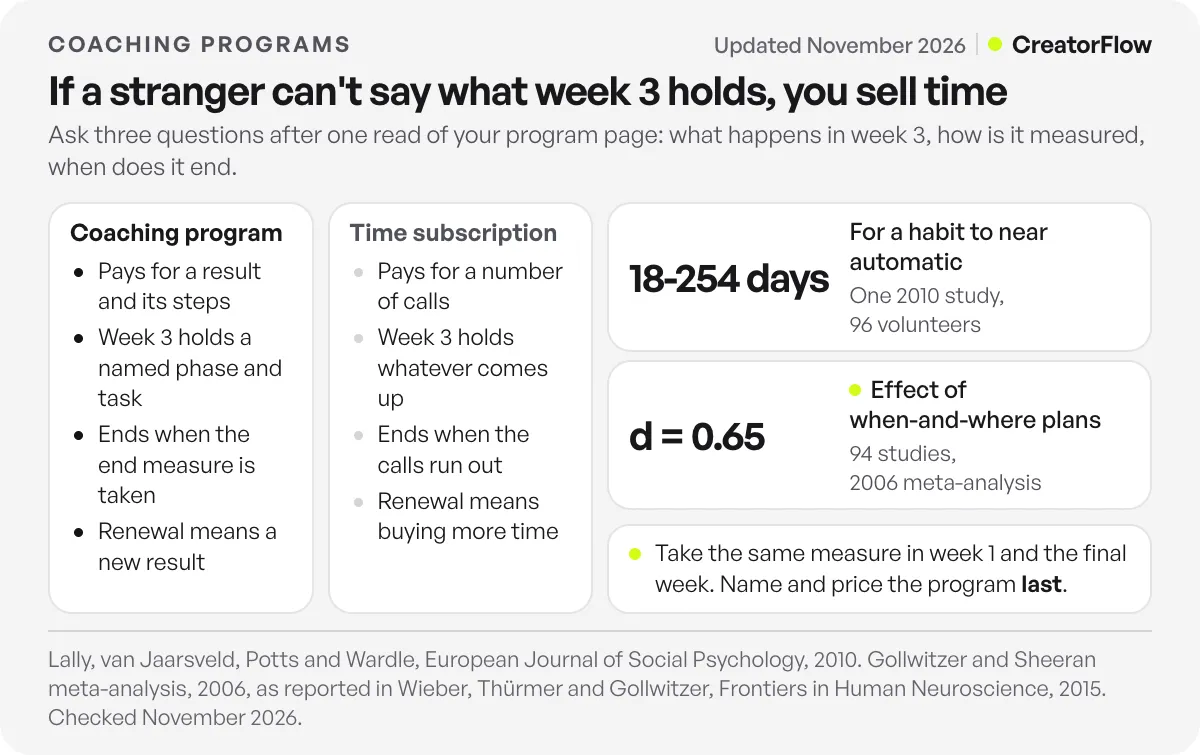
Week 1 is intake in almost every offer, and the last week is a review. The middle is where your method shows, so for a program longer than 8 weeks, ask about its middle week.
Run the same test on your own notes. If your last five clients did five different things in week 3, the sequence does not exist yet. That is normal for a newer coach: keep selling sessions and record the order of work.
How Do You Choose the Result and Measure It?
Choose one result the client can see and you can count, and take the same measure in the first week and the last. “More confidence” fails because neither of you can check it. “Sends 10 proposals at the new price in 8 weeks” passes. If the result cannot be a number, use a dated piece of work, such as a finished sales page.
There is research behind this. Edwin Locke and Gary Latham summarised 35 years of goal studies in a 2002 paper in American Psychologist (PubMed record). They report that specific, difficult goals consistently led to higher performance than telling people to do their best. Their explanation is that “do your best” has no outside reference point, so almost any effort can count as success.
A good measure is also one the client controls. Revenue depends on buyers, so a business coach measures proposals sent and sales calls held instead.
| Coaching type | Result too vague to measure | Result you can measure | Where the measure comes from |
|---|---|---|---|
| Business coach | Grow the business | 10 proposals sent at the new price in 8 weeks | The client’s sent folder |
| Fitness coach | Get in shape | 3 sessions a week for 10 weeks, load added on 3 main lifts | The training log |
| Career coach | Find a better job | 20 targeted applications and 5 practice interviews | An application tracker |
| Health coach | Sleep better | The same bedtime on 6 of 7 nights for 6 weeks | A sleep diary |
The same paper adds a caution. When a task is new and complex, a hard performance goal can make people try strategies at random, and Locke and Latham suggest a learning goal instead. So set learning goals in the early weeks (“test 3 outreach messages”) and the performance goal in the later weeks.
How Do You Build the Sequence From Your Past Clients?
Read your notes from your last five to ten clients and list what you did with each, session by session. The order that repeats in the clients who reached the result is your sequence. Group those sessions into three or four phases, and give each phase a check the client must pass before the next phase starts.
Put each client’s sessions in a column next to the others. Matching rows show your method. A step only one client needed becomes an optional resource you hand out when it comes up.
Here is an example for a business coach whose result is “10 proposals at the new price in 8 weeks”. It is illustrative, not a measured result.
| Phase | Weeks | What the client works on | Check before the next phase |
|---|---|---|---|
| Diagnose | 1-2 | Current prices, last 10 sales, baseline count of proposals | Baseline sheet complete |
| Rebuild the offer | 3-5 | New price, new offer page, the proposal template | Offer page live |
| Sell at the new price | 6-8 | Send proposals, hold sales calls, review each one | 10 proposals sent |
A stranger reading this table can say what week 3 holds, which passes the week 3 test on paper. The checks matter as much as the phases. A client without a finished baseline sheet stays in phase one for another week, and “we covered pricing” becomes “the pricing page is live”, which both of you can see.
How Long Should a Coaching Program Be?
Make the program as long as the phases take for a typical client, rounded to whole weeks. Count how many weeks your past clients needed to pass each check and add them up. Lengths of 6, 8 or 12 weeks are common, but your clients’ checks set the real number. If the result depends on a new habit, also plan what the client does after the last session.
Habit research shows why the last part matters. Phillippa Lally and colleagues asked 96 volunteers to repeat one eating, drinking or activity behaviour every day in the same context for 12 weeks (paper DOI). The time it took people to reach 95% of their plateau in automaticity ranged from 18 to 254 days. Missing one chance to do the behaviour did not materially change the process.
Two design rules follow. A 12-week program can end before a new habit is automatic for some clients, so the final phase should produce a written plan for the next few months. And one missed week is no reason to restart, so build one spare week into the schedule for catch-up.
What Should Each Week of a Program Include?
Each week needs four things written down: the session topic, one task the client does before the next session, the plan for when and where they will do it, and the check that shows it is done. Keep each week to one page. If a week needs two pages of tasks, split it into two weeks.
The “when and where” line comes from research on implementation intentions, which are plans in the form “when situation X happens, I will do Y”. Peter Gollwitzer and Paschal Sheeran’s 2006 meta-analysis covered more than 8,000 participants in 94 independent studies. A 2015 review co-written by Gollwitzer reports a medium-to-large average effect of these plans on goal attainment (d = 0.65).
In a program, the client writes the plan at the end of each session, in their own words. Here is week 3 from the business coach example above:
- Session: Set the new price and draft the offer page together.
- Task: Finish the page and send it to 2 past clients for comments.
- Plan: “On Tuesday at 9am, before I open email, I finish the page.”
- Check: The page link, sent to the coach by Friday.
Put one sample week like this on the sales page, and the week 3 test is passed.
Group Coaching Program or One-to-One: What Changes?
The sequence and the measure stay the same. What changes is timing and attention. A group program runs on fixed dates, so every member is in week 3 at the same time and the checks happen together. One-to-one can start in any week, and the coach adjusts the pace for each client inside the same phases.
A group puts more weight on the written week, because each person gets less private time. One private review per phase keeps each member’s check in front of the coach. The fixed start date also gives a natural enrollment window. If you plan to fill the first round from Instagram, the guide to running a cohort launch through Instagram DMs covers the waitlist and the application step.
One-to-one suits a sequence that is still changing. Run it one-to-one until the checks stop changing, then open a group version.
When Do You Name, Package and Price the Program?
Name, package and price the program after the sequence and the measure are written. A name chosen first tends to promise a result the weeks do not deliver. A name chosen last can describe what the weeks do. The package is the sequence plus the contact and the materials, and the price follows from the result and the work.
A plain name such as “8-Week Pricing Reset” passes the same test as the page, because it tells a stranger the length and the topic.
One program can be sold as several coaching packages, for example group only, group with reviews, and one-to-one. How to split one offer into tiers without three times the work is covered in turning one offer into three price tiers. To set the number itself, see the method for pricing an offer for an Instagram audience.
The page that passes the week 3 test is also what you send when someone asks about the program. If people ask in your comments, CreatorFlow answers each comment containing a keyword such as “PROGRAM” with one DM that holds the page link, set up as shown on the business coaches page. What that message says depends on the price, and DM offer scripts by price point show how it changes.
FAQ
What is the difference between a coaching program and a coaching package?
The program is the sequence of phases, weekly tasks, checks and the measured result. The package is how you sell it, with the amount of contact, the materials and the price added. One program can be sold as several packages without changing the weeks.
What is a signature coaching program?
It is the one sequence you run with every client who has a given problem, built from what worked with past clients and ending at a measured result. The fixed sequence is what makes it yours.
How many sessions should a program have?
Use as many sessions as your phases take for a typical client, based on the weeks past clients needed to pass each check. Then add one spare week for catch-up.
Can I create a coaching program before I have clients?
You can write a draft sequence, but treat it as a guess until people go through it. Run it as a short paid pilot with a small group, call it a pilot on the sales page, and record what each person did each week. Change the weeks where most people got stuck. For fitness coaches, the guide to becoming an online fitness coach covers how to run and document that pilot.
Should a program guarantee a result?
Promise what you control: the sessions, the reviews, the weekly tasks and the measure. Many results depend on other people, such as buyers or employers. When you share client results, name the measure and say how long it took, so a reader knows what was counted.
Sources and checks
Sources checked on November 3, 2026: Locke and Latham, “Building a practically useful theory of goal setting and task motivation”, American Psychologist 57(9), 2002, core findings and moderators read in the full text (PubMed record); Lally, van Jaarsveld, Potts and Wardle, “How are habits formed”, European Journal of Social Psychology 40(6), 2010, abstract via its DOI; Gollwitzer and Sheeran’s 2006 meta-analysis figures as reported in Wieber, Thürmer and Gollwitzer, Frontiers in Human Neuroscience, 2015 (PMC article). The business coach phases and week 3 page are an illustrative example.