
A VSL, or video sales letter, is a single video that sells one offer from start to finish. It does the job of a long written sales page. It names a problem, shows a way to solve it, proves the method works, states the price and asks for one action. Creators use video sales letters to sell courses, coaching, programs and digital products.
The classic version was written for a stranger who clicked an ad and landed on a page with nothing but the video. That viewer knows nothing about you, so the video has to tell your whole story before it can sell. A follower who has watched your Reels for months already knows most of that story. Give them the stranger’s version and many of them leave before they hear the price.
This guide covers where the format came from and how to set the length by how well the viewer knows you. It gives a script structure, four example outlines and a delivery plan for Instagram. It ends with the FTC rules on results claims and the numbers that show whether the video sells.
Key Takeaways
- Definition: A video sales letter is one recorded video that sells one offer and ends with one action, such as buy, apply or book.
- Origin: Copywriter Jon Benson says he made the first one, a video of words on a screen with no face on camera.
- Length: Set the length by how well the viewer knows you. A stranger needs your story and proof. A buyer who asked for the offer needs the offer.
- Delivery: A sales video nobody opens sells nothing. The path to the play button decides how many people hear your pitch.
- Claims: If a testimonial shows results most buyers will not get, the FTC expects you to make clear what buyers generally get.
- Bottom line: Cut each version of the video to fit the person watching, and send it to the place where their interest started.
VSL vs sales page vs explainer video
A video sales letter and a written sales page do the same job in two formats. Both sell one offer and end with one action. An explainer video teaches how something works and usually ends with a softer step, like a free trial or a demo. Choose a sales video when buyers need to hear you, see proof and decide in one sitting.
| Video sales letter | Written sales page | Explainer video | |
|---|---|---|---|
| Main job | Sell one offer | Sell one offer | Explain a product or idea |
| Usual ending | Buy, apply or book | Buy, apply or book | Learn more or start a trial |
| How people take it in | In order, at your pace | Skim, then jump to the price | In order, usually short |
| What it does well | Your voice, face and proof in one place | Fast for skimmers, easy to search | Makes a process clear |
| Where it lives | A page with the video and one button | Its own page | Home page or product page |
Many sellers combine the first two. The page opens with the video and repeats the offer in text under it, so a skimmer can find the price without watching.

Some offers close on a page, and some close in a conversation. Our comparison of landing pages and DM automation covers when each one wins.
Who invented the video sales letter?
Copywriter Jon Benson is the person most often credited with the video sales letter, and he makes the claim himself. He describes deciding one day not to put his face on camera. He recorded a video of words on a screen with his voice instead, and called it the first “ugly” video sales letter.
He tells the story in episode 44 of the I Love Marketing podcast with Joe Polish and Dean Jackson. He says other marketers were already making slideshow-style sales videos. The new part was a video of words on a screen and nothing else.
The thinking inside the format is older. In Breakthrough Advertising (1966), Eugene Schwartz argued that copy has to match how aware the reader already is. Shortform’s summary lays out his five levels, from people who do not feel any need for the product to people who already want it. For the least aware, Schwartz said to open with an emotion or attitude they recognise. For the most aware, the headline’s main job is to get them to complete the purchase.
That idea is the key to the length question, and most guides skip it.
How long should a VSL be?
A sales video should be as long as the viewer needs to decide, and that depends on how well they know you. A stranger from an ad needs your story, your method and proof before the price. A follower who has watched you for months needs much less of that. Someone who commented to ask for the offer mostly needs the offer, the price and how to start.
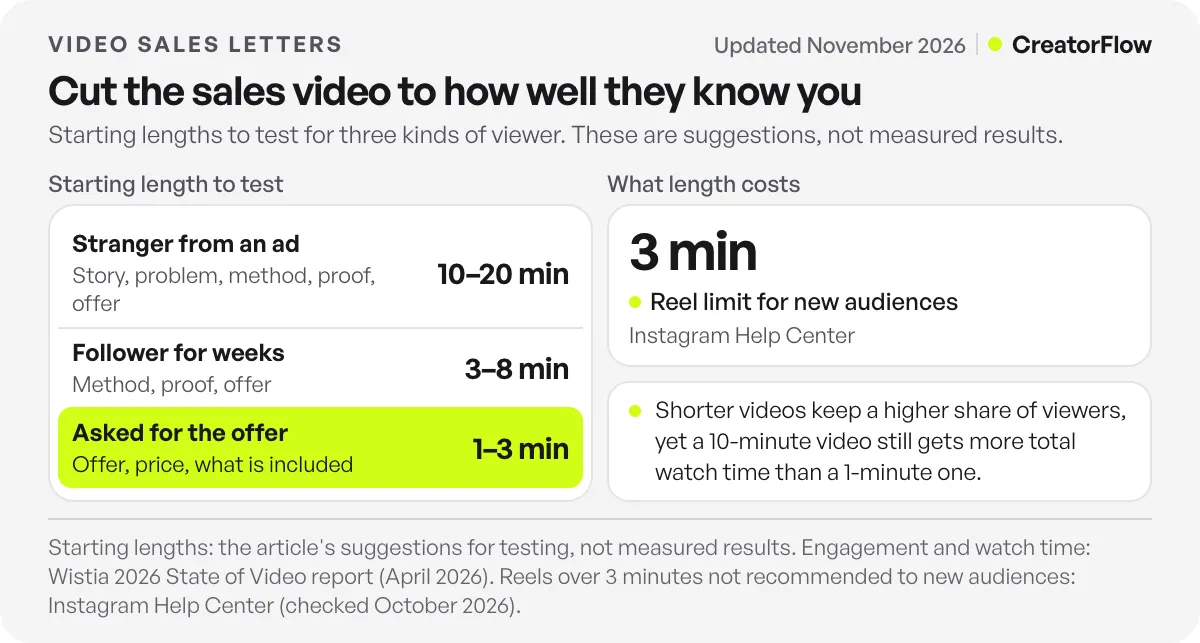
Length costs attention. Wistia’s 2026 State of Video report, built on over 13 million videos, found that the shorter the video, the higher the engagement rate. Wistia defines engagement rate as how much of a video people watch on average. The same report notes that a 10-minute video with a lower engagement rate still gets more total watch time than a 1-minute video.
A longer video loses a larger share of its viewers, and the people who stay give it more time. Every minute spent on background the viewer already knows is a minute in which a warm buyer can leave before the price.
| Who is watching | What they already know | Where the video spends its time | Starting length to test |
|---|---|---|---|
| Stranger from an ad or a search | Nothing about you | Your story, the problem, your method, proof, the offer | 10 to 20 minutes |
| Follower who has watched for weeks | You, your topic, your way of teaching | Your method, proof, the offer | 3 to 8 minutes |
| Person who asked for the offer | That they want it | The offer, the price, what is included, how to start | 1 to 3 minutes |
These lengths are our starting points for testing, not measured results. Your video host’s retention graph will show you the real answer for your audience.
Instagram adds one more reason to keep the follower version short when you post it as a Reel. Instagram’s Help Center says Reels over 3 minutes won’t be recommended to new audiences (checked October 2026). A long sales Reel will mostly reach people who already follow you. That suits a warm video and works against a cold one. Our guide on how long Instagram Reels can be lists every length limit.
How to write a VSL script
A sales video script has five parts in this order: an opening that names the viewer and the result, the problem and what it costs, your method, proof, and the offer with one action. Write it the way you speak. Read every line out loud and cut any line that sounds like a brochure. For a warm viewer, shorten the parts they already know.
1. The opening: name the viewer and the result
In the first 20 seconds, say who the video is for and what they will have after they buy. For example: “If you sell handmade jewellery and your sales drop between holidays, this video shows how to fill those months from Instagram.” A person who does not match should know to stop watching. That keeps your buyers listening.
2. The problem and what it costs
Describe the problem in the viewer’s own words, then say what it costs them in time, money or missed chances. The questions people leave in your comments and DMs are the best source for this part. They are the exact phrases your buyers use.
3. Your method
Explain the approach behind your offer and why it works where other attempts failed. Give the steps a name only if the name helps people remember them. A cold viewer needs this part most. A warm viewer has heard most of it in your content, so give them a short reminder.
4. Proof
Show results you can document: client messages shared with permission, before-and-after numbers, your own results with dates. Put a typical result first and your best result after it. The FTC section below explains why the order and the context matter.
5. The offer and one action
State what is included, the price, any real deadline and the one thing to do next. Use one button and one link. A video that ends by asking people to buy, book a call and join a list gives them three ways to delay.
Video sales letter examples for creators
The four outlines below are illustrative examples we wrote to show how a script changes with the viewer. None of them describes a real business.
Example 1: piano teacher, cold viewer from an ad, about 15 minutes. The opening names adults who quit lessons as children and want to play again. The problem section covers lessons built for kids and practice plans that need an hour a day. The method takes the longest: short daily practice and learning songs before theory. Proof shows two student recordings, one typical and one strong. The offer is an online course with one “Enrol now” button.
Example 2: course creator, followers, about 5 minutes. The viewers have watched months of free lessons. The video skips the creator’s backstory and spends its time on the difference between the free lessons and the full course: the order of the modules, the feedback, the finished project. Proof is student work shared with permission. It ends with the enrolment link and the date the cart closes. For the launch around a video like this, see our guide to automating an Instagram course launch funnel, and the Instagram setups for course creators.
Example 3: digital product seller, people who asked for the offer, about 90 seconds. A viewer commented on a Reel to get the link to a pack of editing templates. They want it already. The video opens on the finished result, shows what is inside the pack in 30 seconds, states the price and points to the checkout button.
Example 4: photographer selling a weekend workshop, warm audience, about 4 minutes. Followers know the photographer’s style. The video shows the workshop location, what students will shoot on each day and the group size. Proof is a past student’s photo from day one next to one from day two. The offer is the workshop page with the dates and the price.
Look at what changes across the four. The longer the viewer has known you, the less time the video spends on you and the problem, and the more it spends on the offer.
How to get people to watch your sales video on Instagram
Put the video one tap away from the moment of interest. On Instagram that moment is usually a comment, a Story reply or a DM. Send the link to the page with the video at that moment, instead of asking people to find it in your bio later. Every extra step between interest and the play button loses people.
The most direct path is a comment keyword. Post a Reel about the problem your offer solves and ask people to comment one word to get the video. Each comment gets a private reply in DMs with the link. Meta’s messaging API documentation allows one private reply within 7 days of the comment, and no more messages until the person replies. In CreatorFlow, a comment with your keyword sends one DM with your text and the page link. Keywords match whole words and ignore capital letters, so “video” matches “Video please” but not “videos”. You can set this up as a comment-to-DM automation.
Match the version of the video to the path. A person who typed your keyword asked for the offer, so the DM should link to the short cut. Say how long it is in the message, for example “Here’s the 4-minute video with everything in the program,” so people know how much time they are agreeing to.
Other paths reach other viewers:
- Link sticker in Stories: your Stories reach the followers who watch you most, so link the warm version here.
- Link in bio: profile visitors include strangers, so a bio link can point to a page with the longer version.
- Email: people who joined your list can get the page link in an email, and any follow-up after that happens by email too. A video nurture sequence can send a few teaching videos first and the sales video last.
Your profile is part of the path as well. Our guide to Instagram profile optimization covers what a stranger sees before they decide to tap.
What can a sales video claim? FTC rules on results
In the US, the FTC’s Endorsement Guides cover testimonials in sales videos. If a client’s result is better than what buyers generally get, you must make clear what the generally expected result is. Keep records that support every result you show, and place typical results next to your best ones.
The FTC’s guidance on the Endorsement Guides says that when an advertiser cannot show an endorser’s experience is representative, the ad “must make clear to the audience what the generally expected results of following that same regimen are.” The FTC revised the Guides in 2023.
This matters most for income and body-change claims. A video that features one client’s revenue tells viewers they can expect something similar. If most buyers earn far less, say what they generally earn, or leave the revenue figure out. Sellers in the UK and the EU have their own consumer-protection rules, so check them before you publish results claims there.
How to tell if your VSL is working
Track four numbers in order: how many people open the page, how many press play, how far they watch, and how many click the offer button and buy. The first number that drops sharply shows you where the problem is. A low play rate points to the delivery. Viewers who leave before the price point to the length or the script.
Start with the retention graph from your video host. If most viewers leave before the offer appears, cut the section where they leave or move the offer earlier. If they reach the offer and do not click, look at the price, what is included or the deadline.
Then look at where viewers came from. On Pro and Growth, CreatorFlow’s link click tracking shows how many people clicked the link in each DM, with clicks by country and city. A Reel that sends many clicks and few sales points to a mismatch between the post and the video. A Reel that sends few clicks and several sales is worth repeating.
FAQ
What does VSL stand for?
VSL stands for video sales letter. It is a recorded video that sells one offer and ends with one action, such as buying, applying or booking a call. The name comes from the written sales letter that the format replaced.
Is a VSL the same as a webinar?
A webinar is usually longer, often live or presented as live, and teaches a topic before it pitches. A video sales letter is recorded, so viewers can watch it at any time, and selling is its only job. Many sellers use both: the webinar for new audiences and a shorter video for people who already know them.
Do I need to show my face in a video sales letter?
No. Jon Benson’s first video sales letter showed only words on a screen. A face helps when your followers already know you, because they recognise you and trust you sooner. Screen recordings and slides work well for software, templates and other visual products.
Can an Instagram Reel be a VSL?
Yes, for warm viewers. Instagram’s Help Center says Reels over 3 minutes won’t be recommended to new audiences, so a long sales Reel will mostly reach your followers. For strangers, put the longer video on a page and use a Reel to send people there.
How many versions of a sales video do I need?
Start with one, aimed at the viewers who send you the most interest today. For most creators that means followers, so start with the medium-length cut. Add a short version for people who ask for the offer, and a long one when you start running ads.
Sources and checks
Checked on November 3, 2026: Jon Benson’s account of the first video sales letter in I Love Marketing episode 44, Wistia’s 2026 State of Video report, Eugene Schwartz’s levels of awareness as summarised by Shortform, the FTC’s Endorsement Guides questions and answers, and Meta’s messaging API documentation for private replies. The Reels recommendation rule comes from Instagram’s Help Center, checked in October 2026. The video lengths suggested in this guide are starting points for testing, not measured results, and the four examples are illustrations, not real businesses.