

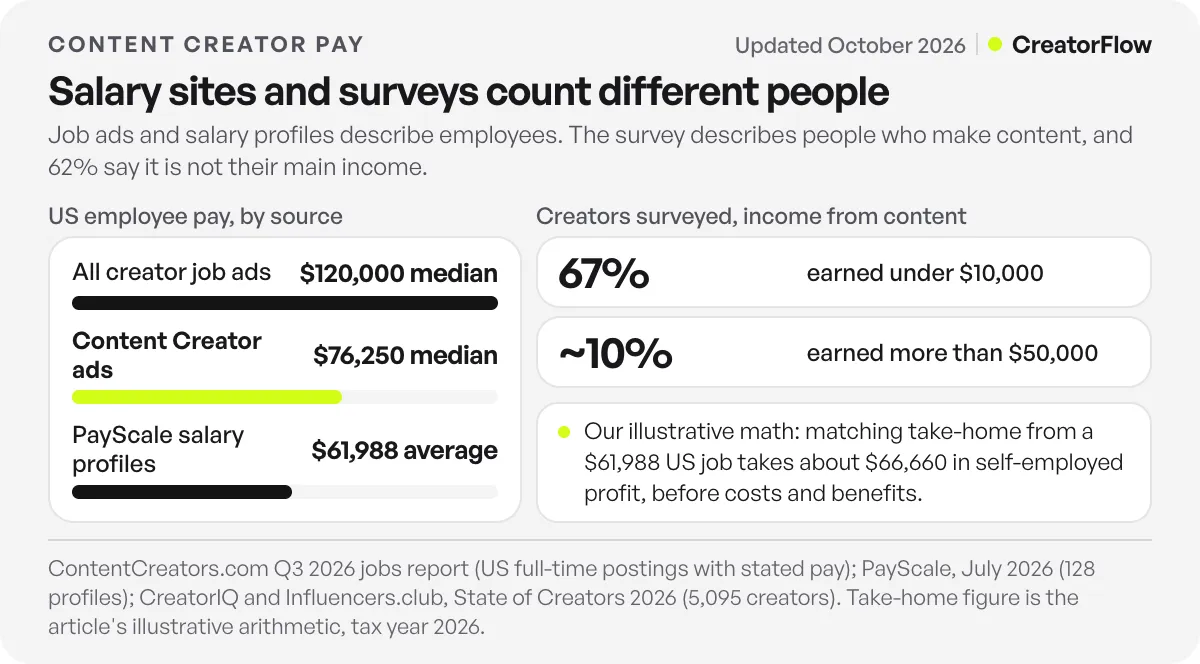
A typical content creator salary in the US is about $62,000 to $76,000 a year for a full-time employee. PayScale reports a $61,988 average, and 2026 job ads show a $76,250 median for the title. Self-employed creators are a different group. In the largest recent survey, 67% earned under $10,000 from content, and 62% said content is not their main income.
Search this question and one site says $116,615, another says $61,988, and a survey says under $10,000. All three can be accurate, because they count different people. Job data counts employees with a title. Surveys count people who make content, often part time and on top of a main income.
This guide puts those numbers side by side, with each source and date. It shows what job ads pay by title and level. Then it works out how much a self-employed creator must earn to match a salary after tax, because a salary and a revenue figure cannot be compared directly.
Key Takeaways
- Employee pay: PayScale’s average for the title is $61,988 from 128 salary profiles. US job ads that stated pay in Q3 2026 show a $76,250 median for the exact title.
- The $120,000 figure: That median covers a broad group of jobs, including growth marketers and creative directors. Only 49.1% of those postings stated pay.
- Self-employed income: In CreatorIQ’s 2026 survey, 67% of creators earned under $10,000 from content, and about 10% earned more than $50,000.
- Matching a salary: To match the take-home from a $61,988 US job, a self-employed creator needs about $66,660 in profit. With $10,000 in costs, that is about $76,660 in revenue (our illustrative math).
- Benefits: US employers spent an average of $10.92 per hour worked on paid leave, insurance and retirement for full-time private workers in June 2026. Self-employed people pay for these themselves.
- Bottom line: Compare take-home pay plus benefits, and never set a salary against a revenue figure.
How much does a content creator make a year?
Two sources put a full-time US employee with this title at about $62,000 to $76,000 a year. Higher numbers exist, and they cover wider groups of jobs. Self-employed creators have no salary, and most people in the largest recent survey earned under $10,000 from content. These groups barely overlap, so compare each number only with its own kind.
| Source and date | Who it counts | What it measures | Number |
|---|---|---|---|
| PayScale, July 2026 | 128 US salary profiles for the title | Base salary | $61,988 average, $41,000 to $86,000 from 10th to 90th percentile |
| ContentCreators.com, Q3 2026 | 54 US full-time postings titled Content Creator, with stated pay | Advertised pay | $76,250 median |
| ContentCreators.com, Q3 2026 | 2,879 US full-time postings across all its creator roles, with stated pay | Advertised pay | $120,000 median |
| ZipRecruiter, October 2026 | Job-site estimate for the title | Average pay | $116,615 average |
| CreatorIQ and Influencers.club, 2026 | 5,095 creators, 5,000+ followers, 63% US | Self-reported income from content | 67% under $10,000 |
| CreatorIQ payment data, 2025 | 14,400 creators paid through its software | Payments through one platform | $3,000 median |
The sources are PayScale’s content creator page, the ContentCreators.com Q3 2026 jobs report, ZipRecruiter’s salary page, State of Creators 2026 and CreatorIQ’s compensation announcement and compensation report. ZipRecruiter blocks automated reads, so its number comes from its search listing in October 2026, and we could not read its method.
Read the “what it measures” column first. Advertised pay is what an employer offered. A salary profile is what a person reported. A survey figure is what a creator said they earned, and CreatorIQ’s public page does not say whether that is before or after costs.
Why do content creator salary numbers disagree so much?
The numbers disagree because each source defines the job differently. A job report can count more than 50 roles as creator work, so growth marketers and brand designers lift the median. A salary profile counts people who chose to report. A survey counts people who make content, and many of them have another main income.
The ContentCreators.com report shows the effect. It covers 5,869 new US postings from 2,017 employers, and 49.1% of them stated pay. Its $120,000 median includes Developer Advocates at $190,000 and Growth Marketers at $152,500. The postings titled Content Creator sit at $76,250, about 36% lower by our arithmetic.
Keep three limits in mind. Roles with no stated pay are left out, freelance and contract roles are excluded, and the postings come from company career pages. Small businesses that hire in other ways may be undercounted. The publisher also runs a job board, so treat this as a company’s own data.
Government data does not settle it. The US Bureau of Labor Statistics media and communication page gives a $74,250 median for that group in May 2025, and its occupation table has no content creator row (checked October 2026). The group includes reporters, technical writers, translators and public relations specialists. A BLS figure quoted as a content creator salary describes those jobs.
What do content creator jobs pay by title and level?
In Q3 2026 US job ads with stated pay, the title Content Creator had a $76,250 median. Junior roles across all creator jobs had a $72,500 median, and senior roles had $137,900. Pay rises as the work moves from making content to running it. Those levels cover the whole group of jobs, so the title alone may sit lower.
| Job title in the ad | Median advertised pay | Postings with stated pay |
|---|---|---|
| Social Media Coordinator | $67,500 | 11 |
| Community Manager | $73,750 | 286 |
| Content Creator | $76,250 | 54 |
| Content Producer | $87,500 | 30 |
| Social Media Manager | $109,750 | 116 |
| Influencer Marketing Manager | $116,650 | 63 |
| Video Editor | $120,000 | 29 |
Across the whole group, medians were $105,000 with no seniority label, $166,025 for lead roles and $180,000 for directors. Remote postings had a $138,663 median against $112,500 for on-site and hybrid. Software companies had a $165,000 median against $63,000 for real estate. Some of these gaps may come from the mix of roles in each group.
PayScale’s career stages sit lower, and they count total pay. It shows an average of $57,659 for 1 to 4 years of experience, from 73 salaries, and $68,356 for 5 to 9 years, from 52 salaries.
A job is one route. A content creator career can also mean freelance work for brands or running your own audience business, and each route pays in a different way.
How much do self-employed content creators make?
Most self-employed creators who answer surveys earn far less from content than a salary, and many do not try to replace one. In CreatorIQ’s 2026 survey, 67% earned under $10,000 and about 10% earned more than $50,000. In MBO Partners’ 2023 survey, 70% of independent creators worked part time.
This comparison has a flaw, so read it with care. A full-time salary set against a survey full of part-timers is unfair to the survey. In State of Creators 2026, 62% said content is not their primary income. The public pages we read print no income figure for full-time creators alone, so their typical income is likely above these numbers, by an amount we cannot state.
The MBO Partners report shows a similar shape from an older US sample. It reports 34% under $5,000, 37% at $5,000 to $30,000 and 9% over $100,000.
We keep the full survey comparison, post rates and top-earner data in how much influencers make. The income streams behind these totals have their own guide.
What does a self-employed content creator take home after tax?
To match the take-home from a $61,988 US job, a self-employed creator needs about $66,660 in profit, about $4,700 more than the salary. The gap comes from payroll tax. Employees pay 7.65%, and self-employed people pay 15.3% on 92.35% of profit. Costs and benefits then push the revenue target higher.
This table is our own illustrative arithmetic, and no real creator or employee is behind it.
| Illustrative only, tax year 2026 | $61,988 job (PayScale average) | $76,250 job (job-ad median) |
|---|---|---|
| Employee payroll tax | $4,742 | $5,833 |
| Employee federal income tax | $5,259 | $7,945 |
| Take-home pay | $51,987 | $62,472 |
| Self-employed profit to match it | $66,660 | $81,990 |
| Revenue needed with $10,000 in costs | $76,660 | $91,990 |
| Paid leave, insurance and retirement at the BLS average | $18,310 | $22,522 |
| Revenue needed to cover those too | $94,970 | $114,512 |
The table assumes a single filer, the $16,100 standard deduction and no other income. It leaves out state tax, credits, retirement contributions and the qualified business income deduction, which could lower the self-employed bill. The $10,000 in costs is our assumption for editing, software and equipment. Figures are rounded to the nearest dollar.
The rates come from the IRS 2026 inflation adjustments, IRS Topic 751 and IRS Topic 554 (checked October 2026). The BLS employer cost table shows full-time private workers in June 2026 at $36.97 per hour in wages, with $4.40 for paid leave, $4.58 for insurance and $1.94 for retirement. That is about 30 cents per wage dollar by our arithmetic. It is an average across all jobs, and you may not buy all of these. The last row treats them as a plain business cost, which is rough, because tax rules differ per benefit.
Now place that target against the survey. Revenue of $76,660 falls in a band that 6% of CreatorIQ’s respondents reported, and about 10% reported more than $50,000. A self-employed creator can reach it, and most survey respondents do not.
A salary also pays for every hour you work. A brand fee pays for the post you can see. The pitching, DM replies, invoices and tax filing come out of that same fee, and creators in CreatorIQ’s survey named a lack of consistent brand deals as their top barrier to growth. The full set-aside example in our creator tax guide covers what to put aside from each payment.
How much do content creators make in the UK and EU?
PayScale’s UK average for the title is £26,788 from only 14 profiles, so use it as a rough guide. We did not find a comparable EU-wide figure for this title. In the UK, matching that take-home as self-employed takes about £26,400 in profit. That is slightly below the salary, because self-employed people pay a lower National Insurance rate.
The arithmetic is illustrative and uses tax year 2026 to 2027 with no other income, outside Scotland. An employee on £26,788 pays about £2,844 in income tax and about £1,137 in National Insurance, and takes home about £22,807. The employee rate is 8% and the self-employed rate is 6%, both above roughly £12,570 (checked October 2026).
Holiday pay changes the picture. GOV.UK says almost all workers are entitled to 5.6 weeks of paid holiday a year. At £26,788 that is worth about £2,885 by our arithmetic. A self-employed creator earns nothing during a holiday unless the money keeps coming from sales already made.
The PayScale UK page was last updated in April 2026. In EU countries, social contributions and tax differ widely, so use the rates from your national tax office.
Should you take a content creator job or work for yourself?
Take a job if you need steady income and benefits now. Work for yourself if you already have paying work and can cover months with little income. You can also do both, and many people do. In CreatorIQ’s survey, 62% said content is not their primary income, so keeping a salary while you test demand is common.
| What changes | Content creator job | Self-employed creator |
|---|---|---|
| A month with no deals | Salary still arrives | Income comes only from other sales |
| Paid leave, insurance, retirement | Employer often pays part in the US | You pay for them, or go without |
| Tax | Employer withholds it from pay | You set money aside and pay it yourself |
| Whose audience grows | Usually the employer’s brand | Your own |
| Upper limit on pay | Pay band for the role | No fixed limit, with a wide spread |
That last row has a cost. In CreatorIQ’s 2025 payment data, the top 10% of creators received 62% of all payments, and the median creator received $3,000.
Here is a test you can run, and it is our opinion, with no study behind it. Take the money you received from content in the last 12 months and subtract your costs. Compare that profit with the profit row in the table above. If it sits below that row, the salary pays better today, and you can keep building on the side.
How can a content creator earn more?
Employees earn more by moving from making content to running it, since job-ad medians rise from $72,500 for junior roles to $137,900 for senior ones. Self-employed creators earn more by closing more deals and selling to people who already asked. In both cases, your own numbers give a better guide than a published average.
If you have a job. Title and sector move pay more than small raises do, at least in the ads. Video Editor ads show a $120,000 median against $76,250 for Content Creator, on 29 and 54 postings. Before you negotiate, find ads for your exact title and sector, and read the stated range.
If you work for yourself. Start with your own numbers. The Instagram money calculator estimates per-post and monthly earnings from your followers, engagement and niche. Check that estimate against the offers you have received. Then work on deal count, with the steps in how to get brand deals on Instagram.
Sell to people who already asked. Affiliate and product income depends on getting a link to the person who wanted it. CreatorFlow sends that link by DM when someone comments a keyword on your post. The Free plan covers comment-to-DM, and Pro at $15/month adds link click tracking, so you can see which posts bring clicks.
FAQ
What is the average salary of a content creator?
PayScale reports a $61,988 average in the US from 128 salary profiles, updated in July 2026. ZipRecruiter’s search listing shows $116,615 for October 2026. The exact title had a $76,250 median in Q3 2026 job ads. The $76,250 figure shows what employers offered, and the $61,988 figure shows what people reported.
How much do content creators make per month?
An employee on $61,988 earns about $5,166 a month before tax and takes home about $4,332, by our illustrative math for a single US filer with no state tax. A self-employed creator in the 67% group from CreatorIQ’s survey earns under about $833 a month from content.
What does an entry-level content creator job pay?
Junior roles across all creator jobs had a $72,500 median in Q3 2026 US job ads, based on 119 postings with stated pay. Those are advertised figures. PayScale shows a lower average of $57,659 in total pay for people with 1 to 4 years of experience, based on 73 salaries.
Do content creators get paid a salary?
Only when an employer hires them. Employees get a salary and often benefits. Self-employed creators get brand fees, affiliate commissions, platform payouts and product sales, and their income moves from month to month.
Do content creators get benefits?
Employees often do, depending on the employer and country. In the US, employers spent an average of $10.92 per hour worked on paid leave, insurance and retirement for full-time private workers in June 2026, according to the BLS. Self-employed creators pay for their own.
Is a content creator a real job?
Yes, employers hire for it. The ContentCreators.com report counted 54 US postings with stated pay under the exact title in one quarter, and 5,869 new postings across its wider group of jobs. The BLS media and communication page has no separate row for the title.
Sources and checks
Checked October 31, 2026: PayScale US and PayScale UK, the ContentCreators.com Q3 2026 report, State of Creators 2026, CreatorIQ’s compensation announcement, the MBO Partners report, the BLS occupation page and employer cost table, the IRS and GOV.UK tax pages. CreatorIQ’s income bands, sample details and 14,400 payment count were read from its charts and report on October 30, 2026. ZipRecruiter’s figure comes from its search listing, because the page blocks automated reads. Survey figures are self-reported, and the salary sites and job report are each company’s own data. The take-home tables are our own illustrative arithmetic. This article is general information and not tax or financial advice.