

A content creator career is paid work making videos, photos or writing for an audience, and it comes in three forms: an employee on a company team, a freelancer paid by brands, or the owner of an audience business. It is a real job in all three forms. They differ in pay, risk and daily work, so choose the form before you choose a niche.
Most career guides treat this as one job. They tell you to pick a niche, post often and grow. That advice fits one form out of three, and it skips the work that fills a self-employed creator’s week: selling, answering the same questions, sending invoices and saving for tax.
This guide compares the three forms side by side, with what official bodies say about the job and what each form pays according to named sources. You also get a way to choose, a first step for each path and a test for going full-time. Nothing here promises an income.
Key Takeaways
- Three careers: Employed in-house, freelance for brands and owner of an audience business are different jobs with different pay and risk.
- A real job: The UK lists content creator as an approved occupation, and the US Small Business Administration named an industry code for creator businesses in October 2026.
- Pay data: Payscale shows a $61,988 average base salary for US staff with the title. In CreatorIQ’s 2026 survey, 67% of creators earned under $10,000 a year.
- Work beyond filming: Freelancers and owners also handle sales, contracts, invoices, tax and support. An employer carries most of that for staff.
- Going full-time: No follower count guarantees a living. 62% of surveyed creators say content is not their main income.
- Bottom line: If you need steady pay now, apply for staff roles. If you make good videos but have no audience, freelance. If people already ask what you use, build an audience business.
What is a content creator career?
A content creator career means earning money from content in one of three ways. An employee makes content for one company and receives a salary. A freelancer makes content for several brands and sends invoices. An owner builds an audience and earns from deals, adverts and products. The title stays the same, and the weekly work changes.
| Employed in-house | Freelance for brands | Owner of an audience business | |
|---|---|---|---|
| Who pays you | One employer | Several brands, job by job | Brands, platforms and your own buyers |
| How money arrives | Fixed salary | A fee per job, after an invoice | Uneven amounts from deals, adverts and sales |
| What gets you hired | Samples that follow a brief | Samples and a clear price | Your audience and what it buys |
| Main risk | One employer can end the job | Gaps between clients | Reach or deal count can fall in any month |
| Work beyond creating | Meetings, reports, approvals | Sales, contracts, invoices, tax | All freelance work, plus audience support and products |
| Who decides the content | The company, through a brief | The client, within your style | You |
An influencer sits inside the third column. French law describes influencers as people who are paid to use their reputation with an audience to promote something. So an influencer is paid for reach, while a staff creator or a freelancer is mostly paid for the content.

Real careers also mix these forms. In a 2025 book chapter based on interviews with micro-influencers, researcher L. Bainotti describes composite careers that blend traditional employment with freelance work or a business of your own.
Is being an influencer a real job?
Yes. Official bodies in the UK, the US, France and Italy each treat content creation or influencing as paid work, through an occupation listing, a business code or a law. None of this makes the income steady, and steady income is usually what the question means. So ask which form of the job can pay your bills.
In the UK. Skills England lists content creator as an approved occupation at Level 3, with typical titles such as Content Producer and Social Media Executive. It also names “social media influencers” as a sub-group in the UK’s 2020 occupation codes (checked October 2026). There is still no official headcount. The Office for National Statistics said in a 2022 response that influencers “do not fit easily into one category” in the older 2010 codes, and that it held no count.
In the US. On October 15, 2026, the Small Business Administration said creator-led businesses are classified under NAICS 5121, Motion Picture and Video Industries, for its programs. This brings clarity and no new money. The same release says creator businesses “have long been eligible” when they meet program requirements. The IRS also lists “content creator/social media influencer” as a source of income on a page written for student athletes.
In the EU. France defined influencers in Law No. 2023-451, which also sets rules for their agents. Italy added a specific business code for influencer marketing, 73.11.03, from 2025.
One gap remains. The US Bureau of Labor Statistics page for media and communication jobs lists writers, film and video editors, photographers and public relations specialists, and names no content creator or influencer occupation (checked October 2026). Guides that quote its $74,250 median wage are quoting that whole group, so the figure says little about creators.
How much does a content creator career pay?
Pay depends on which of the three careers you mean. Payscale shows a $61,988 average base salary for US staff with the title. Collabstr shows an average of $154 paid per UGC piece. CreatorIQ’s 2026 survey found 67% of creators earned under $10,000 a year. These numbers measure different people, so never compare them directly.
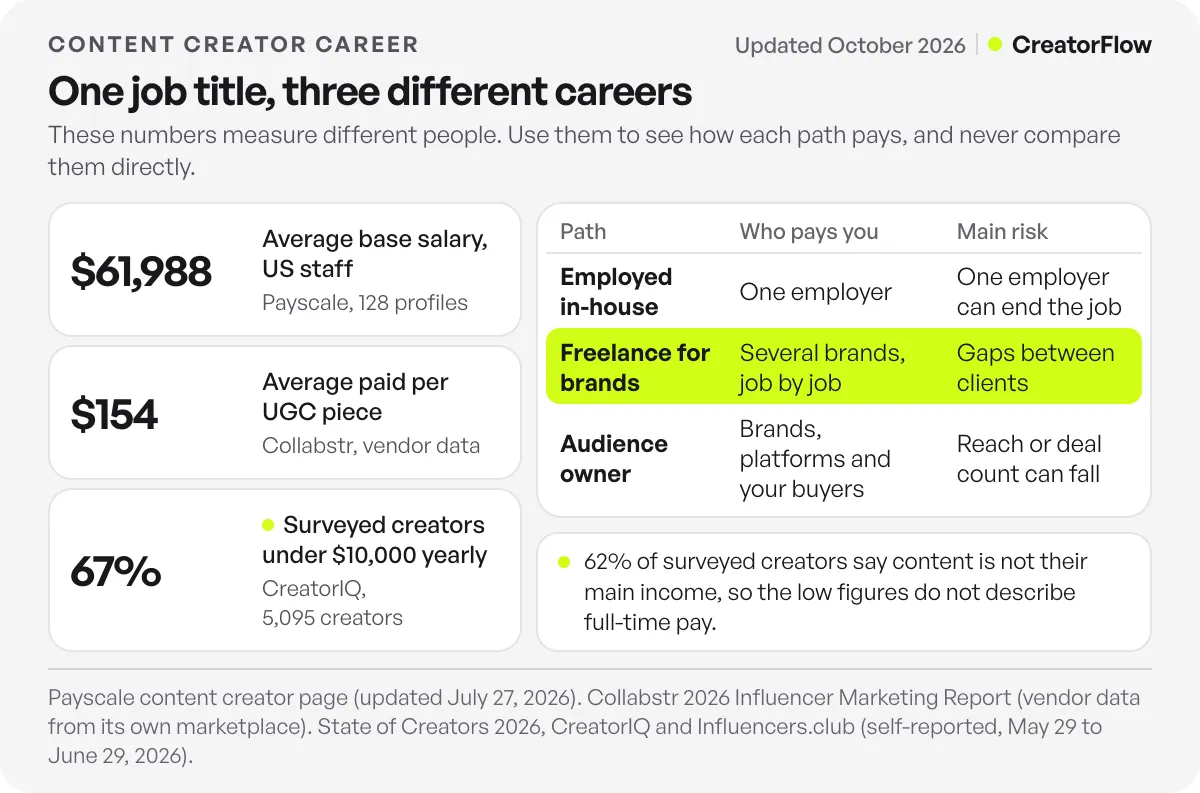
Employed. Payscale’s content creator page shows base pay from $41,000 at the 10th percentile to $86,000 at the 90th. It rests on 128 salary profiles, so treat it as a rough guide (checked October 2026). We compare job boards and surveys in our guide to content creator salary numbers.
Freelance. Collabstr’s 2026 report shows UGC creators asking $180 on average and being paid $154. This is vendor data from its own marketplace. To gross $61,988 at $154 a piece, you need about 403 pieces a year, or almost 8 a week. That is our illustrative math, before costs and tax. Higher fees change it, and so does charging brands for usage rights.
Owner. The closest data is the State of Creators 2026 survey from CreatorIQ and Influencers.club, with 5,095 creators across 100 countries. 67% earned under $10,000 from content, and under 5% cleared $100,000. In the same survey, 62% said content is not their main income, so the low figures do not describe full-time pay. Our breakdown of what influencers earn by source covers the full brackets. For a rough figure on your own account, try the Instagram money calculator.
The same income also leaves you with different amounts. In the US, an employee pays 7.65% in Social Security and Medicare tax, and the employer pays the other 7.65%. A self-employed person pays 15.3% on 92.35% of net earnings. On $60,000, that is about $4,590 for the employee and about $8,478 for the self-employed person, before income tax. This is our illustrative math. Half of the self-employment tax can be deducted when you work out income tax, so the real gap is a little smaller.
What does a content creator do besides making content?
Staff creators mostly make content, attend meetings and report results. Freelancers and owners run a small company as well. They find customers, set prices, sign contracts, send invoices, save for tax and answer messages. This is the part most career guides leave out, and it decides whether you will enjoy the job.
| Work | Employed | Freelance | Owner |
|---|---|---|---|
| Finding paid work | Once, when you apply | Every month | Every month, plus growing the audience |
| Prices and contracts | The employer | You, including usage rights | You, for deals and products |
| Invoices | Payroll pays you | You send and chase them | You send and chase them |
| Tax during the year | Mostly taken from pay | You save it yourself | You save it yourself |
| Questions from people | Often a company team | Client revisions | Your comments and DMs |
| Sick days | Employer rules and sick pay | No work, no fee | Income depends on what keeps selling |
Sales. Freelancers and owners sell every month. In CreatorIQ’s survey, creators named a lack of consistent brand deals as their top barrier to growth. Goldman Sachs Research said in 2023 that brand deals were about 70% of creator revenue, according to survey data. A creator with that mix has an income that depends on regular selling.
Audience support. A post that works brings the same messages again and again: “what’s the link?” and “how much?”. Each one is a person ready to act, and each one takes your time. This is the first job we would hand to software. With comment-to-DM on CreatorFlow, a person comments a keyword you choose and receives your link in a DM, and you spend the time on content.
Invoices. The person who briefed you is rarely the person who pays you. Learn to invoice a brand and chase late payment before your first deal.
Tax. A brand usually pays your full fee with nothing taken out, so you set money aside yourself. Read how creators pay tax in the US and UK before the first payment arrives.
Disclosure. This one applies to every form. The FTC’s guide for influencers says to disclose “any financial, employment, personal, or family relationship with a brand”. That includes a staff creator talking about their own employer’s product. In the UK, the ASA has a separate influencer guide, developed with the CMA, on making clear that ads are ads.
Sick days. GOV.UK says that to qualify for Statutory Sick Pay you must be classed as an employee (checked October 2026). A freelancer has to plan for those weeks in advance.
Which content creator career should you choose?
Choose by how long you can go without steady income and by whether you want to sell. If you need regular pay now, apply for staff roles. If you make good videos but have no audience, freelance. If people already ask what you use or how you did something, build an audience business. You can change path later.
Three questions make the choice clearer.
How many months of costs can you cover with no income? If the answer is few, an employed role is the sensible start. Much creator advice skips this path. It is the only one of the three with a fixed salary.
Do you accept selling as part of the job? Freelancers and owners sell every month, and a person who hates pitching will struggle in both forms. An employed role has its own cost. Skills England says “a content creator works to a brief”, and an audience built on a company account stays with the company.
Does an audience already exist? Freelance work can start without one, because the brand pays for the video and often runs it on its own account. An owner has the highest ceiling and the lowest floor. Under 5% of CreatorIQ’s respondents cleared $100,000, above Payscale’s $86,000 for staff at the 90th percentile. These are different samples, and the same survey has 67% under $10,000.
You can also move across the table over time. Learn the craft in a staff role, take side jobs, then build your own audience once you can pay for the slow months. Read your employment contract for rules on outside work first.
How do you start a content creator career?
Make samples before you chase followers. For a staff role, build three pieces that follow a brief and apply to junior titles. For freelance work, make samples and send a price that names usage rights. For an audience business, post for one audience on one platform and watch who asks for more.
Starting in an employed role
Search for more than the words “content creator”. Skills England’s typical titles include Content Assistant, Junior Content Producer, Multimedia Executive, Social Media Assistant and Social Media Executive. Its duties list asks for content made within a brief and budget, and a review of results against the plan. So add a short note to each sample with the goal and the outcome.
Starting as a freelancer
Make three short samples with products you already own, then pitch brands or join a marketplace. Keep your first quote in writing and name where the brand may use the video and for how long. You can begin while you keep another job.
Starting as an audience owner
Pick one person you can help and one platform. Note what people ask in comments and DMs, because those questions show what they might pay for. When your first brand shows interest, send them a kit from the free media kit generator. Then add a product of your own, so your income does not rest on deals alone.
When can you go full-time as a content creator?
Go full-time when your income has already replaced your salary for several months, and no follower count can tell you that. In CreatorIQ’s 2026 survey, 62% of creators said content is not their main income. Over half of creators with 100,001 to 500,000 followers said it is, which gives a rough marker and no guarantee.
Here is the test we suggest. It is our own rule of thumb, with no study behind it. You pass when all three of these are true:
- For six months in a row, creator income has covered your living costs plus money saved for tax.
- That income comes from at least three payers or products, so one lost client does not end it.
- You hold savings for six months of living costs.
If you fail the test, you still have a career. Many surveyed creators earn elsewhere too, and Bainotti’s research describes careers built that way. A salary pays for slow months and lets you refuse poor deals.
FAQ
Is content creation a real job?
Yes. Skills England lists content creator as an approved occupation, with titles such as Content Producer and Social Media Executive. The US Small Business Administration named an industry code for creator businesses in October 2026.
Is content creator a good career?
It is a good career if the form fits your situation. Employed roles offer a salary and less admin. Freelance work offers variety with uneven income. Owning an audience has the highest ceiling, but 67% of creators in CreatorIQ’s 2026 survey earned under $10,000 a year.
Do you need a degree to be a content creator?
Employers set their own rules. Skills England places the occupation at Level 3, and GOV.UK’s list of qualification levels puts A levels at Level 3 and bachelor’s degrees at Level 6. Clients and audiences judge your samples.
Do you need followers to start a content creator career?
Only for the owner path. Staff roles look at your samples and how you follow a brief. Freelance UGC work pays for the video and the right to use it, so your own audience is often outside the deal.
How long does it take to make a living as a content creator?
We found no public dataset that tracks this, so distrust any exact timeline. A staff role pays from the first month. Freelance income depends on how fast you win repeat clients. An audience business usually takes the longest, because the audience has to exist before it can pay.
Are content creators self-employed?
Staff creators are employees. Freelancers and most audience owners are self-employed, or run their own company. In the US, you pay self-employment tax once net earnings reach $400. In the UK, HMRC’s guide for content creators says to tell it if you made over £1,000 on top of your main income (checked October 2026).
Sources and checks
Checked on October 31, 2026: the sources linked above, including Skills England, Payscale (updated July 27, 2026) and State of Creators 2026 (self-reported, May 29 to June 29, 2026). Collabstr’s figures were confirmed through its own blog and trade coverage of the report. This is general information, not tax, legal or career advice.