

To become a UGC creator, make three short sample videos with products you own, set a starting rate, and send brands a quote that says how long they may use each video and whether they may run it as an ad. You do not need followers. Brands buy the video and the right to use it, so that one line changes your price the most.
Most guides stop at “build a portfolio and pitch brands”. Then the first reply arrives, you quote $150, and the brand runs your video as a paid ad for a year. Your quote said nothing about ads, so you have nothing in writing to charge for. Insense’s pricing guide says paid use and longer terms can add 30% to 150% or more on top of the creation fee.
This guide covers the three videos to make first, what UGC creators charge according to each named source, the rights line to put in a quote, where to find your first paid job, and the disclosure rules in the US and UK. Every rate comes from a vendor or a trade publisher, and each one is labelled.
Key Takeaways
- No follower minimum: Influencer Marketing Hub and Insense both tie UGC pricing to deliverables or production effort, and neither states a follower minimum
- Start with three videos: a problem-and-fix demo, a first-use video and a talking review, each with a product you have used yourself
- Typical rate: Collabstr’s 2026 report shows $180 asked per UGC piece, and brands paid an average of $154. Every published figure is vendor data
- Rights are a separate charge: Insense says paid use often adds 30% to 100% of the base fee, and Influee says usage rights add 30% to 50%
- Honesty rules apply: the FTC says you cannot describe your experience with a product you have not tried, and the UK ASA counts free products as payment
- Bottom line: three samples and one clear rights line are enough to start. Add the rights line before you send your first price
What Does a UGC Creator Do?
A UGC creator makes short videos or photos that a brand posts on its own accounts or runs as ads. The brand pays for the content and for the right to use it. An influencer is paid mainly for access to an audience, so the video appears on the influencer’s own account and the price follows reach.
| UGC creator | Influencer | |
|---|---|---|
| What the brand buys | The video and the right to use it | Access to an audience |
| Where it runs | Brand accounts and paid ads | The creator’s own account |
| What sets the price | Deliverables, effort and usage rights | Reach and audience size |
Insense’s UGC rate guide says UGC is “priced on production effort, not follower count”. Influencer Marketing Hub’s guide to UGC creators says pricing is usually based on deliverables and usage rights.

Do You Need Followers to Become a UGC Creator?
No. None of the sources in this guide state a follower minimum, because the video usually runs on the brand’s account and your audience is outside the deal. Followers matter when a brand also asks you to post on your own profile. That is an influencer job added to a UGC job, so price it separately.
A following can still move your price on some marketplaces. Collabstr’s UGC price calculator uses follower range as one of its inputs. A small account also gives brands a place to see your videos and message you.
How to Become a UGC Creator With No Experience: Make Three Spec Videos
A spec video is a sample you make with no client and no payment. Make three, each 15 to 30 seconds and vertical, with products you have bought and used. Three is our recommendation, and no platform sets a number. Three formats show a brand you can open an ad, show a product working and talk to camera.
Video 1: the problem and the fix. Open on the result, then show the problem, then show the product working. Film two or three different opening lines for the same video, so a brand sees you understand how ads get tested.
Video 2: first use. Film yourself opening or trying the product and react in your own words. A phone and light from a window are enough. Keep the sound clear and the product in frame.
Video 3: the talking review. Look at the camera and say what you use the product for, what surprised you and who should skip it. Only film this with something you have used for real.
Call these samples when you send them, and never imply that a brand hired you. Before you film, read what a brand puts in a UGC brief, because format specs, revision limits and rights are the terms you will be asked to accept. Then arrange the videos with our guide to building a UGC portfolio.
How Much Do UGC Creators Charge?
Published averages sit around $150 to $250 per video, and most of them are vendor numbers. We found no independent survey or government figure for UGC rates. Treat these as prices from companies that sell UGC or creator services, and use them to set a starting point.
| Source | What it measures | Figure | Type of data |
|---|---|---|---|
| Collabstr 2026 report | UGC asking price, then what brands paid, in 2025 | $180 asked, $154 paid | Vendor marketplace data |
| Collabstr 2025 report | The same two figures, one year earlier | $198 asked, $178 paid | Vendor marketplace data |
| Collabstr price calculator | Average UGC price, 2026 | $200 in its search listing, $190 in a May 2026 archived copy | Vendor marketplace data |
| Insense pricing guide | Common baseline, short-form video | $100 to $250 | Vendor benchmark, no sample size |
| Influee rate guide | Average single UGC video | $150 to $212, median about $175 | Vendor figure, no data source named |
| Influencer Marketing Hub | What many creators charge on average | $150 to $250 | Trade publisher citing another vendor |
The range widens with experience. Insense’s rate guide (September 2026) puts beginners at $50 to $400, mid-level creators at $150 to $1,000 and premium creators at $500 to $3,000 or more, based on what it calls publicly available pricing data. For UK readers, Influee’s how-to guide says beginners often charge £50 to £150 per video, with no source named.
Collabstr’s data carries a warning. In its 2026 report, brands paid about 14% less than the average asking price, and both figures sit below the year before. Its 2025 report says UGC asking prices fell about 44% in the previous year, the steepest drop of the platforms it compared, and it points to a growing supply of creators. A base fee alone is under pressure, which is the reason to sell rights separately.
Our suggestion for a first quote is $150 to $200 per video, because that sits inside most of the ranges above. Raise it once you have paid work to show.
How Do Usage Rights Change Your UGC Rate?
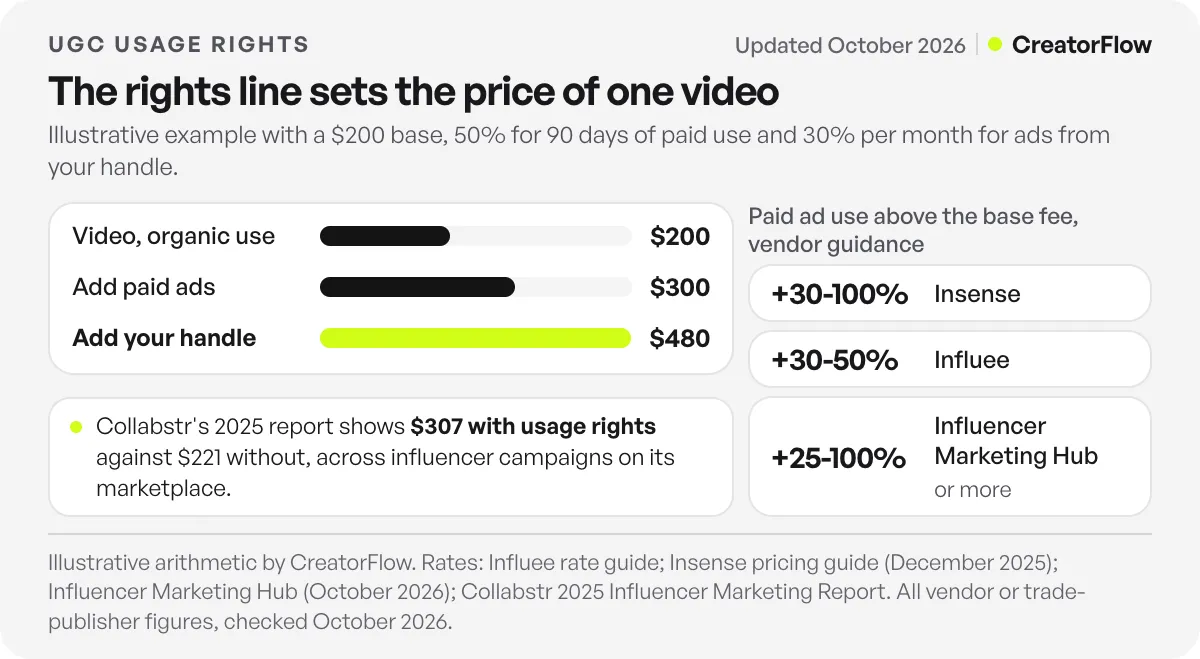
Usage rights say where a brand may run your video and for how long. Publishing on its organic accounts is the small ask. Running the video as a paid ad, keeping it for a long term or running ads from your handle each cost more. The sources below put paid use at about 25% to 100% above the base fee.
| Source | Paid ad use | Long term or buyout | Ads from your handle |
|---|---|---|---|
| Insense | +30% to 100% of base, by term | +100% to 150% for a buyout | Monthly fee, no number given |
| Influee | +30% to 50% of base | Not stated | 30% of base per month |
| Influencer Marketing Hub | +25% to 100% or more | Not stated | Not stated |
These percentages are vendor guidance and they disagree, so use them to open a conversation. The one figure from a marketplace’s own price data is Collabstr’s. Its 2025 report shows an average price of $307 with usage rights against $221 without, a 39% difference. That covers influencer campaigns on its marketplace, so it is broader than UGC alone.
Here is what the rights line does to one video. This example is illustrative, with a $200 base, 50% for 90 days of paid use, and Influee’s 30% per month for ads from your handle.
- Video only, organic use: $200
- Add 90 days of paid ad use: $300
- Add 3 months of ads from your handle: $480
Ownership matters too. In the US, the Copyright Office’s Circular 30 says a commissioned work counts as a work made for hire only if it falls in one of nine categories, and both sides sign a written agreement saying so. Audiovisual works are one of those categories. In the UK, the Copyright, Designs and Patents Act makes the author the first owner, with an exception for employees. Watch for the words “work made for hire” and “assign” in any contract, since they move ownership to the brand. Ask a lawyer about a large contract.
What Should a UGC Quote Say About Usage Rights?
A quote should name the deliverable, the channels, the term and the price of anything extra. Keep it to a few lines so a brand manager can approve it quickly. Send it before filming and ask the brand to confirm it in writing. A price with no rights line leaves the question open until the video exists.
Copy this and change the numbers:
1 video, up to 30 seconds, vertical. 1 round of edits. Price: $200. This covers use on your organic social accounts for 90 days. Paid ad use is an extra $100 for each 90 days. Running ads from my account is an extra $60 per month. Payment: 50% before filming, 50% on delivery.
Then match the platform permission to what you sold. TikTok’s Spark Ads guide offers an authorization of 7, 30, 60 or 365 days, so the permission can end when your term ends.
Instagram works differently. Search summaries of its partnership ad code page say that turning the code toggle off stops new ads, and that active ads using the code keep running. To end a live ad, you revoke the permission, according to summaries of its page on stopping an advertiser’s partnership ads. Check both steps in your own app, because menus change. Put the end date in your calendar on the day you share the code.
Where Do UGC Creators Find Their First Paid Job?
First jobs usually come from a marketplace or a direct pitch. A marketplace brings briefs to you, and the rights are often set in its terms. A direct pitch takes more messages, and you set your own price and rights line. Try both at the same time until one of them starts to produce repeat work.
Read a marketplace’s terms before you price a job there. Billo’s terms of service say the creator assigns all rights to the brand once the brand pays and accepts the work. Insense’s rate guide says standard usage rights are included by default with UGC received through its platform. Price those jobs as a full sale, since you may not be able to charge later for ad use.
For a direct pitch, choose 10 brands whose products you already use. Find the person who runs social media or paid ads, then send three lines: the product you use, one idea for a video, and a link to your best sample. A one-page summary of your rates also helps. Our guide on how to make a media kit covers the layout, and the free media kit generator builds one you can download as a PDF.
Your Instagram profile can do some of this work. Write in your bio that brands can DM you the word “UGC” for your portfolio. CreatorFlow can then send your portfolio link automatically whenever someone sends that keyword, and keyword DMs are on the Free plan. Our guide to DM automation for UGC creators has the message templates.
When you post on your own account, tag the brand. Tags and mentions carry your account name to the brand, and hashtag search does not, as our guide to UGC tracking explains.
Do UGC Creators Have to Disclose Paid Content?
If you post paid or gifted content on your own account, yes, in both the US and the UK. For a video that runs only on a brand’s account or in its ads, the FTC and ASA guides below set no separate rule for you. Agree in writing who adds the label. You must still tell the truth in the video.
In the US. The FTC’s Disclosures 101 for influencers says to disclose any financial relationship with a brand, and it counts free or discounted products as one. It accepts plain words such as “ad” or “sponsored”, and it says not to use “sp”, “spon” or “collab”.
The honesty rules reach further. The FTC’s Endorsement Guides FAQ says “You can’t talk about your experience with a product if you haven’t tried it”. 16 CFR 255.2(c) says ads presenting people as actual consumers should use actual consumers or clearly disclose that they are not. The FTC’s reviews and testimonials rule, in effect since October 21, 2024, says influencers in the business of posting testimonials could be liable if they lie about having used a product.
In the UK. The ASA’s guide for influencers says any payment or incentive, including free products, means related content must make clear it is advertising, with a prominent “Ad” label upfront. It says you, the brand and any agents are all responsible for the label. Being paid is fine as long as the content “reflects your genuine experience”. A search summary of the ASA’s testimonials advice says advertisers need evidence that a testimonial is genuine, so expect a brand to ask you to confirm you used the product.
In practice, never read a script line about results you did not get. This section is general information, so ask a lawyer about a specific campaign.
Is Becoming a UGC Creator Worth It?
It is a real way to earn without an audience, and it is usually part-time income at first. The deals are small on the marketplace data we found. Your income depends on how many jobs you win each month and whether you sell rights on top of the video.
Collabstr’s 2026 report shows brands paying an average of $154 for UGC in 2025, down from $178 in its 2025 report, and it says 80% of campaigns on its platform cost under $300. As an illustration, four videos a month at $200 is $800 before tax and fees. If two of those also sell 90 days of paid use at $100 each, the month reaches $1,000.
The case against is simple. Prices have fallen and the supply of creators is growing. A creator who separates the video from the rights has a second number to sell.
FAQ
How many videos do I need to start as a UGC creator?
Three is enough to start pitching. No platform or regulator sets a number, and three is our recommendation because it shows three skills: opening an ad, showing a product working and talking to camera. Add paid work as you get it and remove your weakest sample each time.
Can I become a UGC creator with no followers?
Yes. Influencer Marketing Hub says UGC creators do not need large followings, and Insense says UGC is priced on production effort. The video usually runs on the brand’s account, so your audience is outside the deal.
How much should a beginner UGC creator charge?
Our suggestion is $150 to $200 per video plus a separate price for paid ad use. Published figures for beginners vary. Influee says beginners may start around $100, and Insense’s rate guide gives $50 to $400. These are vendor figures.
What are usage rights in UGC?
Usage rights say where a brand may use your video and for how long, such as organic posts for 90 days or paid ads for a year. Insense says paid use often adds 30% to 100% of the base fee depending on term, and that a buyout costs 100% to 150% more than the base fee.
What is whitelisting for UGC creators?
Whitelisting means a brand runs ads from your account, so your handle appears on the ad. On Instagram this runs through partnership ads, and on TikTok through Spark Ads. Influee lists it at 30% of the base rate per month. Insense says many creators charge a monthly fee and gives no number.
Do I need a contract to work as a UGC creator?
Have something in writing before you film. A signed contract is safest for larger jobs. For a small job, an accepted written quote that names the video, the channels, the term and the price is the minimum we would accept. Read any contract for the words “assign” and “work made for hire”.
Sources and checks
Checked October 30, 2026: rates and rights guidance from Insense, Influee, Influencer Marketing Hub and Collabstr, whose 2026 and 2025 reports were read from October 2026 archived copies, because the site blocks direct reads. All rate figures are vendor or trade-publisher numbers. Instagram’s help pages and the ASA’s testimonials advice were read through search summaries, as labelled above. Rules come from the FTC, the ASA, the US Copyright Office and UK legislation. This is general information, not legal advice.