
Here is how to make a media kit that brands reply to. Build a one- or two-page PDF or link page with eight parts: a short bio, your audience, your Instagram numbers from the last 30 or 90 days, three to five content examples, past brand work, a results page, your rates, and your contact details. Date every number, and lead with fit and proof rather than follower count.
A brand manager opens your kit and sees 48,000 followers, a 6% engagement rate with no formula, and a screenshot from last spring. They see kits like that every week. If you are in Instagram’s creator marketplace, they can already see your reach, followers and audience breakdown there, so a kit that only repeats those numbers adds little. The kits that get replies show what a brand cannot see anywhere else: that your audience clicks, signs up and uses your codes.
This guide covers the eight sections, which Insights numbers to use now that Views replaced impressions, a results page built from link clicks and sign-ups, a template you can copy, and the mistakes that make brands pass. It is written for Instagram creators pitching their first brand or their fiftieth. Once the kit is ready, pitching brands for Instagram deals covers the email that goes with it.
Key Takeaways
- Eight sections, two pages: bio, audience, Instagram numbers, content examples, past partners, results, rates and contact. Most brands skim, so keep it short.
- Use the 2026 metric names: Instagram made Views its main metric in August 2024 and retired impressions from its API in April 2025. A kit that shows impressions shows old data.
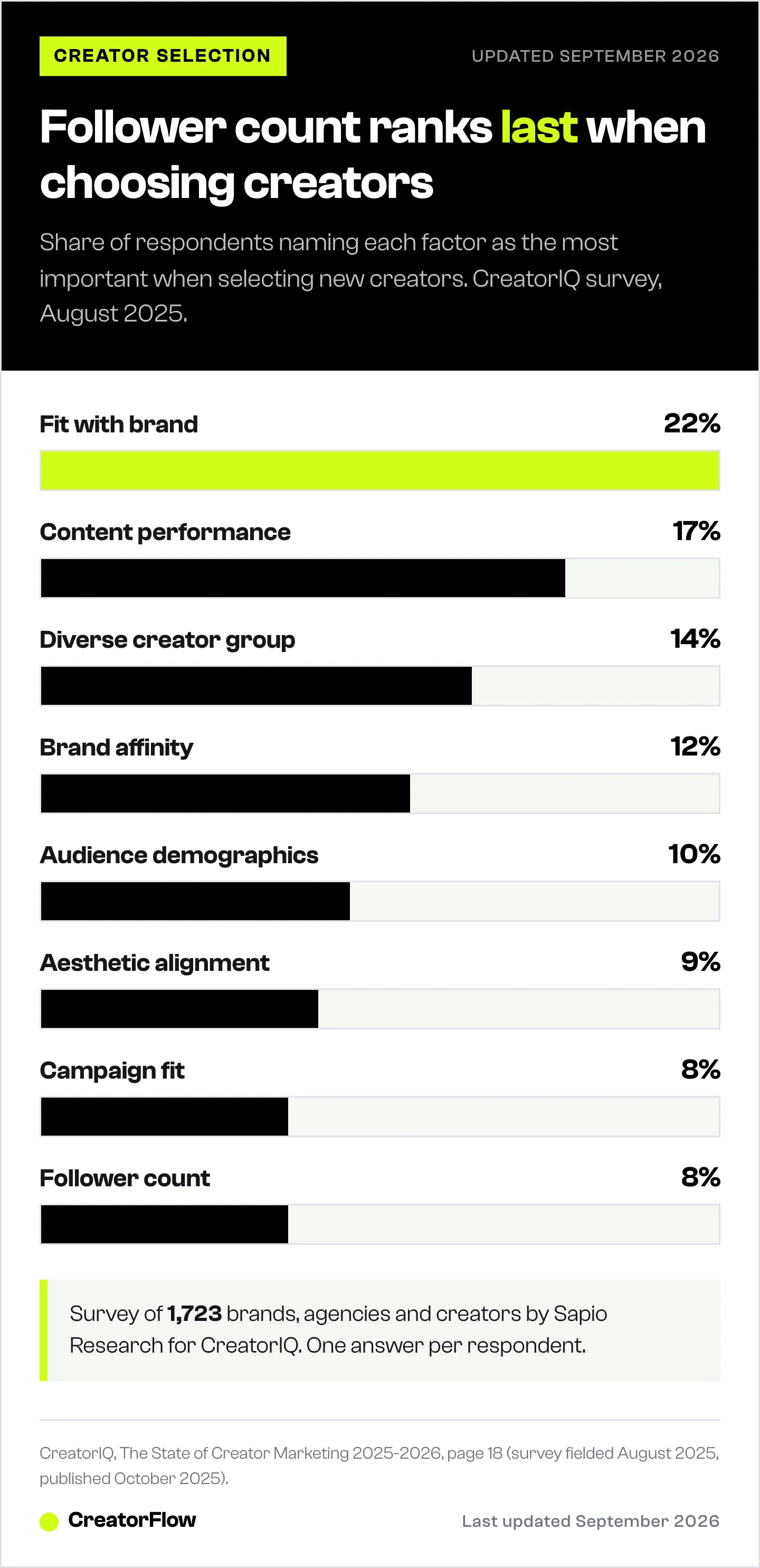
- Follower count ranks last: in CreatorIQ’s 2025-2026 survey, 8% of respondents named follower count as the top factor when picking creators, against 22% for fit with the brand.
- Add a results page: link clicks, click-through rate, the countries clicks come from, email sign-ups and code uses prove your audience acts. Instagram’s insights do not show clicks on links you send in DMs.
- Match Meta’s numbers: brands in the creator marketplace and on paid partnership posts see your real insights, so date every figure and never round up.
- Bottom line: fit gets you shortlisted and proof gets you paid. Update the kit monthly and send it the day a brand asks.
How to Make a Media Kit: The 8 Sections
A media kit is a short sales document about your audience. A brand uses it to decide two things fast: whether your followers match its customers, and whether your content moves people to act. Build it in the order a brand reads it. Start with who you are, then who follows you, how your content performs, proof that it works, and what you offer.
| Section | What to include | Where to get it |
|---|---|---|
| 1. Bio | Name, handle, niche, one-line promise, photo | You |
| 2. Audience | Top countries and cities, age range, gender split | Instagram Insights (needs 100+ accounts) |
| 3. Instagram numbers | Followers, Views, Viewers, average Reel views, engagement rate with its formula | Professional dashboard, last 30 or 90 days |
| 4. Content examples | 3 to 5 posts or Reels in the brand’s category | Your grid |
| 5. Past partners | Brand names, what you made, one result each | Your records and brand reports |
| 6. Results | Link clicks, click-through rate, countries of clicks, email sign-ups, code uses | Your link or DM analytics, brand reports |
| 7. Rates or packages | 2 or 3 packages, or “rates on request” | Your pricing |
| 8. Contact | Business email, a DM keyword, reply time | You |
Bio. Two sentences. Say who you help and what you post, in words a brand would use about its own customer. “I show busy parents 15-minute dinners” beats “foodie and lifestyle lover”.
Content examples. Pick posts for the brand in front of you. A skincare brand wants your skincare Reels, not your best travel post. Change this section for each pitch and leave the rest alone.
Rates. Listing two or three packages filters out brands that cannot afford you and saves a round of emails. If your prices change by deal, write “rates on request” and keep a separate rate card. For benchmarks by market, see our breakdown of brand deal rates by country.
What Brands Look for in a Media Kit in 2026
Brands look for fit first and proof second. In CreatorIQ’s State of Creator Marketing 2025-2026 survey of 1,723 brands, agencies and creators (August 2025), 22% named a creator’s fit with the brand as the most important factor when picking creators. Content performance came second at 17%. Follower count came last, at 8%.
Other research points the same way. IAB’s 2025 creator economy report says 58% of brands rank creator reputation and 56% rank audience alignment among their top selection criteria, and 40% of buyers rank overall ROI as their top KPI for creator campaigns (iab.com, November 2025).
There is a counterweight. Sprout Social’s 2026 Influencer Marketing Report found that half of companies still use creators mainly for brand awareness, and only 24% design campaigns around revenue (sproutsocial.com, August 2026). So reach still matters. Keep Views and Viewers on page one, and treat the results page as the part that breaks a tie between you and a creator with the same numbers.
Which Instagram Insights Numbers to Put in Your Media Kit
Use the numbers Instagram shows today: Views, Viewers, Interactions and followers, plus the countries, cities, age range and gender of your audience. Pull them from your professional dashboard for the last 30 or 90 days, write the date range next to them, and say how you calculated engagement rate. Instagram lets you pick any period within the past 90 days, so a monthly refresh keeps the kit current.
Views is the number of times your content was played or displayed, including in ads. Instagram made it the main metric across Reels, posts and Stories on August 7, 2024, and removed impressions from its API from April 21, 2025 (developers.facebook.com, September 2026). If a template or tool still asks for impressions, it runs on old data.
Viewers is the number of unique accounts that saw your content. Audience demographics appear once you reach more than 100 accounts in the chosen period, and follower demographics need at least 100 followers (help.instagram.com, September 2026). Insights for a single post or Reel stay available for up to two years, which is enough to pick your strongest examples.
Engagement rate means little without its formula, because published benchmarks disagree by ten times:
| Benchmark | Instagram figure | Formula |
|---|---|---|
| Rival IQ 2026 (brand accounts) | 0.30% median per post | Interactions ÷ followers |
| Socialinsider, Q2 2026 | 0.45% average | (Likes + comments) ÷ followers |
| Hootsuite, June 2026 | 3.5% average | Not published |
Write your formula in the kit, for example “(likes + comments + saves + shares) ÷ followers, average of the last 12 posts”. Compare yourself with your own last 90 days and with accounts of your size, not with a single industry number. Our free engagement rate calculator does the arithmetic.
Add a Results Page Brands Can’t Get From Instagram
A results page shows what your audience did after watching: how many people clicked your link, where those clicks came from, how many left an email, and how many used a code. Instagram’s insights count Story link taps and profile website taps. Clicks on links you send in DMs, sign-ups and code uses happen outside Instagram, so they only exist in your own tools. Put each number with its source and dates.
What belongs on it:
- Link clicks and click-through rate for each campaign or automation.
- Countries and cities of the clicks. A US brand wants proof that its buyers are in the US, not only that your followers are.
- Email sign-ups you collected from Instagram.
- Code uses or sales, only when the brand reported them to you and agreed you can share them.
- The window you measured, such as “clicks within 7 days of posting”.
If you send links through comment-to-DM automations, the numbers already exist. On CreatorFlow Pro, CreatorFlow Insights shows link clicks and click-through rate for each automation, plus the countries and cities those clicks come from. For links in bios, emails and Stories, adding UTM parameters to your links lets the brand see the traffic in its own analytics.
Here is how a results block reads, with illustrative numbers:
Spring skincare series, March 1 to 31, 2026. 3 Reels, 41,200 Views. 8,850 DMs sent, 1,860 link clicks (21% click-through rate). Clicks by country: US 58%, UK 17%, Canada 9%. 612 email sign-ups. Code GLOW10 used 94 times (reported by the brand).
Be honest about what you control. Clicks and sign-ups come from your content and your message. Sales also depend on the brand’s price, offer and checkout, so quote only the sales numbers a brand gave you.
Free Media Kit Template (Copy and Fill In)
Paste this into Canva, Google Slides or a notes app, then fill in every bracket. Keep the order.
[YOUR NAME] | @[handle]
[One line: who you help and what you post]

AUDIENCE ([date range])
Top countries: [country %], [country %], [country %]
Top cities: [city], [city], [city]
Age: [largest range] | Gender: [split]

INSTAGRAM NUMBERS ([last 30 or 90 days])
Followers: [number]
Views: [number] | Viewers: [number]
Average Reel views: [number]
Engagement rate: [x%] = (likes + comments + saves + shares) ÷ followers, last 12 posts

CONTENT THAT FITS [BRAND CATEGORY]
[Link 1] [Link 2] [Link 3]

PAST PARTNERS
[Brand]: [what you made] → [one result]

RESULTS ([campaign, dates])
Link clicks: [number] | Click-through rate: [x%]
Clicks by country: [country %], [country %]
Email sign-ups: [number] | Code uses: [number, source]

PACKAGES
[Package 1: deliverables, price]
[Package 2: deliverables, price]

CONTACT
[email] | DM "[KEYWORD]" | Reply within [time]
Prefer a designed PDF? The free Instagram media kit generator builds one from your numbers and packages, and you can add the results block to it.
How Long Should a Media Kit Be, and How Do You Send It?
One page is ideal and two is the limit. A single link page works too, and it is easier to keep current. Send it as a PDF attached to your pitch, with a link in the email body for brands that do not open attachments. Name the file with your handle and the month, such as “handle-media-kit-sept-2026.pdf”, so a brand can tell it is recent.
Update it monthly. Insights only look back 90 days, and a kit with stale numbers reads as a stale account. When a brand replies with a contract, check these contract terms before signing.
A DM keyword makes the kit easy to request. Add a line such as “DM me MEDIAKIT” to your bio or pitch, and set a keyword automation that replies with the link. Brands get it in seconds, even when you are offline.
Media Kit Mistakes That Make Brands Pass
Numbers that do not match Meta’s. To join Instagram’s creator marketplace you need a public professional account, 1,000 followers and to be 18 or older, and joining makes your insights visible to brands (help.instagram.com, September 2026). Meta is merging the marketplace into a new Meta Creator Marketing Hub. When you tag a brand with the paid partnership label, the brand also gets that post’s insights. Round down, never up, because they can check.
Old metric names and no dates. “Impressions” and an undated screenshot tell a brand the kit is old. Use Views and Viewers and write the date range under every number.
Bought followers or views. Since October 21, 2024, the FTC’s rule on fake reviews and testimonials bans buying fake indicators of social media influence, such as bot followers or views, when the buyer uses them to look more influential for a commercial purpose (ftc.gov). Fake audiences also show up in weak click-through rates.
Sponsored posts without their label. Show past paid or gifted posts with the paid partnership label or “Ad” still on them. The FTC in the US and the CMA in the UK both require clear disclosure of paid content, and the UK guidance says tagging a brand or adding a discount code is not enough on its own (gov.uk, September 2025).
An engagement rate with no formula. Write the formula next to it. A brand that sees 6% with no method assumes you picked the kindest one.
FAQ
What should be included in a media kit?
A short bio, audience demographics, your Instagram numbers with dates, three to five content examples, past brand partners, a results section, your rates or packages, and contact details. The results section, with link clicks and sign-ups, is the part most kits leave out.
How long should a media kit be?
One page, two at most. A single-page link site also works. Brands skim, so every section should fit on a phone screen without zooming.
Are media kits still relevant in 2026?
Yes. Brands can see some creators’ insights inside Meta’s tools, but a media kit adds what those tools do not show: your niche and fit in your own words, content picked for the brand, results from outside Instagram, and your packages.
What is the difference between a media kit and a press kit?
A creator media kit sells your audience to brands that want to advertise with you. A company press kit gives journalists logos, facts and contacts for writing about a business. If you search for templates, filter for “influencer” or “creator” to skip press kit designs.
Should I put my rates in my media kit?
List two or three packages if your pricing is stable. It filters out brands that cannot afford you. If every deal is priced differently, write “rates on request” and send a rate card when asked.
Can I make a media kit with a small following?
Yes. Lead with fit, content examples and results, since follower count ranks lowest when brands pick creators. Note that Instagram shows audience demographics only after you reach more than 100 accounts in a period.
How often should I update my media kit?
Monthly. Instagram’s insights cover the past 90 days, so numbers older than that cannot be checked against the current dashboard.
Survey figures from CreatorIQ’s State of Creator Marketing 2025-2026 (fielded August 2025), IAB’s 2025 Creator Economy Ad Spend & Strategy Report (November 2025) and Sprout Social’s 2026 Influencer Marketing Report (August 2026). Instagram metrics, thresholds and creator marketplace requirements from help.instagram.com and developers.facebook.com, checked September 2026. Benchmarks from Rival IQ (March 2026), Socialinsider (Q2 2026) and Hootsuite (June 2026). FTC rule 16 CFR Part 465 and UK CMA guidance checked September 2026. Results example numbers are illustrative.


