

Do influencers pay taxes? Yes. In the US and the UK, money from brand deals and adverts is taxable income, and free products count too when you receive them for promotion. US creators who work for themselves pay income tax plus 15.3% self-employment tax. UK creators must tell HMRC once their total side income goes over £1,000 in a tax year.
The hard part is timing. A brand usually pays your full fee with no tax taken out, and the bill arrives months later. A box of free products can add to that bill without adding any cash. The US form rules also changed for 2026, and some guides still quote the old $600 number.
This guide puts the US and UK rules side by side and names the tax year for every figure. It covers gifted products, the 2026 form thresholds, payment dates, write-offs and a worked set-aside example. This is general information, not tax advice. Use a tax professional for decisions about your own income.
Key Takeaways
- Follower count does not matter: the rules start from income, with a $400 line for US self-employment earnings and a £1,000 line for UK side income.
- Gifted products: both tax offices count the value of products you receive for promotion.
- US forms changed: for payments made in 2026, Form 1099-NEC starts at $2,000, up from $600. Income with no form is still taxable.
- Next dates: January 15, 2027 for the last US estimated payment of tax year 2026, and 31 January 2027 for the UK online return and payment for 2025 to 2026.
- Set-aside share: neither tax office publishes one. In our illustrative example it runs from 16.9% to 29.4% of profit, and it rises with income.
- Bottom line: move a share of every payment to a separate account on the day it arrives, and log every free product with its value.
Do influencers pay taxes in the US and UK?
Yes, in both countries. Creator income is taxable when it comes from brand fees, adverts or products received for promotion, and no follower count changes that. The two systems differ on the starting point, the tax added on top of income tax, and the payment dates. The table compares US tax year 2026 with UK tax year 2026 to 2027.
| United States, 2026 | United Kingdom, 6 April 2026 to 5 April 2027 | |
|---|---|---|
| Starting point | File if net self-employment earnings are $400 or more | Register for Self Assessment if total side income goes over £1,000 before expenses |
| Tax on creator profit | Income tax plus 15.3% self-employment tax | Income tax at 20%, 40% or 45% plus Class 4 National Insurance at 6%, then 2% |
| Free products for promotion | Fair market value counts as income | Value counts as income |
| Paying during the year | Four estimated payments if you expect to owe $1,000 or more | Two payments on account if last year’s bill was £1,000 or more |
The sources are the IRS Form 1040-ES for 2026 and GOV.UK’s income tax and National Insurance rates (checked October 2026). Scotland has different income tax bands, so the UK examples use the rest-of-UK bands. Your US state may add its own income tax, which this guide does not cover.

Are gifted products taxable for influencers?
Yes, when the product comes in exchange for promotion. The US treats that as bartering, so you include the fair market value as income in the year you receive it. The UK says you must include the value of gifts you receive from promoting products online. A true gift with no promotion attached is a less clear case.
In the US. The IRS bartering topic says you include the fair market value of bartered goods or services in the year you receive them, and business barter income generally goes on Schedule C. The IRS page on name, image and likeness income lists “content creator/social media influencer” as an income source and names merchandise, gift cards and services as non-cash pay. That page is written for student athletes, but it is the closest IRS text we found that names influencers (checked October 2026).
The unsolicited box. The IRS Publication 525 (2025 edition) says that in most cases property you receive as a gift is left out of your income. We found no IRS page that applies this to a PR box sent with no request to post. Some guides call every PR box taxable, which goes further than the IRS text we checked. Log the item and its value, note whether anyone asked for a post, and ask a tax professional. If a brief does ask for a post, keep it, and check what the brand deal contract requires from you.
In the UK. HMRC’s content creator page says “you must include the value of any gifts or services you received from promoting products online”. In its example, £700 from brands, £300 in free products and £200 from adverts total £1,200, so the creator must report (checked October 2026).
Tax and disclosure are separate duties. The FTC’s guide for influencers tells creators to disclose free or discounted products even when nobody asked them to mention the product. Our guide to Instagram disclosure rules has templates.
How much tax do influencers pay in the US?
US creators who work for themselves pay income tax on profit plus self-employment tax. For tax year 2026, self-employment tax is 15.3%, made up of 12.4% for Social Security and 2.9% for Medicare. It applies to 92.35% of net earnings, and you can deduct half of it when you work out your income tax.
Your profit goes on Schedule C, and the self-employment tax goes on Schedule SE, as the IRS self-employment tax topic explains (checked October 2026). The 12.4% part stops at a yearly cap. Form 1040-ES sets that cap at $184,500 for 2026, and the Social Security Administration’s 2027 fact sheet raises it to $192,300 for 2027.
For income tax in 2026, Form 1040-ES gives a single filer a $16,100 standard deduction. The rate is then 10% up to $12,400 of taxable income, 12% up to $50,400, and higher above that.
When are quarterly estimated taxes due?
For tax year 2026, the IRS due dates are April 15, June 15 and September 15, 2026, then January 15, 2027. You must generally pay if you expect to owe at least $1,000 after withholding and refundable credits. Brands do not usually withhold tax from your fee, so these payments do that job.
Form 1040-ES for 2026 adds a second test. You pay if your withholding and credits will be less than the smaller of 90% of your 2026 tax or 100% of your 2025 tax. If your 2025 adjusted gross income was over $150,000, the second figure becomes 110%.
You can skip the January 15, 2027 payment if you file your 2026 return by February 1, 2027 and pay the full balance. The IRS when to file page lists April 15, 2026 for last year’s return. We expect April 15, 2027 for this one from that pattern, and the page does not state it yet, so confirm the date with the IRS.
For tax year 2027, Publication 505 lists the same general dates, and weekend or holiday dates move later, so confirm them on the 2027 Form 1040-ES. If you also have a job, you can ask your employer to take more tax from your pay on a new Form W-4 instead.
A brand on net 60 payment terms can pay you long after you did the work, so base each estimate on income received and income you expect.
What changed for the 1099-NEC and 1099-K in 2026?
For payments made in 2026, a business files Form 1099-NEC when it pays you $2,000 or more, up from $600. Form 1099-K from payment apps now applies above $20,000 and more than 200 transactions. Neither change affects what you owe. They only change which forms you receive, and income with no form stays taxable.
| Form | Earlier rule | Current rule | Applies to |
|---|---|---|---|
| 1099-NEC | $600 | $2,000, with inflation changes possible from 2027 | Payments made in 2026 and later |
| 1099-K (payment apps) | Over $600, any number of transactions, under the 2021 law | Over $20,000 and more than 200 transactions | Reinstated retroactively by the 2025 law |
The 2026 instructions for Form 1099-NEC set the $2,000 line, and an IRS business tax briefing confirms the rise from $600. The IRS 1099-K fact sheet explains the $20,000 rule, notes the transition relief given while the $600 rule was pending, and says your state may set a lower line (all checked October 2026).
A brand that pays you $1,500 in 2026 no longer has to send a 1099-NEC, so you may get no form to remind you of that income in early 2027. The IRS 1099-K questions page says “All income, no matter the amount, is taxable unless the tax law says it isn’t”. Send an invoice for every brand deal and keep a list of what was paid and when.
How do UK content creators pay tax?
Add up all your side income for the tax year before expenses. If the total goes over £1,000, you must register for Self Assessment by 5 October after the tax year ends. You then file online and pay by the next 31 January. Your tax is income tax plus Class 4 National Insurance on your profit.
The trading allowance is £1,000 per tax year, shared across all side income, so £800 from content and £500 from crafts must be reported. If you claim the allowance, you cannot also deduct expenses. You also cannot use it in a year when you have trade income from your employer or your spouse’s employer.
For tax year 2026 to 2027, the personal allowance is £12,570. Income tax is then 20% up to £50,270, 40% up to £125,140 and 45% above that. Class 4 National Insurance is 6% on profits from £12,570 to £50,270 and 2% above that.
| Tax year 2025 to 2026 | Deadline |
|---|---|
| Register for Self Assessment | 5 October 2026 |
| Paper return | 31 October 2026 |
| Online return | 31 January 2027 |
| Pay your tax | 31 January 2027 |
These dates come from GOV.UK’s Self Assessment deadlines (checked October 2026). If you register after 5 October, HMRC sends a return deadline of 3 months from the date of its letter. GOV.UK’s penalties page lists a £100 penalty for a late return, with more after 3, 6 and 12 months.
Three more UK rules catch growing creators:
- Payments on account: if last year’s bill was £1,000 or more, you usually pay half of it in advance by 31 January and half by 31 July. GOV.UK exempts you if you paid more than 80% of that tax outside Self Assessment.
- Making Tax Digital: this digital reporting system applies from 6 April 2026 if your qualifying income for 2024 to 2025 was over £50,000. The line falls to £30,000 from April 2027 and £20,000 from April 2028, and it counts income before expenses.
- VAT: you must register when your taxable turnover goes over £90,000 in the last 12 months.
How much should influencers set aside for taxes?
Neither the IRS nor HMRC publishes a set-aside percentage. Work out your own number from your expected profit, then move that share of each payment to a separate account when the money arrives. The illustrative example below shows that a higher profit needs a higher share, and that free products raise the bill with no cash attached.
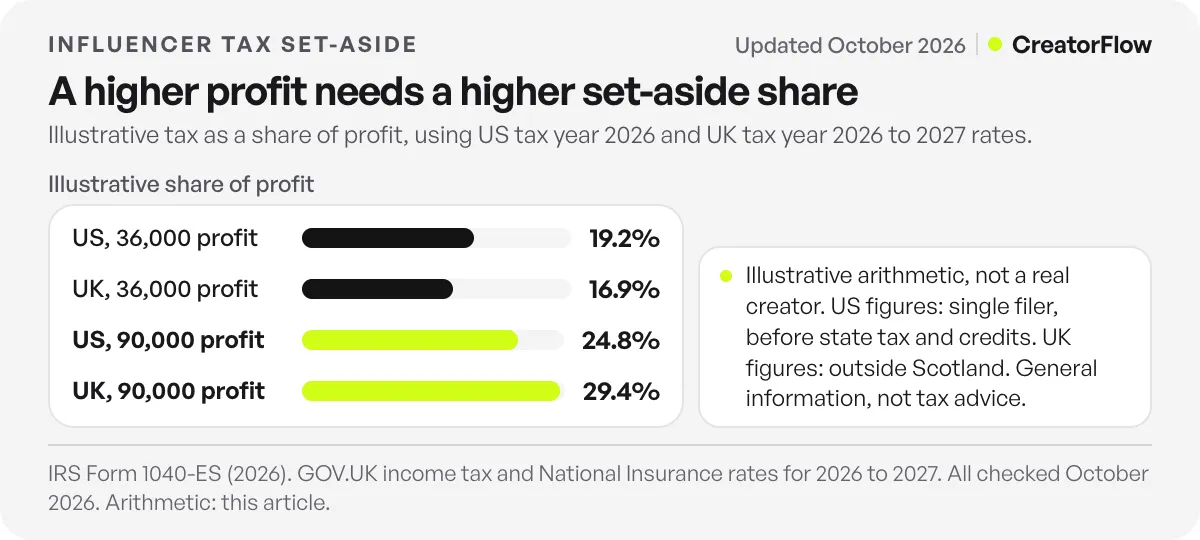
Credit Karma’s influencer tax guide suggests 25% to 30% of each payment. That is a rule of thumb, and the example below tests it.
Illustrative example, not a real creator. The creator receives 40,000 in cash fees and 2,000 in free products, and has 6,000 in expenses. That leaves a profit of 36,000. The US column assumes a single filer, the 2026 standard deduction and no other income. It leaves out state tax, credits and the qualified business income deduction. The UK column assumes no other income and a home outside Scotland.
| Illustrative only | US, tax year 2026 | UK, tax year 2026 to 2027 |
|---|---|---|
| Tax on 36,000 profit | $6,921 ($5,087 self-employment, $1,835 income tax) | £6,092 (£1,406 Class 4, £4,686 income tax) |
| Share of profit | 19.2% | 16.9% |
| Share of the 40,000 cash | 17.3% | 15.2% |
| Tax on 90,000 profit | $22,288, or 24.8% of profit | £26,489, or 29.4% of profit |
Figures are rounded to the nearest whole number. At 36,000, the rule of thumb sets aside more than this example owes, and in the US some of that gap may go to state tax. At 90,000 in the UK, the tax is near the top of that range, so the rule leaves little room.
The 2,000 in free products adds about $506 in the US and £520 in the UK. You owe that money, and the products gave you no cash to pay it.
The UK adds one more step. If this creator’s first bill is for 2026 to 2027, the bill and the first advance payment fall due together. That is about £9,138 by 31 January 2028, then about £3,046 by 31 July 2028. We worked out those 2028 dates from the 31 January and 31 July pattern on GOV.UK, which does not list them yet.
Add the tax to your price before you agree a fee. CreatorFlow’s free Instagram money calculator estimates what a brand might pay you for a post from your followers, engagement rate and niche, using industry averages.
What can influencers write off?
In the US, you can deduct business costs that are ordinary and necessary for your creator work. In the UK, you claim allowable expenses, or the £1,000 allowance instead. In both countries, the personal share of a cost stays out. In the UK, you cannot claim everyday clothing, even if you wear it for work.
Publication 334 explains the US test (2025 edition). An ordinary expense is common and accepted in your field. A necessary expense is helpful and appropriate for your business. If a cost is partly personal, the personal part is generally not deductible. A camera you use only for content passes this test more easily than a phone you also use at home. Test each cost and keep the receipt.
GOV.UK’s self-employed expenses page sets the same limit for mixed use. Its clothing page allows costumes for acting, entertaining or advertising your business, unless they are everyday clothing. It rules out “everyday clothing, such as suits, shirts, dresses or ordinary shoes” (checked October 2026).
What if you are an influencer in the EU?
Check with your own country’s tax office. Rules differ between EU countries, so this guide gives no EU figures. Ask your national tax authority or a local adviser how your country treats brand fees, free products and social contributions. Do this before your first brand payment arrives, because the answer decides what you set aside.
The EU’s Your Europe tax page says no EU-wide rules cover people who live or work outside their home country, so national laws and treaties apply (checked October 2026).
FAQ
Do small influencers have to pay taxes?
Yes, if the income meets the rules, and follower count plays no part. In the US, you must file if your net self-employment earnings are $400 or more. In the UK, you must register if your total side income goes over £1,000 in a tax year.
Do I have to report income if I did not get a 1099?
Yes. The IRS says income is taxable even if you do not get a Form 1099-K, and a brand that pays you under $2,000 in 2026 does not have to send a 1099-NEC. Report the income from your own records.
Is my influencer income a hobby or a business?
The IRS looks at facts such as whether you keep good records, put in time to make a profit, and depend on the income. A 2022 IRS tax tip, now marked as archival, lists the factors. It says hobby income still goes on Schedule 1 of Form 1040.
Do I pay tax on affiliate commission?
In the US, yes, under the same rule that all income is taxable unless the law says otherwise. HMRC’s content creator page names brand payments, gifts and adverts, and does not list affiliate commission by name. Count it in your total, and confirm with a tax adviser if you are near the £1,000 line.
Do I owe tax on a gifted product I never used?
If you received it for promotion, using it does not decide the question. The IRS counts barter income at the time you receive the item. If no promotion was agreed, read the part on unsolicited boxes above and ask a tax professional.
Sources and checks
Checked October 30, 2026 against the IRS Form 1040-ES (2026), Form 1099-NEC instructions (12/2026), Publication 525 and Topic 420, and the UK government’s content creator rules and Self Assessment deadlines. The set-aside figures are our own illustrative arithmetic from those rates. This is general information, not tax advice. Tax rules change, so use a tax professional for your own return.