

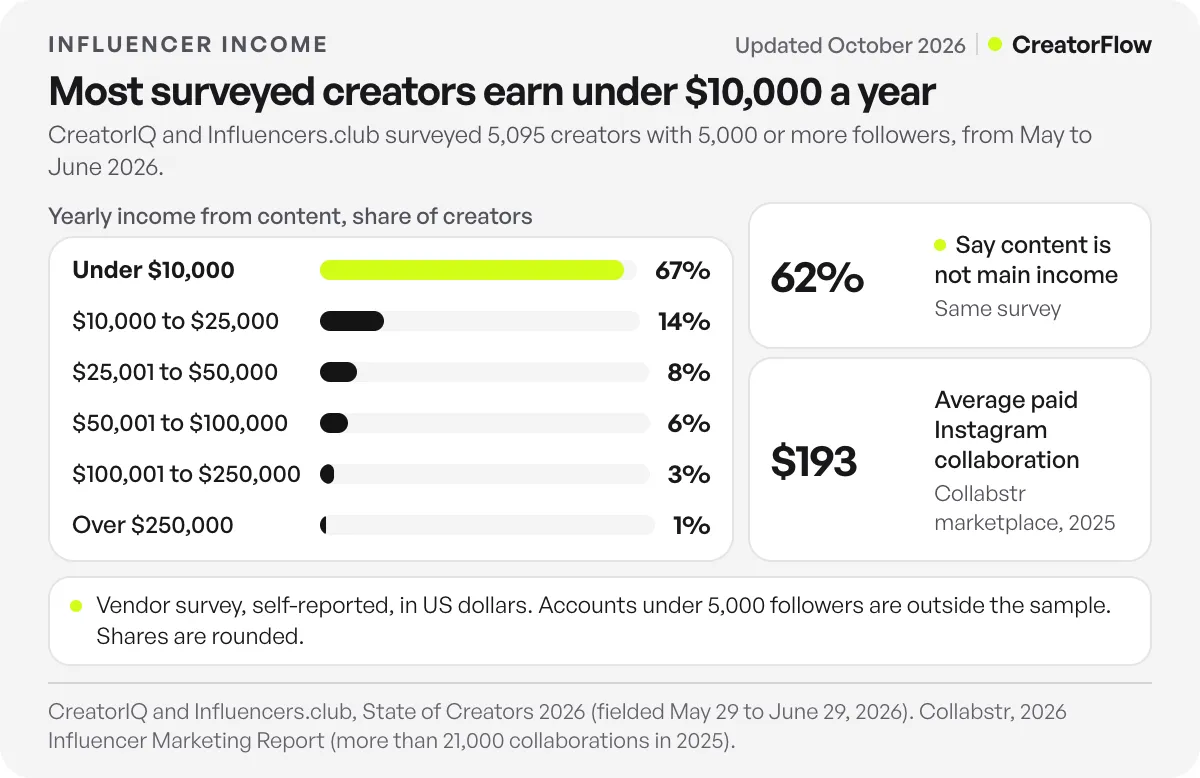
The usual answer to how much do influencers make is under $10,000 a year. In CreatorIQ’s 2026 survey of 5,095 creators, whose smallest follower band starts at 5,000, 67% earned below $10,000 from content and under 5% earned more than $100,000. Posted rates look far higher, because a rate is the price of one deal and says nothing about how many deals arrive.
Search this question and you mostly find rate cards and celebrity deals. A rate card gives you a price per post, so you multiply it by a few posts a month and picture a salary. Survey data looks different. Most creators report a small yearly total, and a minority report a living.
This guide separates three numbers that usually get mixed up: the rate for one post, the income for one year, and the median against the top. Every source is labelled as a vendor, a bank or a survey, with its sample size where the publisher gives one. You also get a way to estimate your own number.
Key Takeaways
- Median income: In the largest recent survey, the median creator earned under $10,000 a year. 67% sat below that line, and 62% said content is not their main income.
- Top earners: Under 5% of surveyed creators passed $100,000. In CreatorIQ’s payment data, the top 10% of creators received 62% of all payments in 2025.
- Post rates: The average paid Instagram collaboration on Collabstr was $193 in its 2026 report, and 80% of all its deals cost under $300.
- Rate against income: At $193 a deal, you need about 260 deals a year to gross $50,000. That is five a week (our illustrative math).
- Sources disagree: The share of creators under $10,000 runs from 18% to 67%, depending on who was asked. Both ends of that range come from the same vendor.
- Bottom line: Plan your income from your own reach and your own deal count, and read any rate table as a price list.
How much do influencers make a year?
About half to two-thirds of surveyed creators make under $10,000 a year, and about 5% make more than $100,000. That is what the two largest recent surveys found. No public dataset covers all creators. Every number below comes from a company that asked its own chosen group, so read the sample column before the income columns.
| Source and type | Who was asked | Under $10,000 | Over $100,000 | Where the median falls |
|---|---|---|---|---|
| CreatorIQ and Influencers.club, 2026 (vendor survey) | 5,095 creators, 5,000+ followers, 63% US and 14% UK, May to June 2026 | 67% | Under 5% | Under $10,000 |
| The Influencer Marketing Factory, 2026 (agency survey) | 1,000 US creators aged 18 to 65, January 2026 | 48.7% | 5.7% | A little over $10,000 |
| MBO Partners, 2023 (vendor survey) | 886 US independent creators, weighted, July 2023 | 34% under $5,000 | 9% | $5,000 to $30,000 |
| CreatorIQ and Sapio Research, 2025 (vendor survey) | 300 creators, 5,000+ followers, 40% US, July 2025 | 18% | 11% | $25,000 to $50,000 |
| Goldman Sachs Research, 2023 (bank estimate) | Global estimate, no sample on the page | Not given | About 4% | Not given |
The median column is our own reading of where the 50% mark lands inside each set of published brackets. The sources are State of Creators 2026, The Influencer Marketing Factory’s report announcement, MBO Partners’ creator economy report, CreatorIQ’s State of Creator Compensation and Goldman Sachs Research.
The full 2026 brackets from CreatorIQ are 67% under $10,000, 14% at $10,000 to $25,000, 8% at $25,001 to $50,000, 6% at $50,001 to $100,000, 3% at $100,001 to $250,000 and 1% above $250,000. The publisher states a margin of error of 1.4 points. All amounts are in US dollars and self-reported.
Now compare the two CreatorIQ rows. Both samples start at about 5,000 followers, yet the share under $10,000 moves from 18% to 67% in one year. CreatorIQ’s public pages do not explain the gap. The mix of people differs: 23% of the 2025 sample had 50,001 to 100,000 followers, against 10% of Instagram respondents in 2026, and the 2025 sample had only 300 people. Our reading is that this gap says more about who answered than about what happened to pay.
There is a fair objection to the low numbers. In the 2026 survey, 62% said content is not their primary income, so many low earners are not trying to replace a salary. The public page does not print income for full-time creators alone. The sample floor has the opposite effect. Accounts under 5,000 followers are left out, and they would probably make the figures lower.
What is the median influencer income?
The median influencer income is under $10,000 a year in the largest recent survey, and the average sits far above it. The gap exists because a small number of large accounts raise the average. When a page quotes only an average, assume the typical creator earned much less than that figure.
CreatorIQ’s payment data shows the size of that gap. It covers 14,400 creators paid directly through CreatorIQ’s software in 2025. They earned an average of $11,400 and a median of $3,000, so the average is about 3.8 times the median. The top 10% of creators received 62% of all payments, up from 53% in 2023, and the top 1% received 21%, up from 15%, according to CreatorIQ’s announcement.
Do not read that $11,400 as yearly creator income. CreatorIQ’s announcement words it as per campaign, and its report words it as across campaigns with direct payments. In both cases it counts money paid through one company’s software, and a creator’s other income is outside it.
Two more averages are worth knowing. CreatorIQ’s 2025 survey reported an average of $44,293, which comes from the 300-person sample with the smallest share under $10,000. ZipRecruiter’s salary page shows $57,928 a year for the job title in the United States, according to its search listing in October 2026. We could not open the page itself. That is a job-title average on a job site. It differs from asking creators what they earned, so it will not match the table above.
How much do influencers make per post?
On Collabstr’s marketplace, the average paid collaboration on Instagram was $193 in 2025, and 80% of all deals cost under $300. Payment data from brands and agencies on CreatorIQ shows larger sums, with 15% of payments at $10,000 or more. The two differ because they describe different markets, so check which market a rate comes from.
| Platform | Average listed price | Average paid |
|---|---|---|
| $214 | $193 | |
| YouTube | $311 | $255 |
| TikTok | $182 | $186 |
| UGC | $180 | $154 |
| Twitch | $398 | $127 |
These figures come from Collabstr’s 2026 Influencer Marketing Report, which is vendor data from its own marketplace. It covers more than 21,000 collaborations and more than 200,000 creators, and it separates asking price from paid price.
Collabstr reports that 80% of engagements cost under $300, 18% cost $301 to $1,000 and 2% cost more than $1,000. Most of its paid averages also fell, though Twitch rose. YouTube went from $418 to $255, which is about 39% by our arithmetic. The report’s text says 63%, which does not match its own two figures. Men averaged $205 per engagement and women $166, down from $291 and $208 the year before. CreatorIQ’s payment sizes sit higher, with 30% at $100 to $499.
Tier tables are harder to use. Published brand deal rates by follower tier disagree with each other, and most of them state no sample or date. Use those tables to open a negotiation, and keep them out of any income plan.
Why do post rates overstate influencer income?
A post rate is the price of one deal. Income is that price multiplied by the deals you close, minus what you spend and what you owe. Most rate tables stop at the price. They leave out deal count, and creators in CreatorIQ’s 2026 survey named a lack of consistent brand deals as their top barrier to growth.
This table is our own illustrative arithmetic. It shows gross income before any costs or tax.
| Fee per deal | Deals in a year | Gross per year |
|---|---|---|
| $193 (Collabstr Instagram average) | 12 (one a month) | $2,316 |
| $193 | 52 (one a week) | $10,036 |
| $193 | 260 (five a week) | $50,180 |
| $1,000 | 12 (one a month) | $12,000 |
| $1,000 | 52 (one a week) | $52,000 |
One deal a month at the Collabstr average stays far under $10,000, and one a week only passes it by $36. The bottom rows need a fee that only 2% of Collabstr engagements passed. This is how a rate card and a survey can both be accurate and still tell different stories.
The table also stops before costs. In the US, IRS Publication 334 sets the self-employment tax rate at 15.3% once net earnings reach $400 a year, and the IRS self-employment tax topic applies it to 92.35% of those earnings. Income tax comes on top. Rules differ in the UK and EU, so ask a tax professional for your country. CreatorIQ also reports that 62% of creators work with operational support such as editors or employees, which is another cost a rate card leaves out.
Goldman Sachs Research said in 2023 that brand deals were about 70% of creator revenue, according to survey data. A creator with that mix loses income in every month without a deal.
How much do Instagram influencers make?
Instagram influencers on Collabstr listed an average of $214 per collaboration and were paid $193 in 2025, so paid deals averaged about 10% below listed prices. None of these surveys print yearly income for Instagram creators alone on their public pages. Follower count links to income, but only moderately, so two accounts of equal size can earn different amounts.
Instagram was the largest platform on Collabstr, with 40% of campaigns, and Reels topped its list of requested formats. In CreatorIQ’s 2026 survey, creators earning more than $250,000 named Instagram as their primary platform for branded content.
Net Influencer’s coverage of the survey reports a rank correlation of 0.40 between Instagram follower count and annual income, the strongest of any single metric. A score of 1.0 would be a perfect match, so at 0.40 niche and format still matter a lot. CreatorIQ adds that views track income more closely than engagement does.
Views are also where many accounts struggle. HypeAuditor data in The Influencer Marketing Factory’s report shows that 46.2% of US-focused Instagram creators get fewer than 1,000 views per post. Niche changes the fee for the same reach, which the highest paying influencer niches compares in detail. If you are starting small, see how to earn with 1K to 10K followers.
How many followers do you need to make a living as an influencer?
No follower count guarantees a living. CreatorIQ’s survey points to about 100,000 followers as the level where content often becomes the main income. In CreatorIQ’s 2026 survey, over half of creators with 100,001 to 500,000 followers called content their primary income. Most creators above 1 million followers earned $50,000 to $250,000 or more a year.
Read that second line with care. A million followers still leaves a band that starts at $50,000, and the page does not say whether these amounts are before or after costs. It is also a small part of the sample, since 1% of Instagram respondents and 2% of TikTok respondents had over 1 million followers.
In the same survey, 81% of Instagram respondents had 100,000 followers or fewer, and the public report prints no income split for them by tier. For that group, income from outside brand deals carries more weight. The Influencer Marketing Factory reports that product or merch sales and affiliate marketing make up 21.2% of creator income, and how content creators make money sorts every stream by who controls it.
Affiliate and product income depends on getting a link to the people who asked for it. CreatorFlow sends that link by DM when someone comments a keyword on your post. The Free plan covers comment-to-DM, and Pro at $15/month adds link click tracking and an Email Gate, so you can count clicks and collect an address before the link goes out.
Which influencer income numbers can you trust?
Trust a number when the publisher names who was asked, how many people, and when. Many income figures online fail that test. Even the better ones come from companies that sell to creators or brands, so treat them as evidence with a motive, and compare at least two before you rely on one.
Goldman Sachs’s 4%. The bank’s 2023 page says about 4% of global creators “are deemed professionals”, meaning more than $100,000 a year. It shows no sample or method on that page. CreatorIQ’s under 5% in 2026 lands close to it, which gives the figure some support from a separate source.
Linktree’s full-time figures. TechCrunch’s report on Linktree’s 2022 survey of 9,500 creators says 12% of full-time creators earned over $50,000 and 46% earned under $1,000. TechCrunch itself questioned who works full-time for $1,000 a year. Linktree is a vendor and the data is four years old, so read it as history.
Celebrity per-post figures. These are usually third-party estimates, and they describe a group too small to plan around.
Income tables with no sample. A table that lists income by follower tier and names no survey is an opinion. Ask where the numbers came from, and do not plan around them if the page cannot say.
The motive question applies to every source here. CreatorIQ sells software to brands and agencies, Collabstr runs a marketplace, MBO Partners serves independent workers, and The Influencer Marketing Factory is an agency. Each one sees only its own part of the market.
How do you estimate what you could earn?
Estimate your income from your own numbers and leave the tier tables aside. Take your median reach, work out a fee per deal, then multiply by the deals you can close in a year. Subtract costs and tax. The figure will often be lower than a rate card suggests, and you can plan around a lower figure.
- Find your median reach. Use your last 10 to 15 posts of the format a brand would buy. The median ignores one lucky Reel, and the average does not.
- Get a starting fee. The Instagram money calculator estimates per-post and monthly earnings from your followers, engagement and niche. Check the estimate against any real offers you have had.
- Count your deals. Use the paid deals you closed in the last 12 months. If the answer is zero, plan for a small number and treat anything above it as a gain.
- Subtract the rest. Take off editing, tools, agent fees and tax.
As an illustration, ten deals at $400 is $4,000 a year before costs. That would place you inside the 67% group in CreatorIQ’s survey, alongside most people who answered it.
FAQ
How much do influencers make with 10,000 followers?
No public survey prints an income figure for exactly 10,000 followers. In CreatorIQ’s 2026 survey, 71% of Instagram respondents had 50,000 followers or fewer, and 67% of all respondents earned under $10,000 a year. Based on those figures, a yearly total under $10,000 is the likely outcome at this size.
How much do influencers with 100,000 followers make?
Over half of creators with 100,001 to 500,000 followers told CreatorIQ that content is their primary income. The survey’s public page does not print a dollar figure for this tier. Income at this size varies with niche, format and how many deals you close.
Do influencers make a lot of money?
A small group does. In CreatorIQ’s 2025 payment data, the top 1% of creators received 21% of all payments and the top 10% received 62%. In its 2026 survey, 1% of creators earned more than $250,000 and 67% earned under $10,000.
What is the average influencer salary?
Most influencers have no salary, because they earn from deals and sales. The averages you will see are $44,293 from CreatorIQ’s 300-person 2025 survey and $57,928 from the search listing of ZipRecruiter’s job-title page (October 2026). The median in the larger 2026 survey is under $10,000, which is a better guide to the typical creator.
Do influencers get paid per follower or per view?
Brands usually agree a fee per deal, and they base it on audience size and views. CreatorIQ found that follower and subscriber counts have the strongest relationship with income, and that views track income more closely than engagement. Platform payouts are a separate income line with their own rules.
Sources and checks
Checked October 30, 2026: State of Creators 2026 (CreatorIQ and Influencers.club, including its income chart and sample table), State of Creator Compensation (CreatorIQ and Sapio Research), Collabstr’s 2026 report (read from an October 2026 archived copy, because the site blocks direct reads), The Influencer Marketing Factory’s announcement, MBO Partners, Goldman Sachs Research, TechCrunch on Linktree and IRS Publication 334. Survey figures are self-reported. Collabstr and CreatorIQ payment figures are each company’s own platform data. Median placements and the deal tables are our own arithmetic. This article is general information and not tax or financial advice.