

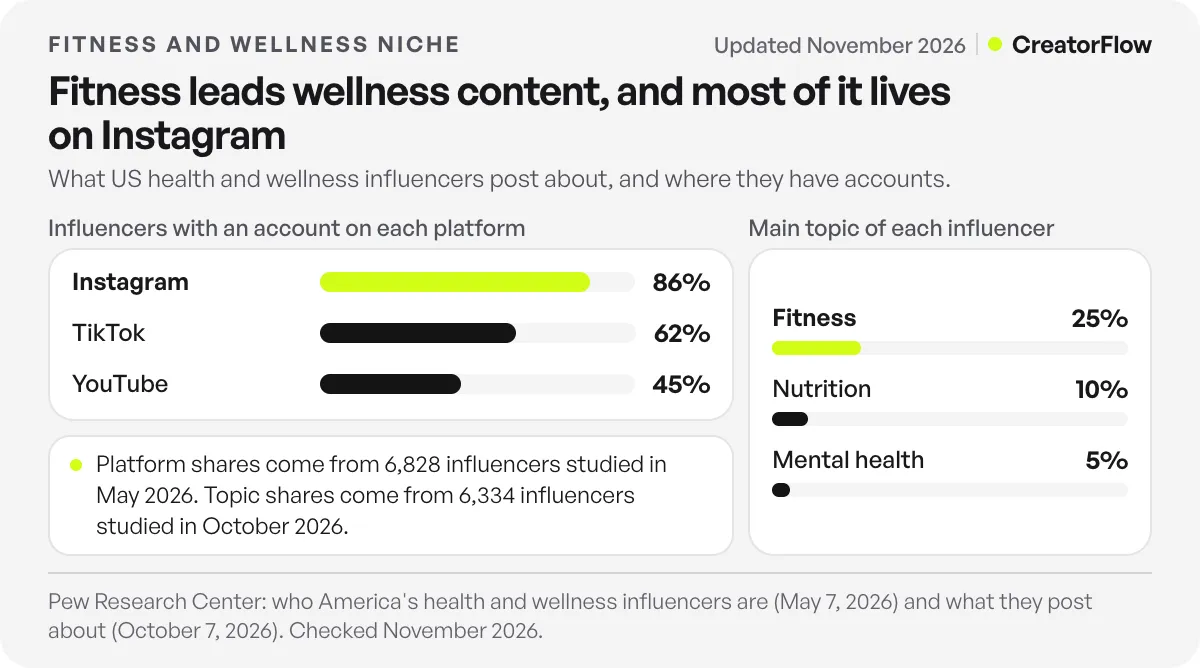
The fitness and wellness niche covers content about exercise, nutrition, sleep, recovery and mental well-being. Its audience is large: in May 2026, Pew Research Center found that 40% of US adults, and half of those under 50, get health and wellness information from influencers or podcasts. Fitness leads the niche. It is the main topic for 25% of the 6,334 influencers Pew studied in October 2026.
That size is also the problem. Thousands of creators post workouts, meal ideas and morning routines, and most of them sound alike. A new account that posts “fitness” competes with all of them at once and gives no one a reason to follow.
This guide turns Pew’s 2026 data into decisions. You get the numbers that size the niche, ten sub-niches with the question each audience keeps asking, the offer that question supports, where the credential line sits, and a first month of posts. It is written for creators and coaches who want to start in fitness and wellness on Instagram, or who already post and want a clearer lane.
Key Takeaways
- The audience is big and young: 40% of US adults get health and wellness information from influencers or podcasts, and 50% of adults under 50 do (Pew, May 2026).
- Fitness is the topic people hear most: 44% of those people often hear about fitness, ahead of weight loss at 37%.
- Instagram is the home base: 86% of the health and wellness influencers Pew studied have an Instagram account, against 62% on TikTok and 45% on YouTube.
- Selling is normal in this niche: 92% of these influencers promote something at least sometimes, and 38% of their posts carry a sponsorship or a product pitch (Pew, October 2026).
- Pick a group with a repeat question: a sub-niche works when one audience asks the same question again and again, and that question leads to an offer.
- Know your credential line: 41% of these influencers describe themselves as health care professionals. Personal experience is content. Individual advice needs a qualification.
What Is the Fitness and Wellness Niche?
The fitness and wellness niche is the creator category built around physical and mental well-being: workouts, running, yoga, Pilates, mobility, nutrition, sleep, recovery and mindfulness. Pew’s October 2026 study of 6,334 health and wellness influencers found fitness was the main topic for 25% of them, nutrition for 10% and mental health for 5%.
The niche is wide in two directions. It is wide by topic, from strength training to gut health to meditation. It is also wide by depth, from a qualified physiotherapist teaching rehab to a beginner filming their first month in a gym. Both ends can build an audience. They build different ones, and they can sell different things.
Many creators mix topics. Pew found 17% of influencers post most about both fitness and healthy habits, which is how most “wellness” accounts look in practice: a training base with sleep, food and routine around it.
How Big Is the Fitness and Wellness Niche in 2026?
The fitness and wellness niche is one of the largest creator categories in the US. Pew Research Center reports that 40% of US adults get health and wellness information from influencers or podcasts, and that 86% of the influencers they follow are on Instagram. Spending is real too: Charm estimates US TikTok Shop health sales at $1.1 billion in 2025.
| Measure | Number | Source |
|---|---|---|
| US adults who get health and wellness info from influencers or podcasts | 40% (50% of adults under 50) | Pew, May 2026 |
| Of those, how many often hear about fitness | 44% (51% of 18 to 29 year olds) | Pew, May 2026 |
| Health and wellness influencers with an Instagram account | 86% of 6,828 studied | Pew, May 2026 |
| Influencers whose main topic is fitness / nutrition / mental health | 25% / 10% / 5% | Pew, October 2026 |
| Influencer posts with a sponsorship or product pitch | 38% | Pew, October 2026 |
| US TikTok Shop health sales in 2025 | $1.1 billion, 44.2 million items | Charm estimate, February 2026 |
| Revenue of yoga, Pilates and fitness businesses on Uscreen in 2025 | $116.8 million | Uscreen |
Sources: Pew, who the influencers are, Pew, topics people hear about, Pew, what influencers post, Charm, Uscreen digital fitness report. Checked November 2026.
Two of these numbers matter most for a new creator. The first is the 86% on Instagram: it is where your competitors already are, and where the audience expects to find them. The second is the 38% of posts that sell something. Followers in this niche are used to being sold to. What they reward is a seller who clearly fits their situation.
Pew also asked why people follow these accounts. Among people who get health information from influencers, 41% say making a health or lifestyle change is a major reason. That is a buyer’s motive. Someone trying to change a habit is looking for a plan, a routine or a person to follow, and many will pay for one.
Fitness and Wellness Sub-Niches: Who Asks What
A fitness sub-niche is a narrow audience with one goal and one repeat question. “Fitness” has no question. “Strength training for women over 40” has dozens, and they repeat in every comment section. The table below maps ten sub-niches to the question their audience keeps asking and the offer that question supports.
| Sub-niche | Who follows | The question they keep asking | Offer that fits |
|---|---|---|---|
| Strength training for beginners | Adults new to the gym | ”What program should I start with?“ | 8 to 12 week program |
| Running for new runners | People training for a first 5K or 10K | ”How do I go from 5K to 10K?” | Race training plan |
| Home workouts for busy parents | Parents with 20 minutes a day | ”What can I do with no equipment?” | Monthly membership |
| Mobility for desk workers | Office and remote workers | ”How do I loosen tight hips from sitting?” | Short video course |
| Yoga for beginners | Stiff, inflexible beginners | ”Can I do yoga if I can’t touch my toes?” | On-demand class library |
| Pilates at home | People without studio access | ”Can I do Pilates without a reformer?” | Membership or class pack |
| High-protein cooking | People training who hate meal prep | ”What can I eat to hit my protein?” | Recipe e-book plus affiliate links |
| Postpartum fitness | New mothers | ”When can I start training again?” | Program led by a qualified coach |
| Sleep and recovery | Tired people who train | ”How do I sleep better after training?” | Guide plus affiliate gear |
| Mindful movement | People who want calm, not intensity | ”How do I stay consistent without burning out?” | Journal, guide or group program |
The questions are examples of how each audience phrases its goal. Check your own with the Instagram search test before you build around one.
Nutrition is the clearest example of demand you can measure. Pew found that 42% of nutrition posts by these influencers mention protein. A creator who owns one practical protein question for one group, such as vegetarians who lift, has a narrower and easier lane than “nutrition”.
How Do You Choose Your Fitness Sub-Niche?
Choose a fitness sub-niche by running three tests. First, can you speak about it within your background? Second, do people search for it in their own words? Third, does it lead to an offer people pay for more than once? A sub-niche that passes all three gives you content ideas, followers and income from the same questions.
1. The background test. Write down what you can teach from training, work or lived experience. A qualified trainer can teach programming. A beginner can document a first year as it happens. Both work if the content stays inside what you know.
2. The search test. Pew found 33% of people who get health information from influencers are looking for it, while 67% come across it in their feed. You need both: words people type, and posts that stop a scroll. Type your sub-niche’s question into Instagram search and read who the top results serve. Our guide to Instagram SEO and the search test covers how to read the results and where the winning words go.
3. The offer test. Ask what this audience would pay for after reading ten of your posts. A plan, a program, a membership, a recipe pack, an hour of coaching? If the answer is “nothing”, the sub-niche can still grow an audience, but you will rely on brand deals. For the wider method of picking a lane, see how to choose your creator niche on Instagram.
Do You Need a Certification to Post Fitness Content?
You do not need a certification to share your own training, meals or progress. You need one before you give individual advice, write programs for other people or make health claims. Pew found 41% of health and wellness influencers describe themselves as some kind of health care professional, 31% as coaches, and 16% mention no background at all.
The line is simple to state and easy to cross by accident. “Here is the routine I followed for 12 weeks” is your experience. “Here is the routine you should follow for your knee pain” is advice. The first is content anyone can post. The second needs the right qualification, and in some places the right insurance.
Three areas need the most care: nutrition for medical conditions, injury rehab and mental health. Pew’s data shows the niche already has many qualified voices in these areas, so an unqualified creator gains little by competing there. If you want to coach for money, our guide on how to become an online fitness coach covers which certificate counts and the nutrition advice a trainer may give.
How Do Fitness and Wellness Creators Make Money?
Fitness and wellness creators make money in five main ways: brand deals, affiliate links, their own programs or coaching, paid memberships, and product sales. Promotion is common: Pew found 92% of health and wellness influencers promote something at least sometimes, and 33% do it in more than half their posts. Most earning creators combine two or three of these models.
| Model | How it pays | Best fit | One data point |
|---|---|---|---|
| Brand deals | Flat fee per post or campaign | Large, clearly defined audiences | 38% of influencer posts carry a sponsorship or product pitch (Pew) |
| Affiliate links | Commission per sale | Gear, supplements, recipes | 66% of supplement posts include promotion (Pew) |
| Own program or coaching | One-time price or monthly fee | Trainers, coaches, qualified experts | 41% of people who follow these accounts do it mainly to change a habit (Pew) |
| Membership | Monthly subscription | Yoga, Pilates, home workouts | Uscreen members stay about 16 months at about $25 a month (Uscreen’s data) |
| Product shop | Margin per unit | Supplements, apparel, equipment | US TikTok Shop health sales: $1.1 billion in 2025 (Charm estimate) |
Affiliate rates and sponsored post prices differ widely by category. Our comparison of the highest paying influencer niches puts fitness and wellness next to finance, beauty and travel.
Every paid model comes with disclosure rules. The FTC’s Endorsement Guides FAQ says a label such as “#ad” or “Ad:” at the start of a post is likely to work, and that a disclosure hidden in the comments or behind a link is not enough. On Instagram, the FTC says you may need to put the disclosure on the picture itself.
Before-and-after results need extra care. The FTC’s rule on fake reviews and testimonials, in effect since October 21, 2024, bans fake or AI-written testimonials and buying fake followers or views. The FTC can seek civil penalties of up to $53,088 per violation in 2026 for knowing violations. Use real client results, with permission, and say what is typical.
What Should You Post in Your First Month?
Start with three repeatable formats rather than thirty one-off ideas. A repeatable format teaches your audience what to expect, and it shows you faster which questions pull comments. Each post should answer one question from your sub-niche and end with one clear ask.
| Format | Example hook for a new-runner account | What to ask for at the end |
|---|---|---|
| Question of the week | ”How do you go from 5K to 10K without getting hurt?” | Comment PLAN for the 6-week plan |
| Week-by-week progress | ”Week 3 of my first 10K block: what changed” | Comment LOG for my training log template |
| One routine, start to finish | ”The 15-minute warm-up I do before every run” | Comment WARMUP for the routine as a PDF |
| Myth and what to do instead | ”You don’t need to run every day to get faster” | Comment PLAN for the plan |
Post the question format most often. It is the one that brings strangers from search, and the comments under it tell you the next question to answer. After four weeks, look at which posts got the most keyword comments. That is your strongest topic, and often your first product.
How Do You Turn Fitness Followers Into Clients?
Turn followers into clients by sending the thing they asked for at the moment they ask. In fitness, the asks are specific: a plan, a routine, a recipe, a link to book a call. A comment keyword makes the ask clear, and an automatic DM delivers it while the person is still looking at your post.
With CreatorFlow, everyone who comments your word, such as PLAN, gets the plan or link in a DM within seconds. Comment-to-DM works on every plan, including Free, and setup takes under 2 minutes. On Pro, a flat $15 a month, Email Gate asks for an email address before the link is sent, so a free plan today can become a client conversation next month. Coaches can see how this fits a coaching business on the CreatorFlow page for fitness coaches, and the full client path is in our Instagram funnel for fitness coaches.
FAQ
What are the sub-niches of fitness and wellness?
Common sub-niches include strength training, running, home workouts, mobility, yoga, Pilates, nutrition, postpartum fitness, sleep and recovery, and mindful movement. Each can narrow further by audience, such as strength training for women over 40 or mobility for desk workers.
Is the fitness niche too saturated?
The broad niche is crowded, but narrow audiences are not. Pew counted fitness as the main topic for 25% of the health and wellness influencers it studied. A specific group with a specific repeat question still gives a new creator room to stand out.
Can I be a fitness influencer without a certification?
Yes, if you share your own experience and label it as yours. Writing programs for other people, giving individual nutrition advice or making health claims needs a recognised qualification. Pew found 16% of health and wellness influencers mention no background at all.
How do fitness influencers make money?
Most combine brand deals, affiliate links, their own programs or coaching, memberships and product sales. Pew found 92% of health and wellness influencers promote something at least sometimes, and 38% of their posts carry a sponsorship or product pitch.
Which platform is best for fitness content?
Instagram is the most common. Pew found 86% of health and wellness influencers have an Instagram account, 62% have TikTok and 45% have YouTube. Many use Instagram as the main account and repost short videos to the others.
What is the most profitable fitness niche?
No public source ranks fitness sub-niches by income. Promotion is most common in nutrition and supplements: Pew found 52% of nutrition posts and 66% of supplement posts include promotion. Sub-niches tied to a clear program, such as race training or strength plans, are the easiest to sell your own product in.
The fitness and wellness niche rewards the creator who answers one group’s question better than anyone else. Pick the group, collect their questions, and make every post answer one of them.
Sources and checks
Audience and influencer figures from Pew Research Center reports published May 7, 2026 (who the influencers are, why people follow them, topics) and October 7, 2026 (what influencers post). TikTok Shop figures are Charm’s own estimates (February 2026), not TikTok data. Membership figures are Uscreen’s own customer data (undated report). FTC guidance from its Endorsement Guides FAQ, the reviews and testimonials rule and the penalty table in 16 CFR 1.98. CreatorFlow plan details from creatorflow.so/pricing. All checked November 2026. The sub-niche questions and post examples are illustrations, not search-volume data.