

How to get photography clients comes down to order. Start with the channels where a stranger trusts you fastest: past clients and their referrals, then partner vendors, Google Business Profile, paid directories, Instagram and ads. In ShootProof’s 2026 survey, 85% of photographers said they rely on referrals. Then fix your reply to “how much?”, because that message decides whether interest becomes a booked shoot.
Most guides give you 25 tactics in no order. You cannot run 25 tactics between shoots and editing. The US Bureau of Labor Statistics counts 67% of photographers as self-employed (checked October 2026). In ShootProof’s 2026 State of the Photography Industry report, over 60% run the business entirely alone and 39% name client acquisition as a main source of pressure.
This guide ranks six channels by what they cost and how long a person takes to go from first contact to booked shoot. It then covers the step most guides skip, which is what you write after someone asks your price. It closes with a simple tracker, so your own numbers replace the guesswork.
Key Takeaways
- Order matters: Start with past clients and partner vendors. They cost no cash, and the person arrives already trusting you.
- Evidence is thin: No public study we could find measures time to booking by channel. The ranking below is reasoning, and we label it that way.
- Instagram is not first: ShootProof reports it second for discovery, and 85% of photographers find it hard to understand and use.
- Reviews expire: BrightLocal’s 2026 survey found 74% of consumers only care about reviews from the last three months.
- The reply is a channel too: Give the price, matching proof and one question in the first message.
- Bottom line: Pick two channels, fix your price reply, and track 20 inquiries before you add anything new.
What is the fastest way to get photography clients?
The fastest route is a personal message to past clients and people who already know your work. It costs no cash, and the person who replies already trusts you. If you have no past clients, a paid directory or ads will produce inquiries sooner, but you pay for each one and the person is comparing you with others.
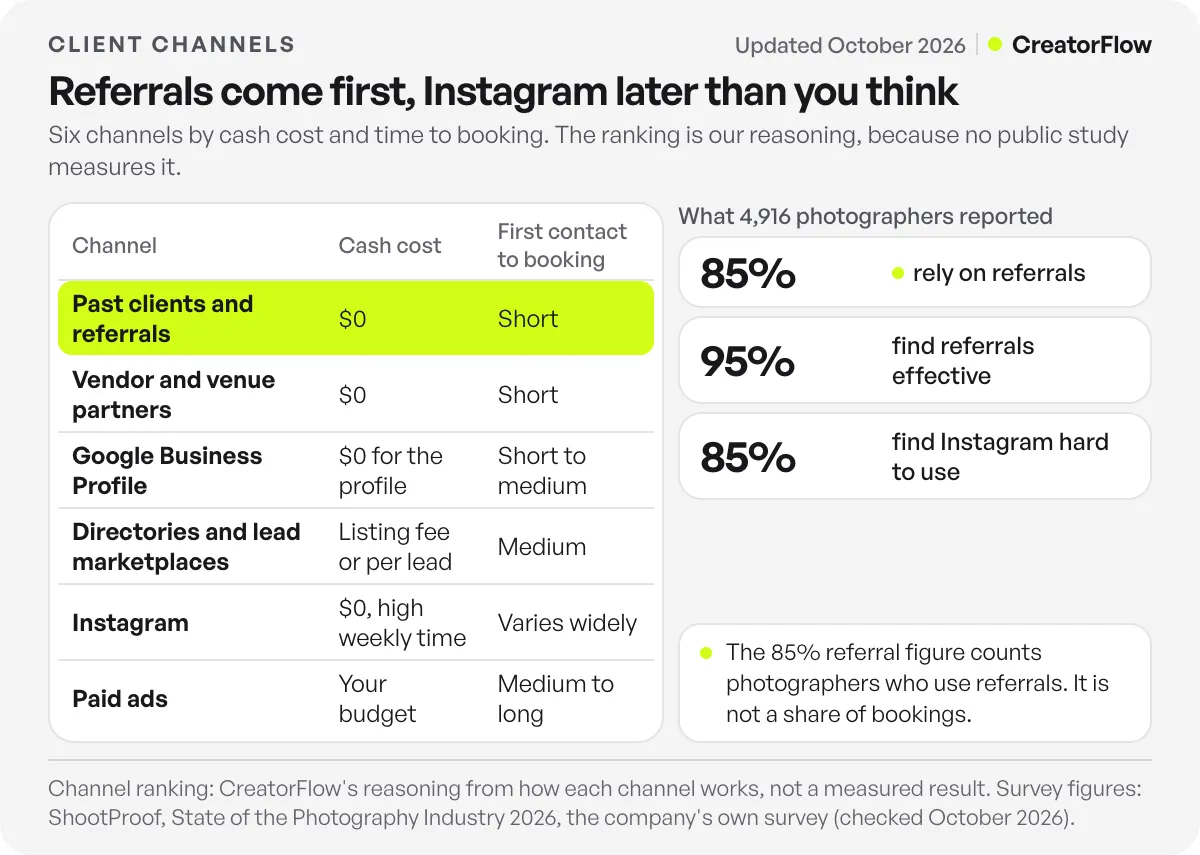
Two clocks matter here. The first is how long a channel takes to produce its first inquiry. The second is how long one person takes to go from first contact to a booked shoot. Guides tend to mix them, and that hides the trade-off.
| Channel | Cash cost | Wait for first inquiry | First contact to booking |
|---|---|---|---|
| 1. Past clients and their referrals | $0 | Short, if you have clients | Short |
| 2. Vendor and venue partners | $0 | Long | Short |
| 3. Google Business Profile | $0 for the profile | Medium | Short to medium |
| 4. Directories and lead marketplaces | Listing fee or per lead | Short | Medium |
| 5. Instagram | $0, but high weekly time | Long | Varies widely |
| 6. Paid ads | Your budget | Short | Medium to long |
This table is our reasoning from how each channel works, and nobody has measured it. A referred person gets the trust from a friend, so the decision is short. A directory visitor sees many photographers on one page, so they compare first. An Instagram follower may watch your work for a long time before they need a shoot.
Two sources show where bookings come from, and neither gives a timeline. In ShootProof’s survey of 4,916 photographers in 90+ countries, mostly in the US, 85% rely on referrals and 95% find them effective. The report’s summary words the same figure as 85% of clients coming from referrals, so do not read it as a share of bookings. ShootProof sells gallery software, and these are its own numbers.
The second source is small. Formed From Light asked 20 wedding photographers where their bookings came from, and its authors call the data informal. Client referrals brought bookings to 14 of the 20, Instagram hashtag searches and online search to 6 each, vendor referrals and Facebook ads to 5 each, and directories to 3.
How do you get photography clients through referrals?
Ask every client at the moment they feel happiest, which is the day you deliver the gallery. Give them a short message they can forward, with what you shoot, where you work and one link. Most people want to help but do not know what to say. A ready sentence removes that problem.
Put the request inside your gallery delivery message, so you never have to remember it:
Your gallery is ready: [link]. Thank you for trusting me with this. If a friend needs photos this year, you can forward this: “[Name] photographs [type of shoot] in [city]. See the work here: [link].”
Then go back through your past clients. Send a personal note to the last 20, with one recent image from their shoot if you have one. This costs an evening and no money, which is why it comes before any new channel.
Partner referrals take longer to build and then keep working. Choose businesses that meet your clients before you do: planners and venues for weddings, midwives and baby shops for newborn work, real estate agents and HR teams for headshots. Offer something useful first, such as credited images of their venue or team. Then stay in touch once a season.
How do photographers get clients from Google and directories?
Set up a free Google Business Profile first, then consider paying for directories. The profile catches people who are searching for a photographer in your city today, which is strong intent. Directories reach people who are already comparing options, so you pay to be seen next to other photographers on the same page.

Google’s local ranking help page says local results are mainly based on relevance, distance and popularity. It also says more reviews and positive ratings can help, and that there is no way to pay for a better local ranking (checked October 2026). So fill in every field, name each type of shoot you sell, set your service area and add recent work.
Reviews are the part most photographers do once and forget. BrightLocal’s 2026 Local Consumer Review Survey, a survey of 1,002 US adults by a local marketing software company, found that 97% of consumers read reviews for local businesses. It also found that 74% only care about reviews from the last three months and 89% expect the owner to respond. Ten reviews from 2023 will not help much with those readers. Ask for one with every gallery, and reply to each one.
Directories need a different test. Thumbtack, The Knot and WeddingWire all put you in front of people who are looking. Ask each one for its price before you sign. On Thumbtack, a moderator on its community forum explains that lead prices depend on job size, the number of available pros and the local market, with no single price sheet (checked October 2026).
Judge any directory by cost per booking, never by leads. Here is an illustrative example, where $1,200 is a round number and no directory’s real price. A $1,200 yearly listing that books two weddings costs $600 per booking. The Knot’s average photographer cost is $3,000, with a $2,800 median, from 10,474 US couples married in 2025 (checked October 2026). At that price, two bookings earn $6,000 before costs against a $1,200 fee. Two $300 family sessions earn $600, which is less than the fee.
How do you find photography clients on Instagram?
Treat Instagram as your proof page first and a source of new clients second. A person who hears your name from a friend will often check your profile before they message you. So your profile has to say what you shoot, where you work and how to book, and your recent posts have to show that exact work.
ShootProof says Instagram ranks second for discovery, ahead of Facebook and Google in perceived importance. The same report says 85% of photographers find it difficult to understand and use. Both can be true, and together they argue for a small, fixed routine over a daily posting goal.
Start with the name and bio, since those decide whether a local person understands you in one look. Our Instagram bio guide has a photographer example you can copy. Then post finished work with the city and the type of shoot in the caption, and tag the location.
Give people an easy next step in the caption. “Comment FAMILY and I will send you my prices and three recent sessions” asks for one word. Comment-to-DM automation then sends that message for you while you are on a shoot. CreatorFlow has a Free plan with comment-to-DM and keyword DMs, and Pro at $15/month. The setup, trigger words and message templates are in our guide to Instagram automation for photographers, so we will not repeat them here.
What to reply when a client asks how much you charge
Reply with your starting price, proof that matches their shoot, and one question. Those three things move the conversation forward. “DM me for details” or a long price list does not. The goal of this first message is a second message, because a person who answers your question is now in a real conversation with you.
Most guides stop before this point. It matters because ShootProof’s respondents say communication is what sets them apart, and only a small minority say they compete on price. Your reply is where a buyer first tests that claim.
For a family session, try this:
Hi [name], thanks for asking. Family sessions start at [price] and include [what they get]. Here are three recent ones: [link]. What month are you thinking of, and where?
For a wedding, the date is the first thing to ask, because you can only shoot one wedding on one day:
Congratulations. Weddings start at [price] for [hours]. Here is one full wedding at a venue like yours: [link]. What is your date and venue? I will check my calendar today.
Send a small set of matching work, never your whole site. A portfolio link sent by DM works well here, because the person can open it in the same thread. The replies that come next are predictable, so prepare them once:
| They write | What to do next |
|---|---|
| ”Are you free on June 14?” | Answer the date first. Then send the contract and deposit link, and say the date stays open until both are done. |
| ”Can you do it cheaper?” | Offer a smaller package with fewer hours or images. Keep your rate the same. |
| ”I need to ask my partner” | Offer to hold the conversation open. Ask which date you should check back on. |
| No reply | Follow up twice by hand, each time with something useful. |
Our guides on answering price objections in DMs and following up when a price inquiry goes quiet have the exact words for the last rows.
Reply fast, and be careful with the numbers you read about speed. The well-known response-time studies measured phone calls to web forms, and none measured a booked photo shoot, as our speed to lead guide explains. The practical reason to reply the same day is simpler. Someone asking your price is often asking others too.
If you automate the first message, know Meta’s rule. Its private replies documentation allows one message to a commenter, sent within 7 days of the comment, and follow-ups only if the person responds (checked October 2026). So put the price, the link and the question in that one message, and let their answer start the conversation.
Which channel fits each type of photography?
Match the channel to how often a client buys and how urgent the need is. A couple buys wedding photos once, so new work depends on referrals and vendors. A family may buy every year, so your past client list matters most. A company needing headshots this week searches Google and books whoever answers.
Weddings: Planners, venues and past couples come first, then a directory if the cost-per-booking test passes. Couples plan ahead, so a slow start is normal here.
Family, newborn and portrait: Message past clients before each season. Add Google Business Profile, and use Instagram as your proof page. Repeat clients make this list more valuable every year.
Headshots and corporate: Google Business Profile and HR or office manager contacts fit best. The need is often urgent and the buyer rarely browses for long, so a fast reply matters more here than in other niches.
Commercial and product: Choose 20 businesses you want to work with and send a short pitch with work from their industry. This is slow, and one client can bring repeat work. It is the one case where a direct pitch beats waiting to be found.
How do you get photography clients with no experience?
Build a small portfolio for one type of shoot, then get proof from real people. Second shooting and a few planned free shoots are the usual routes. Set a clear limit on free work, such as three shoots, and agree in advance what you get back. A free shoot with no terms gives you images and little else.
Before each free shoot, ask for three things: permission to use the images, a written review on your Google Business Profile, and the names of two people who might need photos. That turns one shoot into the start of channels 1 and 3 in the table above.
Second shooting gives you real wedding experience and a contact in the business. Ask the lead photographer first which images you may show, because the rules differ from one studio to the next.
Then charge. Your first price can be low, but a stated price tells people this is a business. ShootProof reports that nearly half of photographers admit to regularly undercharging and 43% struggle to raise prices, so a low price is easier to set than to leave behind.
How do you know which channel books the most shoots?
Keep a simple spreadsheet with one row per inquiry, and ask every person how they found you. After 20 inquiries you will have numbers that no public study offers: how long each channel takes to book, how many inquiries become shoots, and what each booking costs you.
ShootProof found that 31% of photographers track projects in spreadsheets, 29% track jobs mentally or on paper, and only 21.9% use a CRM or booking system. Without a record, the channel that feels busy gets the credit, even when another one books the shoots.
Use six columns: date of first message, channel, time of your first reply, price quoted, date booked or lost, and the reason if lost. Then check three numbers each quarter. Days from first message to booking, by channel. Bookings divided by inquiries, by channel. Money spent divided by bookings, by channel.
Those numbers tell you what to do. A channel with many inquiries and few bookings points to a problem with your reply or your price. A channel with few inquiries and many bookings deserves more of your time. For Instagram, CreatorFlow’s Pro plan adds link click tracking and clicks by country and city, so you can see which posts send people to your portfolio and whether those people are near you.
FAQ
How long does it take to get photography clients?
No public study measures this, so treat any fixed number with care. A message to past clients can bring replies the same week. A new Google Business Profile needs time to collect reviews. Partner referrals and Instagram take longest to start. Track your own time from first message to booking, because your city and your type of shoot change the answer.
Is Instagram worth it for photographers?
Yes, as a proof page and a second or third channel. People who hear about you elsewhere will check your profile, so it has to show current work and a clear way to book. It rarely makes sense as your only channel when you have past clients you have not contacted yet.
Should photographers show prices publicly?
Share at least a starting price. A starting price lets people who cannot afford you leave early and saves both of you a call. It also makes your reply to “how much?” faster. Keep full packages for the conversation, where you can match them to the shoot.
Are wedding directories worth paying for?
Test them with cost per booking. Divide the yearly cost by the number of weddings the listing books, and compare that with your average booking price. Before you sign, ask how many photographers appear in your area, and ask to see inquiry numbers for your city.
How do I ask for referrals without feeling awkward?
Put the request into your gallery delivery message and write the sentence for them. You are asking them to forward one line, which is a small favor. Send it to every client, so it stays routine and never feels like a personal request.
How many channels should a new photographer use?
Use two at the start. Good first choices are past clients or free shoots for proof, and a Google Business Profile for people searching today. Add a third only after you have tracked 20 inquiries and your price reply is working.
Sources and checks
Checked in October 2026: photographer employment and self-employment from the US Bureau of Labor Statistics; survey figures from ShootProof’s 2026 report, which is the company’s own survey; review figures from BrightLocal’s 2026 survey; local ranking rules from Google’s help page; wedding photographer prices from The Knot, read through search results because the page blocks direct reads; private reply rules from Meta’s documentation. The channel ranking is our own reasoning and was not measured. The $1,200 listing and $300 session examples are illustrative.