

Speed to lead is the time between someone asking about your offer and your first reply to them. Faster replies help, and the first hour has the strongest support. The evidence does not show that five minutes wins sales. The famous 100x figure comes from a 2007 study of phone calls to web forms, and that study says it did not address close ratios.
That gap matters because people make decisions from this number. A creator reads that a reply after 30 minutes is wasted, then buys a tool or feels guilty about a night of sleep. The study counted whether a salesperson reached someone by phone. When someone sends you an Instagram DM, you do not have to reach them. They already reached you.
This guide traces the figures to the papers behind them and shows the one study that counted wins and found a different best window. It gives a working reply target for each channel, explains what changes when the buyer messages first, and shows how to measure and improve your own numbers.
Key Takeaways
- What it measures: The clock runs from the moment someone asks until your first reply that answers them.
- The 100x figure: It compares phone calls at 5 and 30 minutes. It measured contact and qualifying, and the paper says it did not address close ratios.
- Best-supported window: All four sources we read favor the first hour. They disagree about what happens inside it.
- Counter-evidence: A preliminary study with the University of Ottawa found the most wins at 10 to 60 minutes, ahead of the first 10 minutes.
- DMs are different: The buyer wrote first, so contact is already done. We found no public study linking Instagram DM reply time to sales.
- Bottom line: Answer everyone first, automate the answers that never change, and reply by hand the same working day when a question needs judgment.
What is speed to lead?
Speed to lead is the time from a buyer’s first sign of interest to your first reply. The sign can be a form, a phone call, a comment or a DM. Sales teams also call it lead response time. They track it because a person’s attention moves on. The number only helps if you decide what stops the clock, and an automatic receipt should not stop it.
A September 2026 test by Clay, which sells sales software, shows why that definition matters. It filled in 6,346 B2B demo and contact forms. Of the 2,013 email replies, 64% were automated, and only four of the 1,281 automated replies were personalized.
Count a reply when it answers the question or moves the conversation forward. “Thanks, we got your message” does neither.
Where does the 5-minute rule come from?
The 5-minute rule comes from a study by James Oldroyd, then a faculty fellow at MIT, using data from InsideSales.com. It was presented on October 16, 2007, at a MarketingSherpa summit. Across six companies, over 15,000 web leads and over 100,000 call attempts, the odds of contact were 100 times higher at 5 minutes than at 30. The odds of qualifying were 21 times higher.
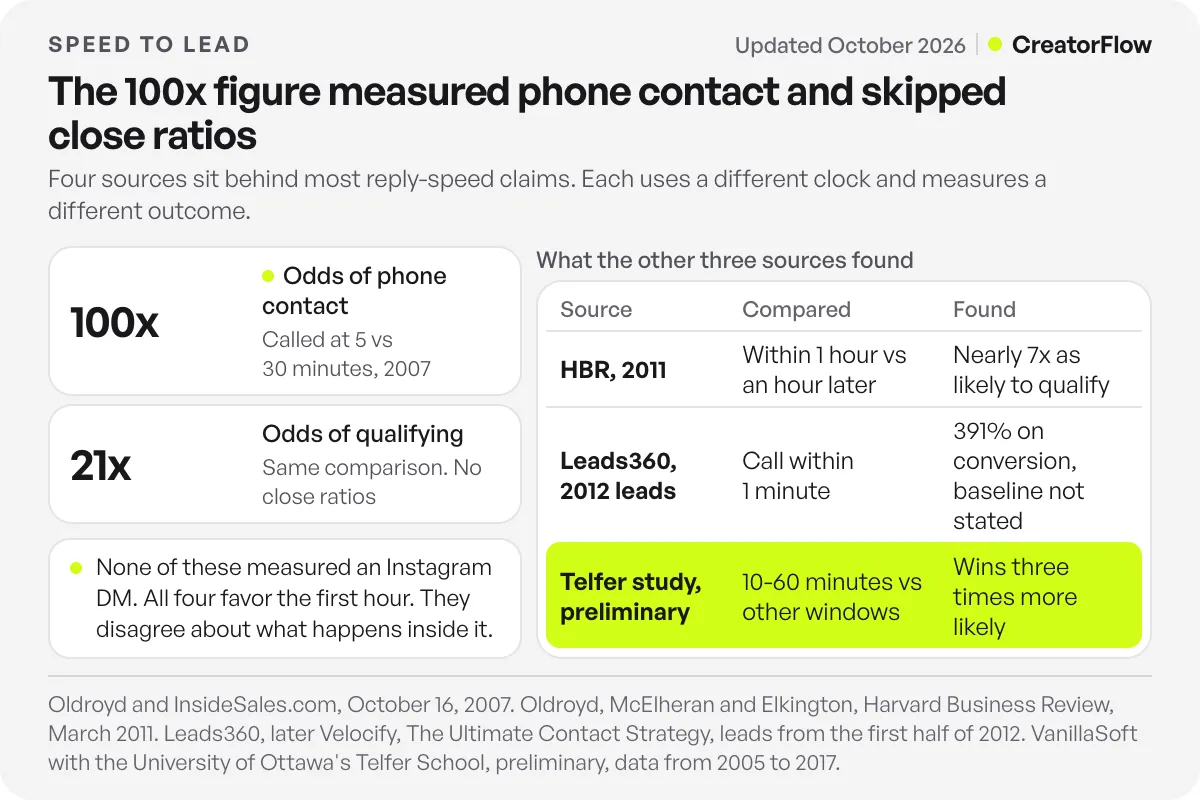
The 2007 paper defines both words, and the definitions matter. A contact was a call that reached a live person and lasted a set time, between 2 and 6 minutes depending on the company. A qualified lead was one willing to enter the sales process, and each company marked that its own way. One line sets the limit. It reads “This study did not address close ratios.”
Three other sources get quoted next to it. Each has a different clock and a different outcome.
| Source | Data | What it compared | What it found |
|---|---|---|---|
| Oldroyd and InsideSales, October 2007 | Over 15,000 web leads, 6 companies | Call at 5 vs 30 minutes | 100x odds of contact, 21x odds of qualifying. No close ratios |
| Harvard Business Review, March 2011 | 1.25 million leads, 42 companies | Try within 1 hour vs an hour later, or 24+ hours later | Nearly 7x and over 60x as likely to qualify, meaning a meaningful conversation with a key decision maker |
| Leads360, later Velocify, leads from the first half of 2012 | Nearly 3.5 million leads, 400+ client companies | Call within 1 minute | 391% “improvement on lead conversion rate”. The paper does not state the baseline |
| VanillaSoft with the Telfer School of Management, preliminary, data from 2005 to 2017 | 4 million web leads, from a dataset of 550 companies | Contact at 10-60 minutes vs the first 10 minutes or after 1 hour | Win outcomes three times more likely at 10 to 60 minutes |
Each source has a commercial tie. David Elkington, chief executive of InsideSales, presented the 2007 study and co-wrote the HBR article. The Leads360 data came from the company’s own clients. The Telfer data came from “an industry-leading provider of sales engagement solutions” and appears on VanillaSoft’s site. A commercial tie does not make a result false, so read the definitions before you repeat the number.
Does replying within 5 minutes mean more sales?
No source we read shows that. The 2007 paper did not address close ratios, and the 2011 article measured conversations. The Leads360 paper reports conversion without stating its baseline. The only source of the four that reports wins by response time found its best results at 10 to 60 minutes, and it calls its own findings preliminary.
The Telfer study classed each lead as a win, a loss or unknown, then looked at when first contact happened. Its authors write that their findings “somewhat contradict this common dogma”. They also write that they do not know why results pick up after the first 10 minutes. The full study was due in fall 2018, and we could not find a published final version of this timing result.
Do not read that as a reason to wait. The same study says contact in the first hour raises the chances of success and that conversion rates drop considerably after 24 hours. Read it as a reason to stop treating five minutes as a law.
The Leads360 chart has its own oddity. It shows 391% at one minute, 160% at two minutes, 98% at three minutes and 62% at 30 minutes. A sales conversation does not lose more than half its value in 60 seconds. Part of that gap may come from who is reachable in that minute, or from which teams can dial that fast. That is our own reading, and the paper did not test it.
None of these reports describes randomly assigning leads to fast or slow replies. They show that fast response and better results appear together. Firms that call within a minute may also differ in their staff, their tools and their leads.
The direction survives all of this. A day’s delay looks costly in every source that measures it, and HBR reports a gap of over 60x between the first hour and 24 hours or more.
What is a good lead response time?
For a phone follow-up to a web form, aim for inside the first hour, because all four sources favor it. On Instagram, send repeat answers automatically and answer judgment questions the same working day. These are our working targets, reasoned from the evidence. No study measured them, so check them against your own results.
| Channel | What the evidence supports | Our working target | Platform limit |
|---|---|---|---|
| Web form, followed by a phone call | First hour in all four sources. Five minutes for reaching someone, in the 2007 data | Inside the first hour. Sooner if a person is free | None |
| Demo or contact form, answered by email | Little. Clay timed replies and did not measure results | Same working day, with a real answer | None |
| Instagram comment asking for a link | No public study we could find | Automatic, when the comment arrives | One private reply, within 7 days |
| Instagram DM or story reply with a repeat question | Live chat research points to answering at all | Automatic, when the message arrives | 24 hours for tools |
| Instagram DM that needs judgment | Live chat research points to the content of the reply | By hand, the same working day | 24 hours for tools, 7 days with Meta’s Human Agent tag |
Phone is the channel where a few minutes have a plain cause behind them, because the person has to be free to answer. If a salesperson is available, call sooner. If the choice is a rushed call now or a prepared call in 20 minutes, the Telfer result gives you room to prepare.

What changes when the buyer messages first?
Contact is already done, so the largest number in the research does not apply. A salesperson phoning a form lead has to catch someone free to talk. A person who sends a DM has started the conversation, and they can read your reply when they return to the app. Delay still costs attention, but we found no public study that measures how much.
A missed call is gone. A message waits in the thread. So the 100x gap, which measured whether a call connected, has no counterpart in a DM. What fades is interest. The person has moved on to other posts, compared other options or forgotten why they asked. That is reasoning from how each channel works, and we label it that way because no one has published the Instagram data.
The closest evidence we found is about buyers who write first in a marketplace chat. Haoyan Sun, Jianqing Chen and Ming Fan studied 1,446 women’s clothing sellers on Taobao from May 2011 to February 2012, in a 2021 paper in Production and Operations Management. Live chat raised conversion, and the effect was stronger when product pages gave less information and when the product was seen as more valuable. The authors read that as chat informing and persuading buyers.
Sun described the size of the effect to Lehigh Business: “On average, we see sellers respond about 50 percent of the time to questions. If they respond 100 percent of the time, they can increase the conversion rate by 9 percent.” This is one Chinese marketplace, one product category and data from 2011 and 2012, so it does not transfer directly to Instagram. It does point at two things the phone studies miss, which are whether you answer at all and what your answer says.
This changes what to fix. If someone asks whether your coaching program suits their situation, a thoughtful reply at lunchtime will likely do more than a template in ten seconds. If someone comments “link” under a Reel, the link is the whole answer, and sending it right away costs you nothing. The same logic is behind our breakdown of what AI DM agents do for course creators.
How fast should you reply to Instagram DMs?
Send the answer automatically when the question repeats, such as a link request or a price list. Reply by hand the same working day when the question needs judgment. Automated tools have 24 hours after the person’s last message for most actions. A private reply to a comment must go out within 7 days of that comment.
Meta’s messaging policy says the standard window “lasts 24 hours” for most user actions. A Human Agent tag lets a person reply manually within a separate 7-day period. A chat that starts from a Click-to-Direct ad can stay open for up to 7 days from the first message (checked October 2026).
Comments work differently. Meta’s private replies documentation allows one message to the commenter within 7 days of the comment, and follow-ups only if the person responds, within 24 hours of that response (checked October 2026). So you get one message before they reply, and that message has to carry the answer.
Volume sets a ceiling too. Meta’s rate-limiting documentation lists 750 private replies an hour per Instagram professional account (checked October 2026), so a post with thousands of comments takes time to clear.
Not every message deserves the same urgency. Start with comments that signal buying intent, then work out what slow replies cost your account using your own numbers.
How slow are most businesses at replying to leads?
Much slower than five minutes, and many never reply. Harvard Business Review’s audit sent a web test lead to 2,241 US companies. Of those, 37% responded within an hour, 16% within one to 24 hours and 24% after more than 24 hours. The other 23% never responded. Companies that replied within 30 days averaged 42 hours.
Clay’s 2026 test, on B2B demo and contact forms only, found a similar shape 15 years later. Two-thirds of companies never replied. Of the replies that came, 5% arrived within five minutes. Average response ran 15 to 24 hours depending on the cut, and 26 to 40 hours for replies from a person.
These two tests cover different samples, so do not read them as a trend. They share one lesson. The biggest loss in both is the lead that never gets an answer. Before you argue about 5 minutes against 30, check how many people got no reply.
How do you measure speed to lead?
Take your recent inquiries from one channel and log three things for each: when the person asked, when they got a useful reply, and what happened next. Report the share with no reply, the median reply time and the share answered after 24 hours. Use the median because one three-day reply distorts an average.
- Pick one channel. Web forms, comments and DMs behave differently, so keep them apart.
- Stop the clock at the first useful reply. An automatic receipt does not count.
- Split by time of day. Nights and weekends usually hide the longest waits, and that tells you what to automate.
- Compare outcomes by band. Group replies into under an hour, same day and later, then compare booked calls or sales.
Treat the last step as a hint. A small account will not have enough leads to prove anything, and the leads you answer fastest may differ from the rest. On Instagram, CreatorFlow’s Pro and Growth plans include link click tracking, which shows whether people clicked the link you sent. Your own numbers for your own channel will tell you more than any figure from 2007.
How do you improve speed to lead?
Work in this order. Make sure everyone gets an answer, automate the answers that never change, then give the remaining questions to a person with a daily time to reply. Each step removes a bigger loss than shaving minutes off a reply that already goes out. Write the first reply so it holds the answer and one next step.
On Instagram, comment-to-DM automation covers the first two steps for repeat requests. CreatorFlow sends a set message when a comment, story reply or DM matches your keywords, and this works on every plan, including Free. Matching is whole-word and ignores capital letters, so “link” matches “Link please” and does not match “linked”.
Here is an example for a wedding photographer who gets asked “how much?” by possible clients. Someone comments “PRICE” on a Reel, and the DM reads:
“Thanks for asking. My wedding packages and prices are here: [your link]. Tell me your date and I will check if I am free.”
The link answers the question. The date request gives the person a reason to reply, which opens the 24-hour window for you to continue by hand.
If you missed comments on a recent post, it is not too late. CreatorFlow Rewind, on Pro and Growth, goes back and sends the DM to people who already commented, inside Meta’s 7-day limit.
FAQ
Is the 5-minute rule from Harvard?
No. The 2011 Harvard Business Review article does not mention five minutes. It compares contact within an hour with contact later. The five-minute comparison comes from the 2007 paper by James Oldroyd and InsideSales.com, which was presented at a marketing summit.
Do 78% of customers buy from the first company to respond?
We could not trace that figure to a study. The pages that repeat it give no title, year or sample size we could follow to a source. Leave it out of your planning and your copy until someone publishes the data.
Is a faster reply always better?
Not in the one source that counted wins by response time. The preliminary Telfer study found its best results at 10 to 60 minutes, ahead of the first 10 minutes. All the sources agree that long delays hurt, and a fast reply that does not answer the question gives the person little.
Does an auto-reply count toward speed to lead?
It counts if it answers the question or moves the conversation forward. A receipt does not. In Clay’s test, only four of 1,281 automated replies were personalized. On Instagram, an automatic DM with the requested link is a full answer, because the link is what the person asked for.
What is a good response time for Instagram DMs?
Automatic for repeat questions, and the same working day for questions that need judgment. These are our working targets, not measured results. Meta gives automated tools 24 hours after the person’s last message for most actions, so a reply after that needs a different route.
How many times should you follow up on a lead?
The phone studies point to about six attempts. The Leads360 paper recommends six calls, and the Telfer study found an average of 5.7 attempts for B2B wins and 5.9 for B2C wins. Instagram works differently. After a comment, you get one private reply, and follow-ups open only if the person responds.
Sources and checks
Checked on October 31, 2026. Sources read directly: the 2007 Oldroyd and InsideSales.com paper; the 2011 Harvard Business Review article, in an archived full-text copy; The Ultimate Contact Strategy, in its November 2012 Leads360 copy and a later Velocify copy; the VanillaSoft and Telfer School preliminary study; Clay’s form test, dated September 22, 2026; and Meta’s messaging policy and private replies documentation. The Taobao paper’s findings come from its abstract and from Lehigh Business, since we did not read its full text.