

Instagram DM automation for med spas sends a set reply when someone comments a keyword such as PRICE or CONSULT on a treatment post, replies to a Story, or sends that word by DM. The reply holds a general answer and your consult booking link. It never diagnoses or gives medical advice. In the UK, the reply offers a consultation and does not name or promote botulinum toxin.
A lip filler Reel goes out at 7pm. By 10pm it has 30 comments that say “price?” and two that ask “am I a good candidate?”. Your injector is off the clock, and your front desk opens at 9am. The American Med Spa Association’s 2024 industry report recap counts 10,488 US med spa locations in 2023, up from 8,899 in 2022. So the person asking has other clinics to ask tonight.
A hair salon can answer “price?” with a price list and a booking link. A clinic that injects prescription medicines has more to think about. The same reply can break a UK advertising rule, a US state price rule or your own clinical policy. This guide covers which questions to automate, what each reply should say in the UK, EU and US, what never goes in a DM, and how to set it up on aesthetic clinic accounts.
Key Takeaways
- One keyword, one reply: Each treatment post gets its own comment word (LIPS, CONSULT, LASER), and the DM holds the answer and the booking link in one message.
- Put everything in message one: Meta lets you send one private reply per comment, within 7 days, until the person writes back. A reply that says “DM us for details” spends that message on nothing.
- UK clinics promote the consultation: CAP says Botox is a prescription-only medicine that “cannot be advertised to the public”, and any reference on your social pages, hashtags included, is likely an implied ad.
- US clinics give exact prices: California’s section 651 bans “as low as”, “and up” and “lowest prices” in price ads by licensed healing arts professionals.
- No medical advice in a DM: “Am I a candidate?” gets the consult link. “My lip is swollen” gets a phone number. Health details never go in Instagram.
- Cost: CreatorFlow Free is $0 for 500 DMs a month. Pro is $15 a month for 5,000 DMs per account on 2 accounts.
How does Instagram DM automation work for a med spa?
Instagram DM automation for a med spa watches three places: comments on posts and Reels, replies to Stories, and DMs. When a comment or DM contains the keyword you chose, or someone replies to your Story, the tool sends one message with your text and a link. A person on your team reads the inbox later and answers the questions that need a person.
The flow has four parts:
- The post asks for the word. The caption ends with one line, such as “Comment CONSULT and we will send you our booking link.”
- The person comments. Everyone who comments CONSULT gets the reply. People who comment something else get nothing automatic.
- The DM arrives in seconds. It holds a short answer, the price where your market allows it, and your booking link.
- The booking system takes over. Consult forms, deposits, reminders and medical history live in your booking or clinical system, not in Instagram.
Meta sets the rules for step 3. Its private replies documentation says the message must go within 7 days of the comment, only one message can be sent, and a follow-up is allowed only if the person responds, within 24 hours of that response (checked November 2026). The messaging API page caps message text at 1,000 bytes. So the first message has to be short and complete.
For how the booking link part works across salons and day spas, see our guide to Instagram DM automation for salons, spas and clinics. The rest of this guide covers what changes when the treatment is medical.
Which questions should a med spa automate?
Automate the questions that get the same answer every time: price, availability, how to book and where you are. Send health questions, reactions and complaints to a person by phone or through your own form. A good first set is three treatment keywords, one booking keyword and two safety keywords. That covers most comments on a treatment Reel without putting clinical judgment in an automated message.
Replace each bracket with your own details. These are templates, not real prices.
| People ask | Keyword | What the DM sends | Who follows up |
|---|---|---|---|
| ”Price?” on a lip filler Reel | LIPS | Filler price per syringe, what it includes, consult link | Front desk, if they reply |
| ”How do I book?” | BOOK | Booking link and opening hours | No one, unless they reply |
| ”Price?” on a toxin or wrinkle post | CONSULT | UK: consultation fee and link. US: exact price per unit and consult link | Front desk |
| ”Am I a good candidate?” | CONSULT | ”Your clinician answers this at a consultation. Book here: [link]“ | Clinician, at the consult |
| ”Can I have this while pregnant?“ | pregnant, medication, allergy | ”A clinician needs to answer this. Please do not send health details here. Call us: [phone]“ | Clinician, by phone |
| ”My lip is swollen” | swollen, swelling, bruise, pain | ”Please call us now at [phone]. In an emergency, call your local emergency number.” | Clinician, same day |
In CreatorFlow, keywords match whole words and ignore capitals, and one automation holds up to 20 keywords. “Swollen” and “swelling” need separate entries. For more on choosing the words, our guide to keyword trigger automation covers matching in detail.
The last two rows matter most. An automated reply points to a person. It is never medical care. Choose who reads the inbox each morning, and treat any message about a reaction as urgent.
Story replies and after-hours questions
Stories work well for price lists. Post a Story that says “Reply PRICE to get our treatment price list”, and the story-reply automation sends the list link to every reply. The reply goes out at 11pm the same way it goes out at 11am. Your team sees the whole conversation in the normal Instagram inbox the next morning.
If someone replies to that DM with a question, Meta’s 24-hour window opens. A person can answer it during opening hours.
Pre-consult forms
Many clinics want medical history before a consult. Send a link to the form on your own booking or clinical system. Do not ask for medications, conditions or photos of a skin problem inside Instagram. The DM can say: “Before your consult, please fill in our form here: [link]. Do not send health details in this chat.”
What can a UK aesthetic clinic say in an automated DM?
A UK clinic can offer “a consultation for the treatment of lines and wrinkles” and send the booking link. It should not name Botox, another toxin brand or an indirect nickname for one, in the DM, the caption or the comment keyword. CAP treats botulinum toxin as a prescription-only medicine, and promoting it to the public breaks rule 12.12 of the CAP Code.
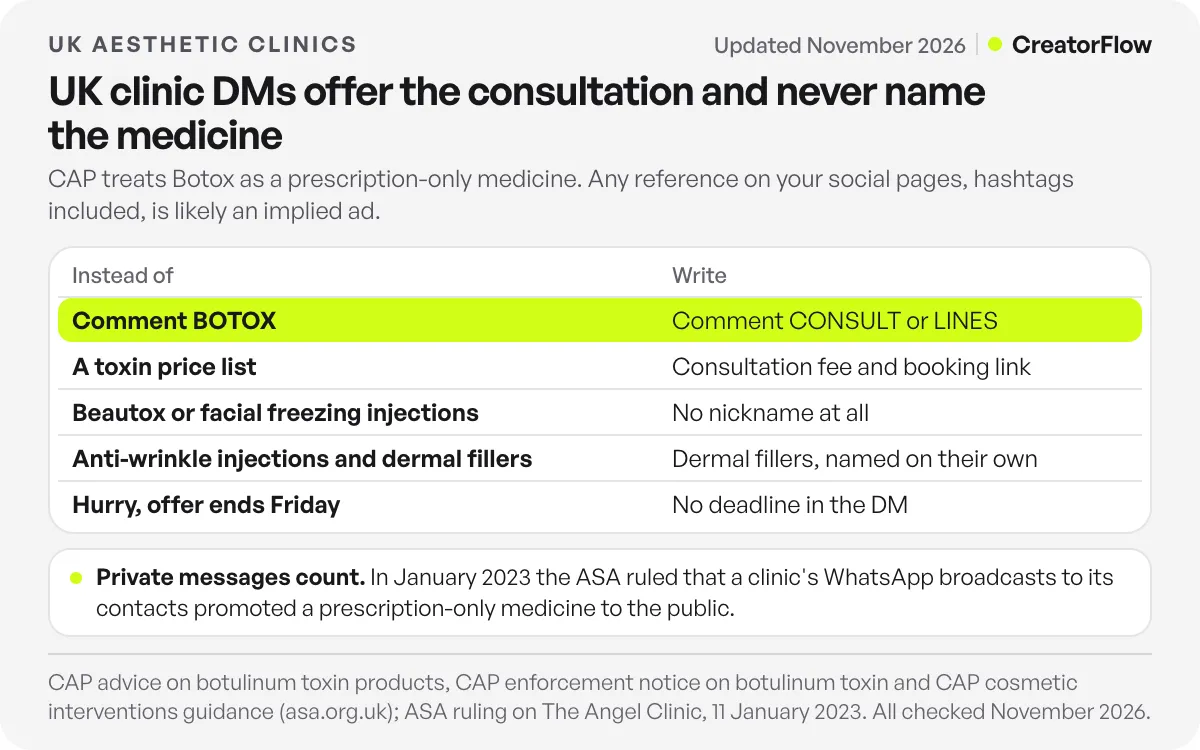
CAP’s advice on botulinum toxin says Botox “cannot be advertised to the public (rule 12.12)” and that “any reference to Botox on their social media pages, including hashtags, is likely to be seen as an implied ad for a POM” (checked November 2026). The same page names “a consultation for the treatment of lines and wrinkles” as likely to be acceptable, and tells marketers to avoid before-and-after images in this marketing.
CAP’s enforcement notice on botulinum toxin adds four points that apply to DM wording:
- Brand names and nicknames are out. Remove “Botox, other brand names or allusions to them such as ‘Beautytox’ or ‘Beautox’”. The notice lists Vistabel, Dysport, Bocouture and Azzalure as other brands.
- Swapped phrases count too. Indirect phrases such as “facial freezing injection treatments” have “the same effect as promoting a POM”.
- Fillers can be named clearly. Non-prescription fillers may be offered “provided there is no implication that a POM is also available”. Use “dermal fillers” or “injectable fillers”, and avoid “anti-wrinkle injections and dermal fillers” side by side.
- Medical conditions can imply a medicine. Avoid lines like “injections for excessive sweating”.
The notice also says the ban applies “even if the POM is being administered by a registered medical professional”, and it cites the Human Medicines Regulations 2012.
Does a private DM count as an ad?
Treat it as one. In January 2023 the ASA ruled against The Angel Clinic over two WhatsApp broadcasts sent to the clinic’s contacts and one Instagram Story about Ozempic. The ASA concluded the broadcasts “promoted a prescription-only medicine to the general public”. We read that as a warning. An automated DM that names a prescription medicine, sent to everyone who comments, could be judged the same way.
So a UK automation for a toxin post looks like this:
- Caption line: “Comment CONSULT to book a consultation for lines and wrinkles.”
- Keyword: CONSULT or LINES. Never BOTOX or TOX.
- DM: “Thanks for asking. Our consultations for lines and wrinkles are [fee] with [clinician title]. Your clinician talks you through the options in person. Book here: [link]“
Two more UK rules for cosmetic posts
CAP’s guidance on cosmetic interventions says “countdown clocks and claims such as ‘Hurry, offer must end Friday’ should not be used”, and points to rule 12.25, which bans marketing cosmetic interventions to under-18s (checked November 2026). So keep “this week only” pressure out of the DM, and do not build automations around content aimed at teenagers.
If you are unsure about a line, CAP’s Copy Advice team offers free, confidential advice before you publish, according to the enforcement notice.
EU clinics
EU law sets the same baseline. Article 88 of Directive 2001/83/EC requires member states to prohibit advertising prescription-only medicines to the general public. Each country enforces it through its own regulator and wording rules, so use the UK pattern as a starting point and check it with your national medicines regulator or your adviser.
What should a US med spa watch in DM replies?
A US med spa can usually state a price in a DM, but state law may control how. California is the clearest case: price ads must be exact, and before-and-after images have their own rules. Federal rules on testimonials, reviews and patient information also apply to what you post and send. Check your own state’s rules with your lawyer or compliance lead.
Exact prices. California’s Business and Professions Code section 651 says “any price advertisement shall be exact”, without phrases such as “as low as”, “and up” or “lowest prices” (checked November 2026). We cannot tell you whether an automated DM counts as advertising under that rule. Write it as if it does: “[exact price] per unit” or “[exact price] per syringe”, plus what the price includes.
Before-and-after posts. The same section treats an image as misleading if it “has been altered in any manner” from the actual subject. Before-and-after views must name the procedures performed, be “comparable in presentation” so poses and lighting do not distort the result, and “contain a statement that the same ‘before’ and ‘after’ results may not occur for all patients.” These rules apply to the post that drives the comments, so fix the post before you automate the replies.
Testimonials and results. The FTC’s Endorsement Guides FAQ says that if you cannot show an endorser’s result is what people generally get, the ad must make clear what the generally expected results are. A free or discounted treatment given to a reviewer or creator needs a clear disclosure. The FTC’s rule on fake reviews and testimonials, announced in August 2024, bans fake testimonials and allows civil penalties against knowing violators.
Patient photos. If your clinic is a HIPAA covered entity, HHS’s marketing guidance says that, with limited exceptions, you need a patient’s written authorization before using their protected health information for marketing. Use a signed consent form for every result photo you post, whether or not HIPAA applies to you.
Brand names. Botox is one trademarked brand of botulinum toxin, and the CAP notice above lists four others. Name the product you inject, spelled correctly, and do not use one brand as the word for all toxins.
UK, EU and US wording side by side
| Market | The DM can say | Leave out | Source |
|---|---|---|---|
| UK | ”A consultation for lines and wrinkles”, the consult fee, “dermal fillers” by name | Botox and other toxin brands, nicknames, “anti-wrinkle injections” next to fillers, countdown offers | CAP advice and enforcement notice |
| EU | Consultation wording, checked with your national regulator | Prescription-only medicines by name | Directive 2001/83/EC, Article 88 |
| US, California | Exact price per unit or syringe, what it includes, consult link | ”As low as”, “and up”, “lowest prices” | Business and Professions Code section 651 |
| US, all states | Typical results, disclosed free treatments | Fake or bought testimonials, patient photos without signed consent | FTC Endorsement Guides, FTC review rule, HHS |
What should never go in an automated DM?
An automated DM from a clinic should never diagnose, recommend a treatment for a person, give dosage or aftercare advice for a symptom, or ask for health details. It should not promise a result. In the UK it should not name or imply a prescription-only medicine. Every one of those needs a clinician who has seen the patient.
Use this list when you write each reply:
- No diagnosis. “That sounds like volume loss” is a clinical opinion. Send the consult link instead.
- No suitability answers. Pregnancy, medications, allergies and past reactions go to a clinician by phone or form.
- No symptom advice. Swelling, bruising, pain or anything after a treatment gets your phone number and the local emergency number.
- No health data requests. Do not ask for medical history, conditions or photos of a problem in Instagram. Link your own intake form.
- No result promises. “You will look 10 years younger” is a claim you would need to back up. Describe the consult, not the outcome.
- No pressure. “Only 3 slots left at this price” is the kind of line CAP’s cosmetic guidance warns against in the UK.
Therapists face the same boundary between a general answer and a clinical one. Our guide to DM automation for therapists and wellness practices covers how to keep health details out of Instagram.
How do you turn treatment posts into consult requests?
Give each treatment post one keyword and one reply. Write a caption line that names the keyword and what the person gets. Send the price or consultation fee and the booking link in the first message, because Meta allows one private reply per comment until the person writes back. Then read three numbers each month per post: DMs sent, link clicks and consults booked.
A few patterns work well for clinics:
- Treatment explainer Reels. “What happens in a lip filler appointment” with “Comment LIPS for the price and booking link.”
- Injector introduction posts. A post about your injector’s training, with “Comment CONSULT to book with [name].”
- Result posts (US). A before-and-after that meets your state’s rules, with the procedure named and the results statement in the caption.
- Price list Stories. “Reply PRICE for our full price list”, answered by the story-reply automation.
- Consultation posts (UK). A post about what happens in a consultation for lines and wrinkles, with “Comment CONSULT.”
Surgical practices follow the same pattern with longer consults. Our page for plastic surgery clinics shows the CONSULT flow on a surgical post. For the difference between Instagram’s Book Now button and a booking link sent by DM, see our guide to Instagram booking options.
How do you set up DM automation for a med spa?
Start with your three most asked-about treatments, your booking keyword and your safety keywords. Write each reply, connect your booking link and add the caption line to each post. In CreatorFlow one automation takes under two minutes to set up. The first full set takes one sitting, and you add a treatment at a time after that.
- Connect your account. Use an Instagram professional account. CreatorFlow is a Meta Tech Provider and connects through Meta’s official Instagram API, with no password sharing.
- Pick a trigger. Choose a comment on a specific post, any Story reply, or a keyword sent by DM.
- Add keywords. Use whole words that match your market’s rules. In the UK, CONSULT or LINES.
- Write the message. Keep it under 1,000 bytes. Put the price or fee, one sentence on the consultation, and the link in one message.
- Add the safety automations. Reaction and health words go to a reply with your phone number.
- Test from a second account. Comment the keyword from an account that is not the clinic’s own, and check the DM arrives.
The step-by-step screens are in our comment-to-DM setup guide.
What it costs
| Plan | Price | DMs | Instagram accounts | Useful for a clinic |
|---|---|---|---|---|
| Free | $0 | 500 a month | 1 | Testing three treatment keywords |
| Pro | $15 a month, or $144 a year | 5,000 a month per account | 2 | Link click tracking, clicks by country and city, Email Gate |
| Growth | $30 a month, or $288 a year | 10,000 a month per account | 5 | Groups with several clinic accounts |
New accounts start with a 14-day Pro trial. It asks for a card at checkout, and nothing is charged until the trial ends. Pro’s click data by city helps a local clinic see whether a post reached people who can visit. The Email Gate on Pro and Growth can ask for an email before sending the link, which suits a waitlist for a new treatment. Keep health questions out of that step.
FAQ
Can a UK clinic use BOTOX as a comment keyword?
No. CAP says any reference to Botox on your social pages, including hashtags, is likely to be seen as an implied ad for a prescription-only medicine. A caption that says “comment BOTOX” is that kind of reference. Use CONSULT or LINES, and offer a consultation for lines and wrinkles in the DM.
Can an automated DM tell someone if they are a good candidate?
No. Suitability depends on health history and an in-person assessment, so it needs a clinician. The DM can say that the clinician answers this at a consultation and send the booking link. Questions about pregnancy, medications or allergies should go to a clinician by phone or through your own form.
Should a med spa post prices in the comments or in the DM?
Send prices by DM and keep the public comment area for the keyword. A DM can hold the exact price and the booking link together, and you can edit it in one place when a price changes. In California, write exact prices without “as low as” or “and up”. In the UK, send the consultation fee for toxin treatments instead.
Can I send before-and-after photos in an automated DM?
In the UK, CAP advises avoiding before-and-after images in botulinum toxin marketing, so leave them out. In the US, a DM can link to a result post that meets your state’s rules, with the procedure named and a statement that results may vary. Get signed patient consent for every photo you use.
Is it safe to discuss treatments with patients in Instagram DMs?
Keep Instagram DMs to general information, prices where allowed and links. Treat the inbox like a public front desk. Move anything about a person’s health to your phone line, your own intake form or the consultation itself. Tell people in the DM not to send health details there.
Does the automation reply when the clinic is closed?
Yes. The automation sends the reply whenever someone comments the keyword, replies to a Story or sends the keyword by DM, at any hour. If the person writes back, Meta’s 24-hour window opens, and your team can answer during opening hours. Check the inbox each morning for reaction or complaint messages first.
What does it cost to start?
CreatorFlow’s Free plan costs $0 with 500 DMs a month on one Instagram account, enough to test three treatment keywords. Pro costs $15 a month, or $144 a year, with 5,000 DMs a month per account on two accounts, plus link click tracking. Growth costs $30 a month for five accounts.
Sources and checks
Checked November 13, 2026: CAP’s botulinum toxin advice and enforcement notice, the ASA’s Angel Clinic ruling, CAP’s cosmetic interventions guidance, Directive 2001/83/EC, California section 651, the FTC Endorsement Guides, the FTC review rule, HHS marketing guidance, Meta’s private replies and messaging API pages, and AmSpa’s 2024 report recap. This is general marketing guidance, not legal or medical advice. Check your wording with your regulator or adviser.