

Yes, coaches should give away information for free, but only the general method. Teach in public what anyone in your niche could look up. Charge for the work that changes from client to client: diagnosing their situation, putting the steps in the right order for them, and checking their progress every week. AI tools made general answers free. They did not make personal ones free.
Many coaches still hold their best ideas back for paying clients. The logic makes sense: if the free posts explain everything, why would anyone pay? But a person who wants your framework can now ask ChatGPT for a version of it in seconds. Hiding it does not protect your income. It only hides the proof that you know your subject.
This guide shows what changed, what people pay a coach for now, where to draw the line between free and paid, and the strongest argument against giving it away. It is written for coaches, consultants and course creators who sell their knowledge and use social media to find clients.
Key Takeaways
- General answers are now free: in a 2025 study of about 1.1 million ChatGPT conversations, seeking information grew from 14% to 24% of all messages in one year.
- Personal guidance is a different thing: the same study describes practical guidance as “highly customized to the user,” while information is “the same for all users.”
- People still want a human: 80% of consumers in the 2026 ICF consumer study prefer coaching to be human-led in some form.
- Teach the method, sell the application: your posts show how you think. Your paid work applies that thinking to one person and stays with them until it works.
- Free content does not mean free coaching in DMs: explain the method openly in posts, but keep the personal diagnosis for the paid offer.
- The counter-argument is real: generic free content is the easiest thing for AI to replace, so your free content needs your own examples and opinions to be worth anything.
Should Coaches Give Away Information for Free?
Coaches should give away the general method for free and charge for applying it to one person. General information, like a framework, a list of steps or a definition, is now free from AI tools and search. What clients pay for is the part a tool cannot do for them: an expert who looks at their situation, chooses what matters first and holds them to it.
The old model worked when information was scarce. A paid course or program was often the only place to find a complete, ordered explanation of a skill. Paying for access made sense.
That is no longer true for most topics. If your free content only hints at what you know, a prospect compares your hints with a complete answer from an AI tool. The AI answer looks more useful. You lose the comparison you were trying to win.
What Changed: AI Made General Answers Free
The clearest data comes from a 2025 working paper by OpenAI researchers and academic economists, published by the National Bureau of Economic Research as “How People Use ChatGPT”. It analysed about 1.1 million conversations from May 2024 to June 2025, a period in which ChatGPT reached about 700 million weekly users.
Three findings matter for coaches:
- Seeking information grew fast. It rose from 14% to 24% of all messages in the period studied.
- Practical guidance stayed large. It held at about 29% of usage. This includes how-to advice and tutoring.
- Teaching is a big use. Requests for tutoring or teaching made up 10.2% of all messages and 36% of practical guidance messages.
In the US, a Pew Research Center survey from early 2025 found that 34% of adults had used ChatGPT, and 26% had used it to learn something new. Among adults under 30, 46% had used it to learn something new.
So your prospects can already get a decent general answer to most questions in your niche, for free, at any hour. That is the starting point your content competes with.
What Clients Pay a Coach For Now
The same NBER paper draws a useful line. It describes seeking information as “the same for all users,” while practical guidance is “highly customized to the user.” That is also the line between your free content and your paid offer: the method is the same for everyone, and the application is different for every client.
When you look at what a coaching client gets that a general answer does not give them, it comes down to four things:
- Diagnosis. You look at their situation and tell them which of the ten possible problems is the real one.
- Order. You decide what they should do first, what can wait and what to skip, because doing everything at once fails.
- Feedback. You review their work, their numbers or their form, and correct it before a small mistake becomes a habit.
- Accountability. You check in every week. They do the work because someone will ask about it.
Consumers seem to agree that the human part matters. In the 2026 ICF Global Consumer Awareness Study, run with PwC across 26 countries, 80% of consumers said they prefer coaching to be human-led in some form. The study does not rank reasons for hiring a coach, so treat the list above as a description of the job, not as survey data.
Where to Draw the Line Between Free and Paid
Draw the line at the person. Anything that is true for everyone in your niche goes in your free content. Anything that depends on one person’s situation stays in your paid offer. This rule is simple to apply post by post, and it also answers the most common fear: that free content makes the offer pointless.
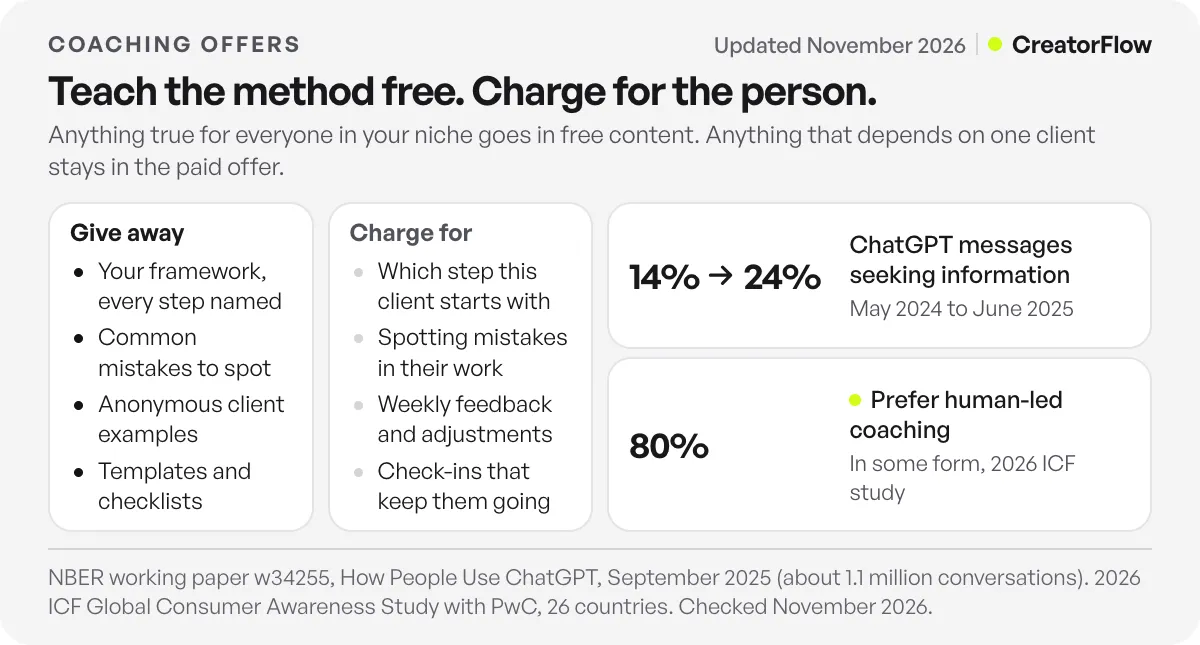
| Give away in public | Keep for paying clients |
|---|---|
| Your framework, with every step named | Deciding which step a client should start with |
| Common mistakes and how to spot them | Spotting the mistakes in this client’s work |
| Examples from anonymous client cases, with consent | Reviewing the client’s own numbers, plan or form |
| Templates and checklists | Changing the template to fit their situation |
| Your opinions on trends in your niche | Weekly check-ins and adjustments |
| How you would solve a typical problem | Being available when they get stuck |
A fitness coach can post the full structure of a beginner strength plan. The paid client gets the plan adjusted to their injury, their schedule and their progress each week. A business coach can explain exactly how they set prices. The paid client gets their own price set and tested.
The free version proves you know the method. The paid version is the method applied to one person until it works. People who read the free version and do it alone were rarely going to buy. People who read it and think “I need help applying this to me” are your clients.
Two Well-Known Versions of This Idea
The idea is not new. Alex Hormozi summed it up in a 2022 post on X: “Give away the secrets, sell the implementation.” Gary Vaynerchuk’s “jab, jab, jab, right hook” makes a similar point: the jabs are the value you give away in your content, and the right hook is the ask, as he explains on his own blog.
What has changed since those lines were written is the reason. Before, giving away the secrets was a smart way to build trust. Now it is closer to the default, because your prospect has another free source for general answers anyway. The question is no longer whether to give it away. It is whether your free version is better than the one an AI tool gives them.
The Argument Against Giving It Away
The strongest argument against free content is that generic free content is easy to replace. If your posts say the same thing as every other coach in your niche, AI can produce them too, and nobody needs to follow you to get them. In that case, more free content does not help. It adds to the noise.
That is a fair point, and it changes what you should give away rather than whether you should. Free content earns trust when it carries things an AI answer does not:
- Your own examples. A real, anonymous case from your work, with the numbers.
- Your opinions. Where you disagree with common advice in your niche, and why.
- Your way of explaining. The analogy, the drawing or the order that makes the idea click.
- Your face and voice. People hire a coach they feel they know. A talking video does that better than any text.
There is a second fair concern: giving away so much that you end up coaching people for free. That usually happens in DMs, not in posts. Someone asks a question, and the reply turns into a 500-word personal plan. The fix is the same line as above. Posts teach the method to everyone. DMs answer briefly and point to the paid offer for anything personal. Our guide on turning customer questions into sales shows how to keep DM answers short without being unhelpful.
How to Turn Free Content Into Clients
Free content makes money only when it gives people a next step. Teach the method openly, then offer something free and specific that leads toward the paid work, such as a checklist, a short training or a self-assessment. The people who ask for it have told you they care about the problem you solve.
A simple path that works on Instagram:
- Post the method. Teach one part of your framework fully in a video or carousel.
- Offer the next step. Invite viewers to comment a keyword for a free resource that helps them apply that part.
- Deliver it in the DM. Send the resource in the first message, and ask one question about their situation.
- Follow up with proof. Send case studies and explain the offer by email or DM to people who asked.
- Invite them to apply. Ask the people who replied and engaged to apply or book a call.
Talking-to-camera videos suit step 1, because people hear how you think. The yapping format is built for it. For what to send after someone gives you their email, see what to send your new email list. On Instagram, CreatorFlow sends the keyword DM for step 3 automatically, so the resource arrives while the person is still watching your post. For step 4, soft selling on Instagram shows how to make the offer without a hard pitch.
If you want to see what this looks like in money, the booked-hours math for coaches shows why filling the calendar with the right clients matters more than guarding information.
FAQ
Should coaches give away information for free?
Yes, the general method. Share your frameworks, common mistakes and examples openly, because prospects can find general answers through AI tools and search anyway. Charge for diagnosing one person’s situation, choosing the order of steps, giving feedback and holding them accountable each week.
Will free content stop people from buying my coaching?
It rarely stops the right people. Those who read your method and apply it alone were unlikely to buy. Those who read it and want help applying it to their own situation are your clients, and the free content is what made them trust you.
What do people pay coaches for if information is free?
They pay for application to their situation: a diagnosis of the real problem, a plan in the right order, feedback on their work and someone who checks in. In the 2026 ICF consumer study, 80% of consumers said they prefer coaching to be human-led in some form.
How do I stop giving free coaching in my DMs?
Keep the line at the person. Teach the method in public posts. In DMs, answer questions in one or two sentences and point people to the paid offer for anything that depends on their situation. A personal plan written in a DM is free coaching.
Can ChatGPT replace a coach?
It can replace general information and some how-to advice. In a 2025 NBER study, teaching and tutoring made up 10.2% of ChatGPT messages. It does not replace a human who reviews your work, notices what you missed and checks in each week, which is what most coaching clients pay for.
What is the best free content for coaches?
Content that only you could make: real anonymous client cases with numbers, opinions where you disagree with common advice, and your own way of explaining your method. Generic tips are the easiest content for AI to replace, so they build the least trust.
Is “give away the secrets, sell the implementation” still good advice?
Yes, and it matters more now than when Alex Hormozi posted it in 2022. Prospects already have free access to general answers through AI tools, so hiding your methods no longer protects anything. Your free content should be better than the general answer, and your offer should do the implementation.
Your best ideas are already half public, because AI tools have read the internet. Publish the complete version with your own examples, and let the people who want help applying it come to you.
Sources and checks
ChatGPT usage figures from the NBER working paper “How People Use ChatGPT”, September 2025. US usage figures from Pew Research Center, June 2025. Consumer preference figure from the 2026 ICF Global Consumer Awareness Study. Quotes from Alex Hormozi on X and Gary Vaynerchuk’s blog. All checked November 2026. Individual results vary.