

An Instagram content funnel splits your posts into three jobs. Top-of-funnel posts reach people who do not follow you. Middle-of-funnel posts build trust with people who do and invite them to comment a keyword for something free. Bottom-of-funnel posts ask the ready few to apply, book or send a DM. Each stage needs its own format and its own number to judge it by.
Most coaches already post all three kinds by accident. The problem is how they judge them. A case study that gets 900 views and two booked calls looks like a flop next to a broad tip that got 40,000 views and zero enquiries. So the coach cuts the case study and posts more broad tips. Reach goes up, clients do not.
This guide shows which formats fit each stage, the one number each stage should be judged by, how to test reach without confusing your followers, and a weekly mix to start from. It is written for coaches, consultants and service providers who post on Instagram and want clients from it, not only followers.
Key Takeaways
- Three stages, three jobs: reach new people, earn trust, then ask for the sale. One post rarely does all three well.
- Judge each stage by its own number: sends per reach at the top, keyword comments per 1,000 reach in the middle, enquiries per post at the bottom.
- Low reach at the bottom is normal: a deep post for buyers reaches fewer people by design. Cutting it because of reach removes the post that sells.
- Instagram names its top signals: Adam Mosseri said in January 2025 that watch time, likes and sends matter most for ranking, with sends weighing slightly more for people who do not follow you.
- Test top-of-funnel ideas with Trial Reels: they show to non-followers first, so a broad test does not crowd your followers’ feed.
- Original work keeps you in recommendations: Instagram’s April 2026 update limits recommendations for accounts that mostly re-upload other people’s content.
What Is an Instagram Content Funnel?
An Instagram content funnel is a plan that gives every post one of three jobs: reach people who do not know you, build trust with people who follow you, or ask ready buyers to take a step. Marketers call these stages top, middle and bottom of funnel, often shortened to TOFU, MOFU and BOFU. The idea is old. What Instagram adds is a clear set of signals for each stage.
The funnel works because a stranger and a buyer need different things from you. A stranger needs a reason to stop scrolling. A follower needs a reason to believe you can help. A buyer needs a clear next step. One post that tries to do all three usually does none of them well.
Here is the whole funnel on one page:
| Stage | Who sees it | Job of the post | Formats that fit | Call to action |
|---|---|---|---|---|
| Top (TOFU) | Mostly non-followers | Get found by new people | Reacts with your commentary, broad questions in your niche, quick tips, myth checks | Follow for more |
| Middle (MOFU) | Followers and repeat viewers | Earn trust | Talking to camera, walk-and-talk videos, carousels, stories from your work, behind the scenes | Comment a keyword for a free resource |
| Bottom (BOFU) | Warm followers close to buying | Turn interest into an enquiry | Client results, case studies, whiteboard breakdowns of your method, your offer explained | Apply, book a call or send a DM |
Top of Funnel: Posts That Reach People Who Do Not Follow You
Top-of-funnel posts exist to put your face in front of new people. Judge them by sends per reach and by the share of views that come from non-followers. Adam Mosseri said in January 2025 that sends weigh slightly more for content shown to people who do not follow you, so a post people forward is a post Instagram shows to strangers.
That comment came in a January 2025 video from Mosseri, where he named watch time, likes and sends as the three signals that matter most for ranking. He told creators to watch average watch time, likes per reach and sends per reach. Likes, he said, weigh slightly more for content from accounts you already follow.
What makes a good top-of-funnel post for a coach:
- A topic wider than your offer. A business coach who sells pricing help can post about burnout, hiring a first assistant or quitting a job. More people care about those, and the right ones will still find you.
- A hook that names the viewer. “If you coach and your calendar is half empty” stops the right person faster than a general tip.
- Your own take on something people already discuss. A green-screen react or a stitch works when your commentary is the content.
That last point matters more in 2026. On April 30, 2026, Instagram announced on its creators blog that accounts which mostly re-upload other people’s work lose eligibility for recommendations, now including photos and carousels. They get it back once most of their posts over a rolling 30 days are original. Followers still see the posts either way. For a coach, this means a react video needs your view to carry it. A repost with a caption on top does not count as your work.
The call to action at this stage is small: follow the account. Asking a stranger to book a call is too big a step and it lowers the chance they share the post.
Test reach ideas with Trial Reels
Trial Reels are the cleanest way to test a top-of-funnel idea. Instagram’s Trial Reels announcement from December 2024 says they are shown to non-followers first, and your followers do not see them in Feed or the Reels tab. You get plays, likes, comments and shares after about 24 hours, and you can share the reel with everyone later or let Instagram do it automatically based on its first 72 hours.
That makes them a good fit for broad topics you are unsure about. Your followers keep seeing middle and bottom posts, while strangers decide which broad topics earn a place in the main feed. Our guide to Instagram Trial Reels covers the setup.
Middle of Funnel: Posts That Build Trust and Collect Leads
Middle-of-funnel posts turn a viewer into someone who trusts you enough to raise a hand. Judge them by keyword comments per 1,000 reach: how many people asked for your free resource out of every thousand who saw the post. Reach will be lower than at the top. That is fine, because these posts speak to people who already know your name.
The formats here are the ones where people hear you think:
- Talking to camera. One idea, explained the way you explain it to a client. The yap video format is built for this stage.
- Walk-and-talk videos. The same idea, but outside and less formal. They feel like a voice note from someone you know.
- Carousels. A framework or a checklist people save and come back to.
- Stories from your work. What a client was stuck on, what you changed, what happened. Keep details anonymous unless you have consent.
- Behind the scenes. How you prepare a session, what your week looks like, what you are building.
The call to action is a keyword comment for something free and useful: a checklist, a short training, a template. The comment triggers a private DM with the resource, which turns a viewer into a lead you can follow up with. Pick a keyword that is short and easy to spell. Our list of comment keywords that convert shows which ones work and why.
Two Meta rules shape this step. A business can send one private reply to a commenter, within 7 days of the comment, and can send more only if the person replies, within 24 hours of that reply. So put the resource in the first message, or ask a simple question that invites a reply. Where the handoff from comment to DM usually breaks is covered in the content-to-DM handoff guide.
Bottom of Funnel: Posts That Turn Interest Into Enquiries
Bottom-of-funnel posts ask warm followers to take the step that leads to a sale: apply, book a call or send a DM with a word. Judge them by enquiries per post, counted in your DMs, applications and bookings. Expect these posts to reach fewer people than anything else you publish, because they go deep on one problem that only buyers care about.
The formats here prove you can do the work:
- Client results. A testimonial video, a before-and-after with numbers, a screenshot of a message, always with the client’s consent.
- Case studies. One client, one problem, the steps you took, the result. Walk through the reasoning, not only the outcome.
- Whiteboard or tablet breakdowns. Draw your method on paper or a screen and explain each part. The viewer sees how you think, which is what they would pay for.
- The offer itself. Who it is for, who it is not for, what happens in the first week, and how to start.
The call to action is direct and specific. “Send me the word PLAN and I will ask you three questions to see if this fits” is clearer than “link in bio”. A buyer who has watched five of your posts does not need more persuasion. They need to know exactly what to do next.
Bottom posts also do quiet work you will not see in the numbers. A follower who is not ready this month remembers the case study when they are. That is one more reason not to judge them by reach.
The Number to Judge Each Stage By
Each stage needs one main number, and it should be a ratio, not a total. Totals grow with reach, so a big top-of-funnel post always beats a small bottom-of-funnel post on totals. Ratios show whether each post did its own job. Track them weekly in a simple sheet, one row per post.
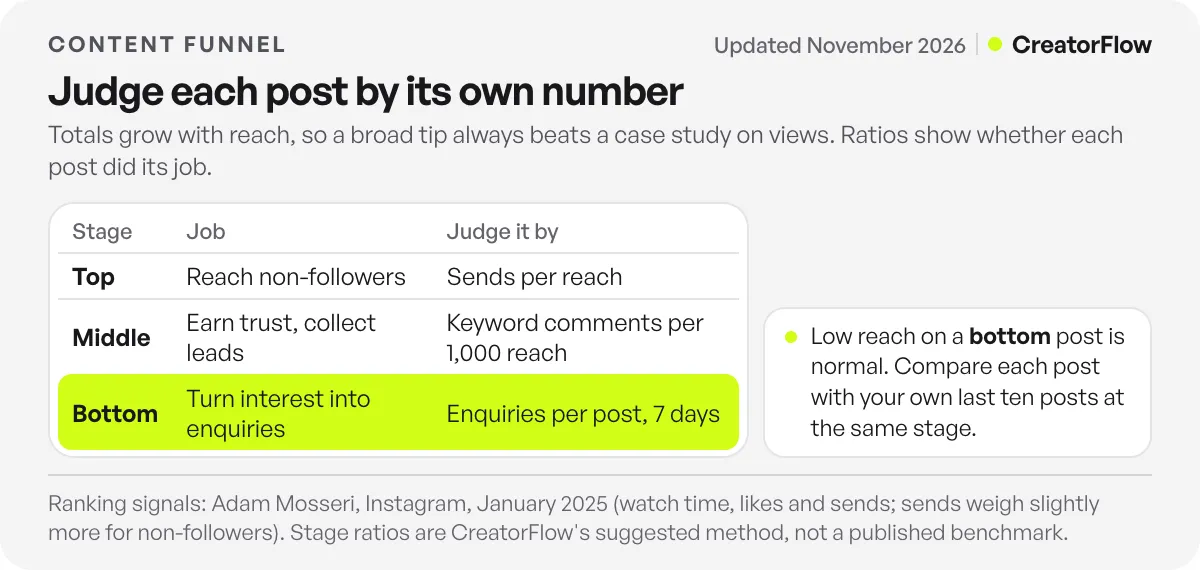
| Stage | Main number | Where to find it | What a weak result tells you |
|---|---|---|---|
| Top | Sends per reach, and the share of views from non-followers | Instagram Insights for the post | The topic is too narrow or the first 3 seconds do not name the viewer |
| Middle | Keyword comments per 1,000 reach | Comment count on the keyword, divided by reach | The free resource is not specific enough, or the ask is buried |
| Bottom | Enquiries per post | DMs with the keyword, applications, bookings in the 7 days after | The next step is unclear, or the proof is too general |
Two warnings. First, do not compare your ratios to someone else’s. Accounts differ by niche, audience size and offer price, and no public benchmark covers coaching posts by stage. Compare each post with your own last ten posts at the same stage. Second, give bottom-of-funnel posts a week. Many people watch a case study, think about it, and send the DM days later.
A Weekly Content Mix to Start From
A simple starting mix for a coach posting five times a week is two top-of-funnel posts, two middle posts and one bottom post. This is a starting point, not a measured best ratio. After four weeks, move one slot toward whichever stage is your bottleneck, using the numbers in the table above.
How to read the bottleneck:
- Few new followers each week. Your top is the problem. Add a top-of-funnel slot, or run two Trial Reels a week on broad topics.
- Followers grow, but few keyword comments. Your middle is the problem. Make the free resource more specific to one problem and put the ask in the first lines of the caption, not only at the end.
- Plenty of leads, few enquiries. Your bottom is the problem. Post more proof, explain the offer more clearly, and follow up with leads by DM or email.
- Plenty of enquiries, few sales. The content is working. The problem is now the sales call or the offer. The client acquisition system for coaches breaks that part into stages you can measure.
Stories sit across all three stages. Use them to repeat the keyword from a middle post, to share a client message, or to answer questions from your DMs. Your followers see stories first, so they are a good place for bottom-of-funnel asks that would feel too direct in the main feed.
Common Mistakes With an Instagram Content Funnel
The most common mistake is judging every post by views. Here are the others we see most often, and the fix for each:
- Asking strangers for a sales call. A top-of-funnel post with “book a call” in the caption asks too much too soon. Ask for a follow.
- A free resource that is too broad. “My free guide to growing your business” collects few comments. “The 5 questions I ask before I set a coaching price” collects more, because the reader knows exactly what they get.
- Only posting top-of-funnel content. Reach without trust gives you followers who never buy. If every post is a broad tip, your followers have no reason to see you as the expert for their problem.
- Only posting bottom-of-funnel content. The opposite mistake. Your existing followers buy once, and there is no one new behind them.
- Treating the funnel as a set of fixed formats. A carousel can be a top post or a bottom post. What decides the stage is who the topic is for and what you ask them to do.
If you are unsure what to post at each stage, start with your client questions. The same question can become a broad top post, a deeper middle post with a free resource, and a case study at the bottom. Our guide to content pillars that attract clients shows how to turn those questions into topics.
How CreatorFlow Fits the Middle of the Funnel
The middle stage is where a viewer becomes a lead, and it depends on the DM arriving fast. CreatorFlow sends the private reply when someone comments your keyword on a post or reel, so the free resource reaches them while they are still looking at your content. On Pro and Growth, Email Gate asks for an email address in the DM before sending the resource, so the lead stays reachable after the conversation ends.
FAQ
What is an Instagram content funnel?
It is a plan that gives each post one of three jobs. Top-of-funnel posts reach new people, middle-of-funnel posts build trust and collect leads with a keyword comment, and bottom-of-funnel posts ask warm followers to apply, book or send a DM. Each stage is judged by its own number.
What is TOFU, MOFU and BOFU content on Instagram?
TOFU means top of funnel: broad posts that reach non-followers, judged by sends per reach. MOFU means middle of funnel: trust-building posts like talking videos and carousels that invite a keyword comment. BOFU means bottom of funnel: case studies, client results and offer posts that ask for an enquiry.
How many posts should be top of funnel?
There is no proven ratio. A practical starting point for five posts a week is two top, two middle and one bottom. After four weeks, move a slot toward the stage where your numbers are weakest: few new followers means more top posts, few keyword comments means a stronger middle.
Why do my sales posts get so few views?
Bottom-of-funnel posts go deep on one problem, so fewer people care about them. That is expected. Judge them by enquiries per post, not views, and give each one about a week, because many buyers watch, wait and then send a DM later.
Do green-screen and stitch videos still work on Instagram in 2026?
They can, when your commentary is the main content. Instagram’s April 2026 originality update limits recommendations for accounts that mostly re-upload other people’s work. A react where you add your own view counts as your work. A repost with a caption on top does not.
Should coaches use Trial Reels for top-of-funnel content?
Yes, they suit it well. Trial Reels show to non-followers first and stay out of your followers’ Feed and Reels tab, so you can test broad topics without crowding the feed your followers see. You get the results after about 24 hours and can share the winners with everyone.
What is a good keyword comment rate on a middle-of-funnel post?
No public benchmark exists for coaching posts. Measure keyword comments per 1,000 reach on your own posts and compare each new post with your last ten middle posts. A rising number means your free resource and your ask are getting clearer.
A content funnel only works if you let each post do its job. Keep posting the case study that reached 900 people and booked two calls. Judge it by the calls.
Sources and checks
Ranking signals from Adam Mosseri’s January 2025 Instagram video. Trial Reels behaviour from Instagram’s creators blog, December 2024. Originality rules from Instagram’s April 2026 creators blog post. Private reply rules from Meta’s developer documentation. All checked November 2026. The weekly mix is a suggested starting point, not a measured result. Individual results vary.