

Instagram partnership ads are paid ads that run from a creator’s handle, with the brand and the creator both shown at the top. The brand needs the creator’s permission, given for one piece of content or for the whole account. The brand pays Meta for the media. The creator earns whatever the deal with the brand says, so the fee and the permission both belong in the contract.
Most guides are written for the brand, and they repeat Meta’s lift numbers without saying what those numbers measured. The creator gets a sentence about approving a request. That request can decide whether a brand may run one post for a month or build new ads under your name with no post behind them.
This guide covers both sides: the setup for brands, the permission choice for creators, a way to price that permission, and the steps that end an ad. It also shows where Meta’s best-known figures come from, so you can judge them before you plan a budget.
Key Takeaways
- What it is: An ad from a creator’s handle, paid for by a brand, with both accounts in the header.
- Two permissions: Content-level covers one post, story or Reel. Account-level lets a brand create ads from your handle with no existing post.
- The evidence: Meta’s 19% lower acquisition cost comes from tests run June 2021 to January 2022. Check what each figure compared before you use it.
- What to charge: Meta publishes no rate. Influee, a vendor, lists 30% of the base rate per month for the closest service.
- Stopping an ad: Turning off an ad code stops new ads. Ads already running with that code keep running.
- Bottom line: Creators should give the smallest permission that does the job, with a price and an end date in writing.
What Are Instagram Partnership Ads?
They are Facebook and Instagram ads that run from a creator’s or partner’s handle while the brand controls the budget and the campaign. The creator gives permission, and the ad shows both accounts. A brand gets a person’s name and voice on the ad. The creator gets paid only if the contract says so.
Meta’s Partnership Ads API page describes running ads “from a creator or other partner’s handle”. Its ad code page adds that both accounts appear in the ad header and that these ads are listed in the Meta Ad Library (checked October 2026). The table separates this format from three things people often confuse it with.
| Format | Handle shown | Permission needed | Paid reach |
|---|---|---|---|
| Partnership ad | Creator and brand | Content-level or account-level | Yes, from the brand’s ad account |
| Instagram Boost | Your own | None, the post is yours | Yes, from your own budget |
| Brand ad using a creator’s video | Brand only | Usage rights in your contract | Yes, from the brand’s ad account |
| Collab post | Both profiles | Collaborator accepts the invite | No, it is an organic post |
The format is in real use. In Meta’s Ad Library on October 31, 2026, 29 of the 111 highest-impression active US ads we pulled from ManyChat’s page ran under the handles of 12 creators. The sample is the highest-impression ads we pulled, and the Ad Library shows no spend or performance for them. So the count says the format is being used, and it says nothing about results.
Meta’s scale figure points the same way. PPC Land reports that CFO Susan Li said on the October 21, 2026 earnings call that the product grew over 97% year over year and passed a $15 billion annual revenue run rate. PPC Land took that quote from a third-party transcript. The number is what advertisers pay Meta, so it says nothing about what creators earn.
Do Partnership Ads Work?
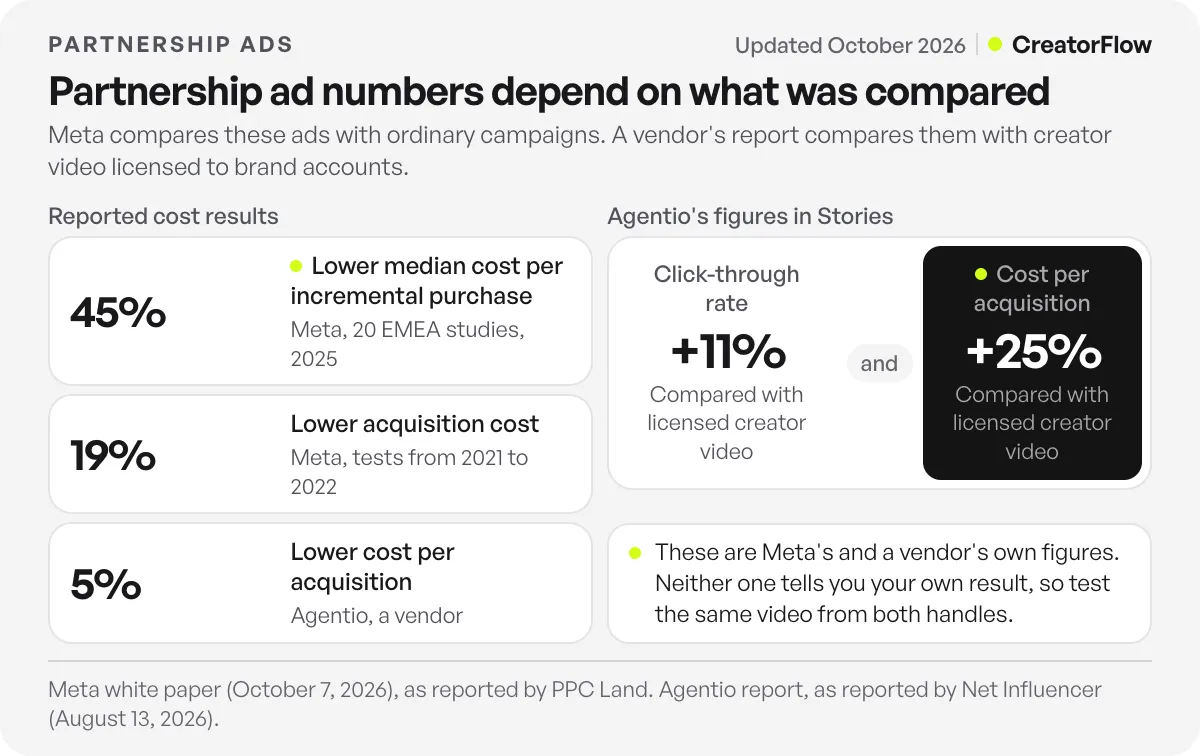
Meta says yes, and each of its figures compares different things. The best-known number comes from tests that are over four years old. The newest comes from Meta’s own analysis of one region. A vendor’s report found a smaller cost gain and one placement where cost went up. Use these figures to decide what to test, and do not use them as a forecast.
| Figure | Who says so | What it measured |
|---|---|---|
| 45% lower median cost per incremental purchase | Meta white paper, October 7, 2026 | 20 EMEA conversion lift studies, January to June 2025, cells with at least 30% of assets in this format, 92% confidence |
| 19% lower acquisition cost | Same paper | 15 advertiser tests in North America and APAC, June 2021 to January 2022, more than 20% of spend |
| 13% higher click-through rate | Meta, as repeated in trade guides | Meta’s average against standard campaigns. We could not read the original announcement |
| 5% lower cost per acquisition, 19% higher CPM | Agentio, a vendor | $130 million of spend, 65,000 ads, 137 brands, against creator video licensed to brand accounts |
The white paper rows come from PPC Land’s report, because we did not read the 54-page paper ourselves. PPC Land notes that 92% is below the 95% confidence level commonly used in testing. It also notes that 30% refers to a share of assets, while the 19% test used a share of spend. Those two thresholds cannot be compared directly.
Single Grain’s guide and many others print the 13% figure next to the 19%, as Meta’s average. A figure repeated in many guides is still one source.
The Agentio numbers come from Net Influencer’s August 13, 2026 report. Agentio sells creator media buying, so it has a stake in the result, and the report does not explain its method. The useful part is the different baseline and the placement split. Click-through rate was 19% higher overall. In Stories, cost per acquisition was 25% higher, even with an 11% higher click-through rate.
Meta’s numbers compare these ads with ordinary campaigns. Agentio’s compare them with creator video run from the brand’s own account. A brand that already has creator video faces that second choice, and the reported cost gain there is smaller.
How Do Brands Set Up Partnership Ads?
A brand sets one up in Ads Manager. First get permission from the creator, as an ad code or an account-level acceptance. Then build a normal campaign, turn on the partnership ad toggle at the ad level, and enter the code or choose the creator. Meta reviews the ad before it runs. Agree the fee and the rights before you ask for any code.
Instagram’s page on how to create a partnership ad and Leadsie’s walkthrough give this order (checked October 2026). Menu names change, so check them on your own screen.
- Agree the fee, term and permission type in writing. Our guide on briefing a UGC creator lists what a brief should name.
- In Ads Manager, click Create and set the objective, budget, audience and placements as usual.
- At the ad level, turn on the Partnership ad toggle.
- With a code, click Enter ad code or post info, then paste the code, post ID or post URL.
- With account-level access, add the creator as the second identity. Then pick an existing post or create a new ad.
Account-level requests go through Creator Marketing Hub. Instagram’s page on managing these permissions says the partner accepts in the Instagram or Facebook app. After that, you can create ads with that partner without further requests. Another Meta page calls the same tool Partnership Ads Hub, so search for both names.
Check two things before you build. Content with licensed music cannot run in this format, according to Instagram’s creator page, so ask for royalty-free audio before filming. Both accounts must meet Instagram’s eligibility rules, which cover professional accounts and public content. That page also says some business categories, including dating, gambling and crypto, need written permission from Meta first.
Plan your test before launch. Run the same creator video from the creator’s handle and from your own, and compare cost per purchase by placement. If you only need paid reach for your own post, our guide to Instagram’s Boost button covers that option.
Which Permission Should a Creator Give?
Give the smallest permission that does the job. Use a content-level permission when the brand wants one finished post. Consider account-level access only for a long relationship with a brand you trust, and charge more for it. Account-level access is the bigger grant, because the brand can create ads from your handle with content that was never posted on your profile.
| Choice | What the brand can do | Fits | Ask for |
|---|---|---|---|
| Allow brand partner to boost toggle | Promote that post | One sponsored post you already published | An end date |
| Partnership ad code | Promote one post, story or Reel, in Ads Manager or by API | A short campaign | An end date, and one advertiser named |
| Account-level permission | Create ads from your handle, including ads with no existing post | A long brand relationship | A monthly fee, a review step and a term |
Meta’s account-level guide says that once a creator accepts, the advertiser can create ads from the handle without a pre-existing post (checked October 2026). The brand can also use existing posts that tag it, and can include or exclude your audience from the campaign. That page does not mention a separate approval from the creator for each ad, and we could not confirm one on any Meta page. So write your review right into the contract.
Two details on codes are easy to miss. Instagram’s content-level page says one code can be used by up to 2 advertisers at a time. It also says archiving your content does not remove an advertiser’s code access, so hiding a post from your profile does not end the permission.
Your grid changes with the workflow too. Instagram’s creator page says that if you publish first and the brand then promotes it, the post sits on your grid. If you send the file for the brand to upload in Ads Manager, it does not appear there.
The Ad Library listing also means other brands can see who you run ads for. Keep that in mind when a contract includes category exclusivity. Our list of contract clauses to read first covers how to word it.
How Much Should Creators Charge for Partnership Ads?
Charge for the permission separately from the content. Meta publishes no rate. Instagram’s creator page only says you can negotiate higher pay because of the wider usage rights. The one public number we found is a vendor’s, at 30% of the base rate per month, so treat it as a starting point for your own quote and raise it as the brand’s control grows.
Influee’s price guide lists “Whitelisting / Spark Ads” at 30% of base rate per month, and usage rights at 30% to 50% of base rate (checked October 2026). It does not name this Meta format, so 30% is the closest match, and it is the vendor’s own figure. Insense’s rate guide says the price rises with control, from approving one post up to full ad access.
Here is the arithmetic for a 3-month term. It is illustrative, and the $500 is an example fee.
| Line | Illustrative amount |
|---|---|
| Base fee for one Reel | $500 |
| Ad access at 30% of base per month | $150 per month |
| 3-month term | $450 |
| Total quote | $950 |
You can get a first estimate for your own base fee with our Instagram money calculator. Then add ad access as its own line in the rates section of your media kit, so a brand sees the price before it asks. Our UGC creator guide has a short quote template with a paid-use line that you can copy.
Price these four things in the quote, because each one changes what you are selling:
- Term: Start and end dates, with a fee for each extra month.
- Permission type: Ad code for one post, or account-level access at a higher price.
- Creative: Only your finished post, or new ads the brand writes under your name.
- Audience: Whether the brand may target your followers, since they will see the ad from you.
How Do You Stop a Partnership Ad?
Turning off the code is not enough to end a live ad. Instagram treats these as separate actions, one for new ads and one for ads already running. So first stop the active ads, then remove the permission. Do this on the end date in your contract, because a live ad under your name can keep running after the deal ends.
Instagram’s partnership ad code page says the toggle stops a code from creating new ads and that “any active ads using the code will continue running”. Its page on stopping an advertiser lists three actions: remove account-level permissions, stop active ads from running, and turn off the code. We read both through search summaries, because the pages block direct reads, so check the steps in your own app.
Instagram’s creator blog says creators can see active and inactive ads in one list in their creator settings. Open it when a deal ends. Meta’s permissions page says partners can revoke access at any time, but your contract may still bind you. If you cut off an ad early, read what you agreed first.
Put the end date in your calendar on the day you share the code. The Meta pages we read show no expiry date on a code, so you must track the date yourself.
Do Partnership Ads Need a Disclosure?
Yes, treat them as disclosed advertising, and do not rely on the platform’s label alone. In the US, the FTC says to disclose any financial relationship with a brand. It also warns against assuming a platform’s tool is enough. UK guidance also points to a separate Ad label. Put a clear “Ad” in the caption of any post that may run as an ad.
The FTC’s Disclosures 101 guide says “Don’t assume that a platform’s disclosure tool is good enough” (checked October 2026). It suggests using the tool in addition to your own clear disclosure. For UK audiences, our guide to ASA and CMA disclosure rules covers what the label does and does not do there.
A brand can write ad text in Ads Manager, and the name on the ad is yours. So your contract should say who approves the text, including any claim about results. This article is general information and not legal advice.
Where Should Traffic From the Ad Go?
Choose the destination before you build the ad, because it decides who has to do work afterwards. A site purchase needs no reply from anyone. A message destination needs someone ready to answer. A lead form needs someone to follow up. Agree in writing who owns each of these jobs, and who watches the comments under the creator’s handle.
Meta’s supported configurations page lists click-to-message destinations, lead generation, catalog ads and testimonials for this format (checked October 2026). The Meta pages we read do not set out who handles comments on these ads, so put that in the contract too.
Creators also get interest on their own organic posts. To answer those people quickly, CreatorFlow sends a DM with your link when someone comments a keyword on your organic posts and Reels. The Free plan covers one Instagram account, and Pro costs $15/month.
FAQ
What is the difference between a partnership ad and Instagram Boost?
Instagram Boost promotes your own content, paid for from your own budget, and shown from your handle only. A partnership ad runs from a brand’s ad account with the creator’s permission, and it shows both accounts. The brand controls the targeting and the budget.
Do creators get paid for partnership ads?
Only if the contract with the brand says so. Your pay comes from the brand. Instagram’s creator page tells creators to ask for this in proposals and to negotiate higher pay for the wider usage rights.
How do I get a partnership ad code?
You create it on the post, story or Reel in the Instagram app, and then you share it with the brand. Instagram’s help page on ad codes has the current steps. One code can be used by up to 2 advertisers at a time, and you can make a new code whenever you need one.
Can a brand run ads from my account without a post?
Yes, if you accept an account-level permission. Meta’s developer guide says the advertiser can then create ads from your handle without a pre-existing post. A content-level permission covers only the post, story or Reel you chose.
How many followers do I need for these ads?
Meta publishes no follower number for this format on the pages we read. Its eligibility page asks for a professional account, public content and an authentic, established presence, including a sufficient follower base. The real test is whether a brand will pay for your handle.
Do these ads work better than normal Instagram ads?
Meta reports that they do, from its own studies. Agentio, a vendor, reports a smaller gain against creator video run from brand accounts, and a higher cost in Stories. Neither number tells you your own result, so run the same video from both handles and compare.
Sources and checks
Checked October 31, 2026: Meta’s developer pages on ad codes and account-level permissions, plus Instagram’s page for creators. Instagram’s help pages block direct reads, so we read them through search summaries. Meta’s October 2026 white paper figures come from PPC Land, and we did not read the paper. Agentio’s figures come from Net Influencer and are the vendor’s own. Rate figures are Influee’s and are also a vendor’s. The Ad Library count was pulled October 31, 2026, and it shows no spend or performance data.