

A value ladder is the order of offers a buyer moves through, from free content to a low-priced entry offer, then to your core coaching program and beyond. For coaches, the rung that decides revenue is the step from the entry offer to the core program. Build the entry offer as a short, dated sample of the core work, and plan the step up before it ends.
Most coaches build the ladder from the bottom. A free guide, then a cheap course, then a workshop, then the program. Buyers take the cheap rungs and stop there. The usual fix is to add one more rung in the middle, which gives buyers one more place to stop.
This guide covers where the term comes from, where coaching ladders break, what a 1966 field study says about why the first purchase should look like the second, four tests for an entry offer, how to plan the conversation about the next step, and how to measure whether the ladder works.
To turn each rung into an Instagram flow, see the three DM funnels for creators and coaches.
Key Takeaways
- Where the term comes from: Russell Brunson, co-founder of ClickFunnels, popularised “value ladder” in his book DotCom Secrets. Moving up the ladder is often called “ascension”.
- The weak rung: Coaching ladders lose most buyers between the entry offer and the core program, because the two are often different products.
- Same work, smaller scope: An entry offer that uses the same method and the same kind of contact as your program makes the next purchase feel like the next session.
- A known end and a carry-over: The entry offer ends on a date the buyer knows when they pay, and it produces one piece of work that the core program starts from.
- Plan the step up early: Book the conversation about the core program inside the entry offer, and base it on the client’s own results.
- Bottom line: Fix the gap between the entry offer and the core program before you add any new rung.
What Is a Value Ladder?
A value ladder is a planned sequence of offers, each priced higher and giving more of you than the one below it. The bottom rungs cost little or nothing and let people try your thinking. The top rungs cost more and give more access. The ladder is the set of offers. The sales work is helping the right buyers take the next step.
The term is Russell Brunson’s. His book DotCom Secrets has a chapter on it, and the book’s own page describes it as the method used to build ClickFunnels. The idea underneath is older: sellers have used a small first purchase to open a larger one for as long as there have been free samples.
For a coach, a typical ladder has five rungs. The table shows what each rung is for and where it tends to go wrong.
| Rung | Example for a coach | What it is for | Where it tends to break |
|---|---|---|---|
| Free content | Reels, posts, a podcast | Show how you think | Reaches people who will never buy coaching |
| Free download | A checklist or short guide | Start a relationship by email | Collects readers, with no next step |
| Entry offer | A short, paid piece of coaching | Let buyers feel your coaching for a small price | Sells a different product from the program |
| Core program | Your main coaching offer | Deliver the full result | Asked for after the buyer has left |
| Ongoing or premium | A membership or a small mastermind | Keep finished clients close | Built before anyone asked for it |
Where Do Most Coaching Value Ladders Break?
Most coaching ladders break between the entry offer and the core program. The free rungs fill up and the entry offer sells. Then few buyers move up, because the entry offer was a different product, because it ended without a plan, or because nobody asked at the right time. Adding rungs does not fix any of the three.
The entry offer is a different product. A coach sells one-to-one coaching, but the entry offer is a recorded course. Buying a course shows that someone likes courses. It says little about whether they want calls with you.
The entry offer has no clear end. Lifetime access to a mini course never finishes, so there is no natural moment to talk about the next step. The program offer arrives months later, by email, to someone who has moved on.
The step up is asked for too late. Many coaches mention the program on the last call, or by email after the end. By then the buyer has stopped thinking about the problem, and the program feels like a new purchase.
Coaches often blame price. A wide gap between the entry price and the program price is normal on any ladder. How to set the core price is covered in how to make money coaching online, which works from income targets and booked hours.
Why Should the Entry Offer Look Like the Core Program?
A first purchase makes a second, larger one more likely when the two are about the same thing. The best-known evidence is a 1966 field study on small and large requests. People who had agreed to a small request on one topic agreed to a large request on the same topic far more often than people asked cold.
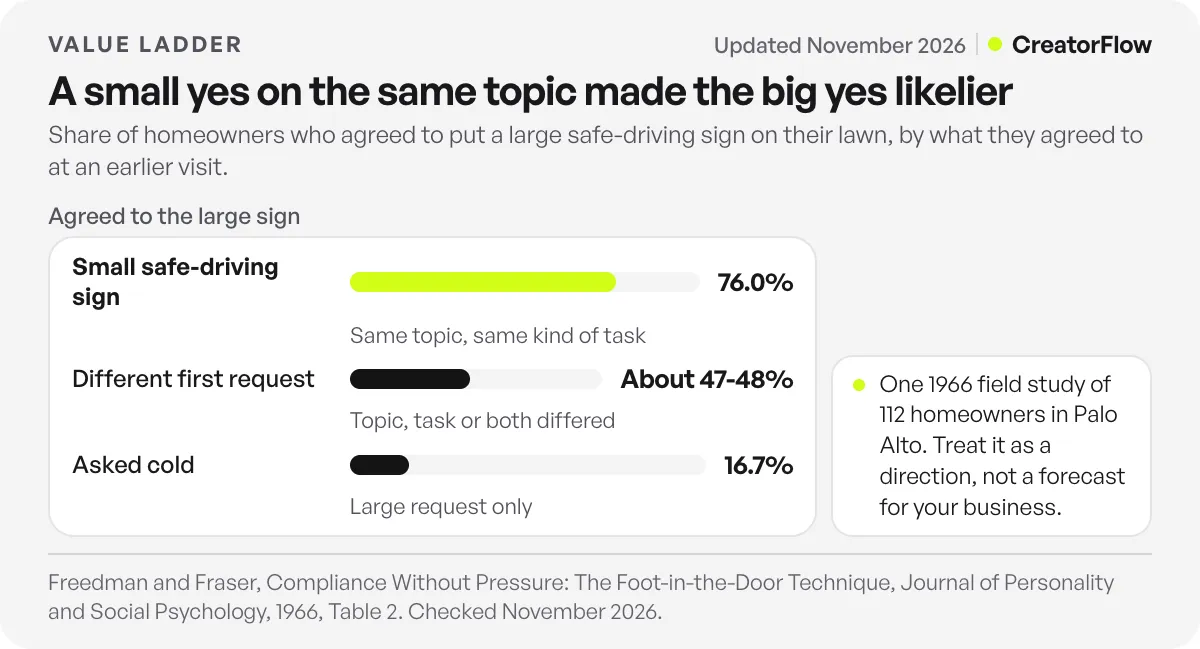
The study is Jonathan Freedman and Scott Fraser’s “Compliance Without Pressure: The Foot-in-the-Door Technique” (PubMed record). In its second experiment, researchers asked 112 homeowners in Palo Alto, California, to put a large “Drive Carefully” sign on their lawn.
The results, from the paper’s own Table 2:
- 76.0% agreed if, at an earlier visit, they had agreed to show a small safe-driving sign.
- About 47-48% agreed if their first request differed in topic, in type of task, or in both.
- 16.7% agreed when asked only the large request.
Two things in that table matter for a coach. Any small first step helped. The first step that matched the large request in both topic and form helped the most. This is one study of 112 people, so treat it as a direction, not as a forecast for your business.
A second study points the same way. Joseph Nunes and Xavier Drèze gave 300 car wash customers loyalty cards, and the cards that started with some progress already stamped led to more completed cards and faster visits, as Knowledge at Wharton reported. People work harder to finish something they have already started.
Put together, the entry offer should be a small version of the same work, and the progress a client makes in it should count inside the core program.
How to Design a Low Ticket Offer That Leads to Coaching
A low ticket offer leads to coaching when it passes four tests. It uses the same method as your program. It uses the same kind of contact. It ends on a date the buyer knows when they pay. And it produces one piece of work that the core program starts from. An offer that fails two or more of these is a separate product.
Test 1: The same method, on a smaller part of the problem
Pick one part of the problem your program solves and coach it with your program’s method. A business coach who builds sales pipelines can work through one client’s pipeline numbers. Do not hold the method back: buyers judge the program by what they see here.
Test 2: The same kind of contact
If your program is live calls, the entry offer includes live calls. If it is written feedback in a group, so is the entry offer. Buyers decide on the program by how it felt to be coached by you.
Test 3: An end date the buyer knows
Fix the number of sessions or the end date at the sale and put it in the welcome email. A known end gives the client a reason to do the work now, and both of you a natural point to decide what comes next. Set the length by what one smaller result takes to produce.
Test 4: One piece of work that carries forward
The entry offer should leave the client with something the core program uses on its first day: a baseline, a written plan, an audit of their numbers, a first draft. This is the stamped card from the Nunes and Drèze study. A client who joins the program starts at step two instead of step one.
Three examples of offers that pass and offers that do not:
| Coach | Core program | Entry offer that passes the tests | Entry offer that fails them |
|---|---|---|---|
| Business coach | One-to-one work on a sales system | Two live sessions on the client’s own pipeline, ending with a written plan | A recorded course on sales mindset |
| Fitness coach | Ongoing coaching with weekly check-ins | A short block of check-ins on the client’s real training log | A downloadable meal plan |
| Life coach | Monthly one-to-one sessions | One long session and one review session, ending with a priorities map | A set of journal prompts |
Should the Entry Offer Solve the Whole Problem?
No. The entry offer should solve one smaller problem completely and show the client how much of the larger problem is left. A teaser that solves nothing makes buyers feel cheated. An entry offer that solves everything leaves no reason to continue. A complete slice sits between the two.
The test is what the client can say at the end. “I now have a written sales plan, and I can see the three parts I still cannot do alone” is a good ending. “I watched some videos” is a teaser. “My problem is gone” means the entry offer was your program sold cheap.
This is also the difference between a ladder and a set of price tiers. Tiers are side-by-side versions of one offer, which turning one offer into three price tiers covers. A ladder is a sequence over time, and each rung is designed to lead to the next.
How Do You Move Clients From the Entry Offer to the Core Program?
Plan the conversation about the core program into the entry offer itself. Book a review session before the last session, while the client is still working on the problem. In it, show them their own progress, name what is left, and recommend one next step with a price and a start date. Give them a clear way to say no.
Book it at the sale. The review is in the schedule the client sees when they pay. It is part of the offer, so it never feels like a pitch.
Prepare a one-page summary. Write down where the client started, what changed, and what is still open, in their numbers and their words. The page is useful to the client whether they continue or not.
Recommend one next step. If the core program fits what is left, say so, with the price and the start date. If it does not fit, say that too. One recommendation is easier to decide on than a menu.
Set a decision date. Give a date for a yes or no, and follow up by email or through your booking tool. A client who says no still leaves with the summary and the carry-over work.
How Many Rungs Should a Coaching Value Ladder Have?
Start with three: free content, one entry offer, one core program. Add a free download when you have an email process that uses it. Add an ongoing or premium rung only when finished clients ask what comes next. Every new rung is one more product to deliver and one more place for buyers to stop.
The number to watch is your ascension rate: the share of entry offer buyers who join the core program by the decision date. Track it per group of buyers who started together. As illustrative arithmetic, if 20 people buy the entry offer in a month and 4 of them join the program, the ascension rate for that group is 20%.
Entry offers differ too much for a public benchmark to mean much, so compare your own groups with each other. If the rate is low, run the four tests on your entry offer and check when you ask.
Where Does Instagram Fit in a Value Ladder?
Instagram feeds the bottom rungs. Posts and Reels show how you think, and a comment or a DM is the moment someone asks for the next step. The job at that moment is to send the free download or the entry offer link fast, while the person is still interested, and to see which posts produce buyers.
A common setup is a comment keyword on a post about one part of the problem. The person who comments gets a DM with a link to the matching download or entry offer page. Checkout, booking and follow-up emails happen on your own tools after that click. If your posts get comments but no coaching enquiries, the four break points in the content-to-DM handoff for coaches are the place to look first.
CreatorFlow sends that first DM when someone comments a keyword, replies to a Story or sends a keyword by DM, through Meta’s official Instagram API. On Pro and Growth it tracks clicks on the link, so you can see which posts send people to the entry offer. Setups for this job are on the CreatorFlow pages for business coaches and life coaches. Before you price the entry offer, pricing an offer for an Instagram audience shows how to test what your followers will pay.
FAQ
Who created the value ladder?
Russell Brunson, co-founder of ClickFunnels, popularised the term “value ladder” in his book DotCom Secrets. The underlying idea, a small first purchase that opens a larger one, is much older. Psychologists studied the same effect in 1966 under the name “foot in the door”.
What is the ascension model in coaching?
Ascension is the movement of a buyer from a lower rung of the ladder to a higher one, for example from a paid entry offer into a core coaching program. The ascension rate is the share of entry offer buyers who make that move by the decision date you set.
How much should a low ticket offer cost for a coach?
There is no fixed ratio that works for everyone. Price it to cover the time it takes you to deliver, and high enough that buyers take the work seriously. Then check whether the people who buy it can afford your core program. If they cannot, the price is attracting the wrong buyers.
What is the difference between a value ladder and a sales funnel?
In common use, the ladder is your full set of offers in order of price and depth. A sales funnel is the path that sells one of those offers, such as an ad, a landing page and a checkout. One ladder can have several funnels, one for each rung.
Should I credit the entry fee toward the core program?
Some coaches credit part or all of the entry fee against the program, which removes the feeling of paying twice. It matters less when the entry offer already produced work the program uses. If you offer a credit, give it a deadline and put it in writing at the review session.
Sources and checks
Sources checked November 3, 2026: the DotCom Secrets book page for the ladder chapter and Russell Brunson’s authorship; Freedman and Fraser’s 1966 paper (PubMed record), Table 2 read from the full text, for the 76.0%, about 47-48% and 16.7% figures and the 112-homeowner sample; and Knowledge at Wharton for the Nunes and Drèze car wash study of 300 customers. The ascension arithmetic is illustrative. CreatorFlow features are from creatorflow.so.